

Garden room news for the past fortnight. The fees councils charge for building control are being reformed from 6 November, the competition regulator has fined Wayfair over fake countdown deals, and the latest official and survey figures show homeowners still choosing to improve rather than move.
New building control charging rules start on 6 November
The Building (Local Authority Charges and Amendments Relating to Charging) (England) Regulations 2026 were laid on 15 October and come into force on 6 November 2026. They replace the 2010 charging rules in England and let councils charge, on a fuller cost-recovery basis, for more of their building control work. That includes advice given ahead of an application, which councils previously had to give free for the first hour, plus enforcement, sanctions and appeals. Councils must publish their charging schemes online at least seven days before they take effect, and publish an annual statement of what they charged and what it cost. Existing charging schemes stay in force until each council updates its own.
Why it matters: most garden rooms never touch building control. A detached room under 15 square metres with no sleeping accommodation is normally exempt, as our building regulations explainer sets out. But larger rooms, rooms with a bedroom, and rooms between 15 and 30 square metres built within a metre of the boundary in combustible materials do need approval. If yours is one of those, a pre-application chat with your council that used to be free may now be charged. Check your council’s new charging scheme before you ring. Sources: MHCLG Circular 05/2026, 16 October 2026; government response to the consultation.
Wayfair fined £4.8m for countdown deals that did not end
On 14 October the Competition and Markets Authority fined Wayfair £4.8m for false time-limited offers. Its ‘Daily Deals’ and 24-hour ‘Flash Deals’ carried countdown timers and lines like ‘Here Today, Gone Tomorrow’, but many products stayed at the same price or lower after the deadline passed. In the same announcement Appliances Direct was fined £1.2m and ordered to refund about £432,000. Both firms admitted breaking the law and had their fines cut by 40% for settling early.
Why it matters: countdown banners and ‘ends tonight’ offers are common across online sellers of sheds, summerhouses and garden buildings. The CMA now has the power to fine these directly, and this case shows a ticking clock is not proof that a price is about to rise. If you are comparing garden rooms online, note the price, wait a day or two, and check again before you pay a deposit. Source: CMA, 14 October 2026.
Repair and maintenance work grew in August as new housing fell
ONS figures published on 15 October show construction output fell 0.2% in August, the fourth monthly fall in a row. New work dropped 0.7%, with private new housing down 1.9%, while repair and maintenance grew 0.4%. Over the three months to August, total output was down 1.0%.
Why it matters: spending on existing homes is the part of the building trade still growing, and garden rooms sit in that market. With new-build work slowing, installers and groundworkers have more capacity than they did a year ago, which helps when you are asking for a firm start date or comparing quotes. Source: ONS, Construction output in Great Britain: August 2026.
61% of homeowners would rather improve than move
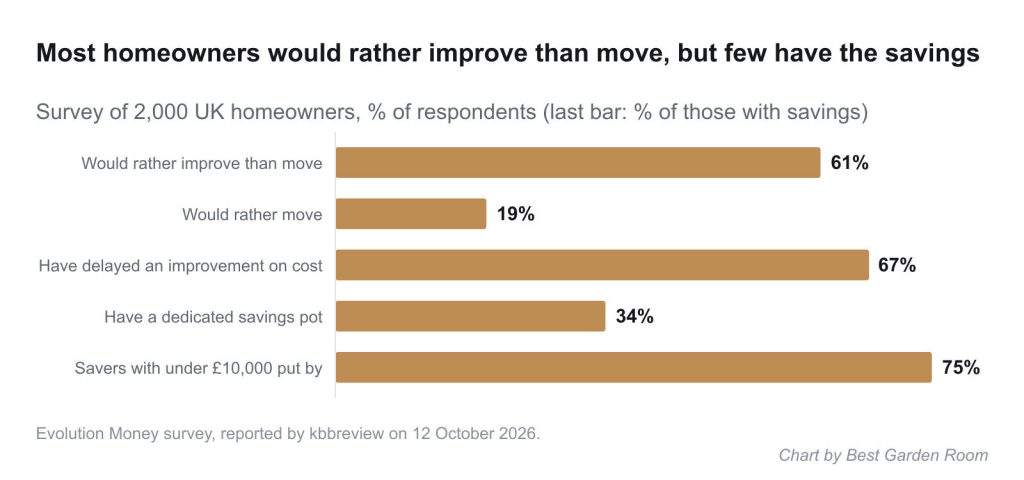
A survey of 2,000 UK homeowners by lender Evolution Money, reported on 12 October, found 61% would prefer to upgrade their current home than move in the next five years, against 19% who would move. Of those choosing to stay, 42% gave the cost and stress of moving as a reason and 41% said house prices were too high. But money is tight: 67% had delayed an improvement because they could not afford it, only 34% had a dedicated savings pot, and 75% of those had less than £10,000 put by.
Why it matters: it is the ‘improve, don’t move’ pressure that keeps garden room demand going. An insulated room under 15 square metres adds usable space without planning or building control in most gardens, which is a cheaper route than an extension or a move. The survey comes from a finance company, so read it as a direction of travel rather than a hard count. Source: kbbreview, 12 October 2026.
Related guides
- Garden Room News: Power 26.32p a kWh, VAT-Free to March
- Garden Room News: Rates Held, Materials Up 5.9%
- Garden Room News: Staged Payments Arrive, Timber Stays Dear
- Garden Room News: New NPPF Lands, PD Rules Unchanged
- Garden Room News: Mid-July 2026
- Garden Room News: Mid-July 2026
- Garden Room News: Early July 2026
- Garden Room Planning News: Late June 2026
- Garden Room News: June 2026