

A small garden shed is anything that fits where a full 6×4 will not: a slim 3×6 pent against a side fence, or a waist-high store for tools and a mower. The catch is that the nominal size on the label is not the space you get inside. Forest Garden’s 3×6 overlap pent, one of the most common small sheds sold in the UK, gives you 88.5cm of internal width, about the width of a single wardrobe. That is plenty for long-handled tools and a rotary mower stood on end, and not enough to walk in and turn round.
Here is what the three common small formats really hold, using manufacturer dimensions, plus the base, door and planning points that decide whether a small shed works on your plot.
Three small shed formats, measured
Every figure below is from the Forest Garden specifications published by retailer Gardensite, checked in October 2026. We use Forest because it publishes internal sizes, which most brands do not.
Pent garden store: under knee-to-chest height
Forest’s pent garden store has a base of 99 x 48cm, rises to 125cm at the eaves and 132cm at the back, and holds a stated 600 litres. The door opening is 109cm high. It is a cupboard rather than a shed: you reach in, you do not step in. It suits long-handled tools, a strimmer, a hose reel and bags of compost, and it can sit on a patio or against a wall where a walk-in shed never could.
3×6 pent: the narrow walk-in
The 3×6 overlap pent is 88.5cm wide and 182.6cm deep inside, with an internal height of 192.8cm and a single door of 59 x 164cm. External eaves height is 188.3cm and the ridge sits at 198.8cm. With the roof overhang it occupies 101.9 x 188.2cm of ground. It has 7mm overlap cladding, 28 x 28mm framing, a 12mm floor and a 25-year limited guarantee.
Because the door is on the long side, a 3×6 works best along a fence, with shelves on the short end walls and hooks on the back wall. One person can step in to reach a shelf, but two cannot work side by side.
6×4 pent: the smallest shed most people can work in
Turn the footprint round and add 30cm of depth and the space changes. Forest’s 6×4 security pent is 182.6cm wide and 118cm deep inside, with the same 59 x 164cm door. That depth lets you stand inside with a mower parked to one side. We cover that size in full in our 6×4 garden shed breakdown.
Floor area: why small sheds feel smaller than the label
Floor area grows quickly as you step up a size. Working from the internal figures above, the 3×6 pent gives about 1.62m² of floor, the 6×4 about 2.15m², and an 8×6 pent (236 x 182.6cm inside) about 4.31m². The garden store’s base works out at 0.48m². So a 6×4 has around 4.5 times the floor of the store, and an 8×6 has twice the floor of a 6×4.
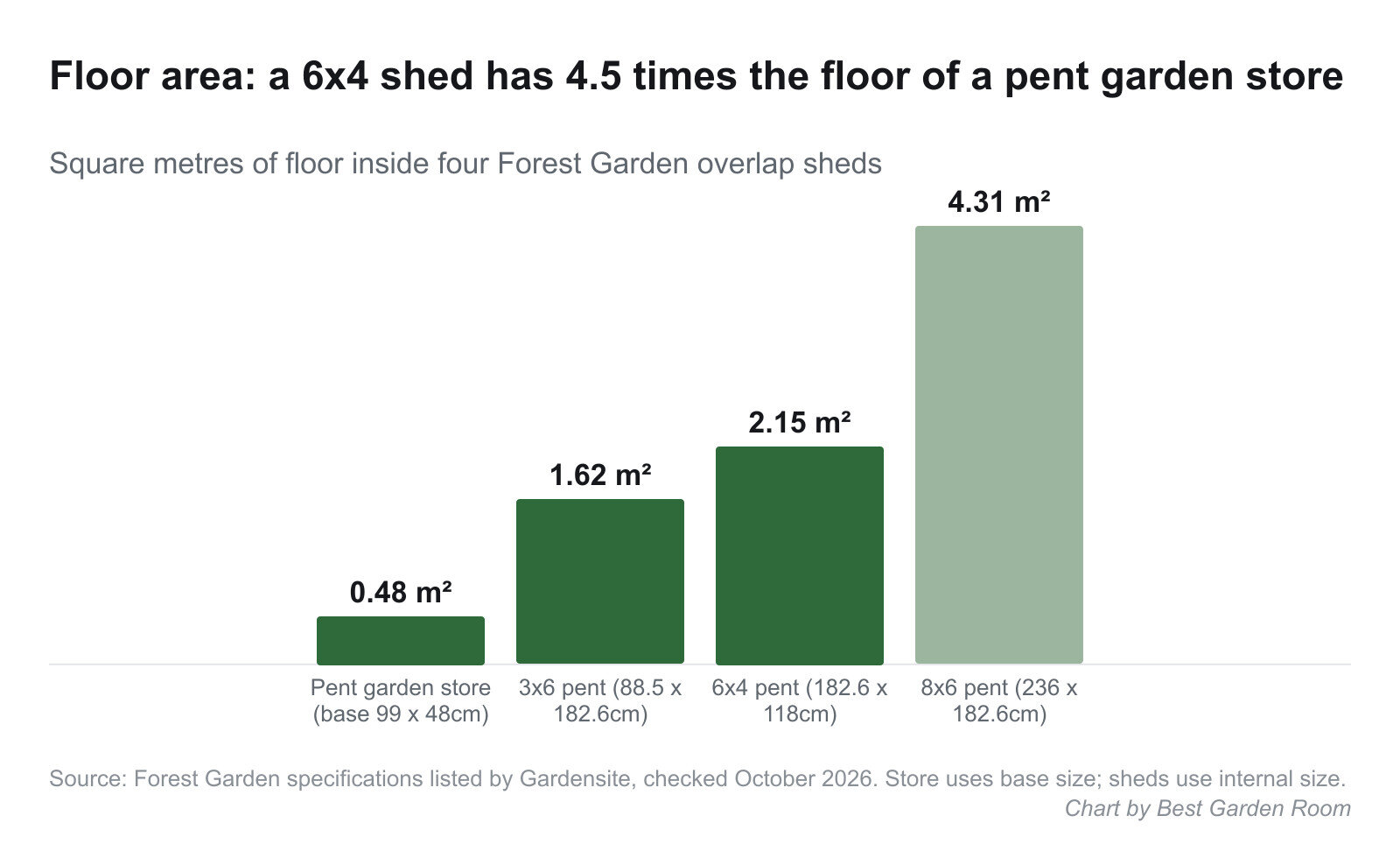
The bigger loss in a small shed is circulation. In a 6×4 or larger, you can keep a strip of clear floor down the middle and line the walls. In a 3×6 the clear strip is the whole shed, so everything has to go on the walls or above head height. If you need to get the mower out without unloading three other things first, measure the mower’s width and handlebar height against that 59cm door and 88.5cm internal width before you buy.
For our size-up view, see the 8×6 garden shed page, which is the point at which a shed starts to work as a small workshop.
Pent or apex for a small shed
Almost every small shed is a pent, with a single roof slope, and there are good reasons:
- Height near a boundary. A pent’s highest point is at the back, so it can sit tight to a fence while staying under the 2.5m height limit for outbuildings within 2m of a boundary. The 3×6 pent tops out at 198.8cm.
- Water goes one way. Point the low side away from the fence, or fit a gutter, so you are not soaking your neighbour’s side or the gap behind the shed.
- Headroom where you stand. On a pent with the door on the high side, you get the full height where you step in.
An apex roof gives more height in the middle and can look better from the house, but on a 3ft-wide shed there is no middle to speak of. Choose apex for a small shed only if it stands clear of the boundaries and you want it to look like a building rather than a cupboard.
Base, siting and fixing
A small shed needs the same base as a big one: firm, level and raised so the floor stays dry. A slab of paving on compacted sub-base, a concrete pad, or a plastic grid base filled with gravel all work. Do not stand the floor straight on soil or lawn, because a 12mm floor sitting in damp will fail long before the guarantee runs out.
Three siting points matter more on small sheds than on large ones:
- Leave a gap behind it. Butted hard against a fence, the back wall cannot dry out and you cannot re-treat or repair it. Aim for enough room to get a brush in.
- Anchor it. A narrow, tall shed is lighter and has a higher centre of gravity than a 6×4, so it is more likely to rock or shift in wind. Use ground anchors or brackets into the base.
- Plan the door swing. A 59cm door needs about 60cm of clear space in front of it to open fully. On a narrow side return, check bins and the side gate are not in the way.
Planning permission for a small shed
Most small sheds do not need planning permission, because they fall under permitted development for outbuildings. The Planning Portal sets out the main limits for houses in England:
- No outbuilding forward of the wall forming the principal elevation of the house, which usually means no shed in the front garden.
- Within 2m of a boundary, the whole building must be no more than 2.5m high.
- Single storey only, with a maximum eaves height of 2.5m.
- Outbuildings and extensions together must not cover more than half the land around the original house.
Flats, maisonettes, listed buildings and some conservation areas have different rules, and some estates have restrictive covenants or an Article 4 direction. Building regulations generally do not apply to a detached outbuilding under 15m² with no sleeping accommodation, so a small shed is almost always outside them. Our garden shed planning permission page covers the edge cases.
Making a small shed hold more
- Go vertical. Rails and hooks for long-handled tools on the back wall, and narrow shelves on the short end walls, keep the floor clear.
- Screw into the framing, not the cladding. On a shed with 7mm boards and 28 x 28mm framing, the cladding will not hold a loaded shelf. Find the uprights.
- Use the door. A shallow rack on the inside of the door holds gloves, secateurs and twine.
- Keep fuel to a minimum. Store petrol in proper containers and only the amount you need for the season.
Our garden shed storage ideas go through these in more detail. For garden rooms, offices and bigger outbuildings, start at the Best Garden Room homepage.
Frequently asked questions
What is the smallest garden shed you can walk into?
A 3×6 pent is about the smallest walk-in format. Forest’s version is 88.5cm wide and 182.6cm deep inside, with 192.8cm of internal height, enough for one person to step in and reach a shelf.
Will a lawnmower fit in a small garden shed?
Usually, but check two numbers: the door width (59cm on Forest’s 3×6 and 6×4 pents) and the internal width or depth. A mower that fits through the door may still block everything else in a 3×6.
Do I need planning permission for a small shed?
Usually not. Under permitted development a shed within 2m of a boundary can be up to 2.5m high, and must not stand forward of the front of the house. Listed buildings and some conservation areas are stricter.
Does a small shed need a base?
Yes. Any shed needs a firm, level base that keeps the floor off wet ground, such as paving slabs on compacted sub-base, a concrete pad or a gravel-filled grid. A floor on bare soil rots quickly.
Is a pent or apex roof better for a small shed?
Pent, in most gardens. It sits lower, can go against a fence within the 2.5m boundary height limit, and sheds water in one direction. Apex suits a free-standing shed where looks matter more than height.
Related guides
- Garden Room Planning Permission UK: The 30m² and 50% Rules Explained
- How Much Does a Garden Room Cost to Run in Winter? Real UK Figures
- Garden Room vs Extension: Honest Cost, Value and When Each Wins
- How Much Does It Cost to Run Electrics to a Garden Room in 2026?
- Ground Screws vs Concrete Base: Which Garden Room Foundation Is Right for You?
- Do Garden Rooms Need Building Regulations? The 15, 30 and 1m Rules Explained
- Prefab vs Bespoke Garden Rooms: Which Is Right for You?
- Garden Room Buying Mistakes: 12 Costly Errors to Avoid
- How to Buy a Garden Room: The Complete UK Buyer’s Guide (2026)
- What to Look for in a Garden Room: 15 Things to Check Before You Buy
- Buying a Second-Hand Garden Room: Is It Worth It?
- Garden Room Kits vs Fully Installed: Should You Self-Build or Buy Turnkey?
- Garden Room Deposits, Contracts and Deliverables: Protecting Your Money
- How Long Does a Garden Room Last? Lifespan and Maintenance
- Garden Room Cost Per Square Metre: 2026 UK Rates Explained
- How Much Does a Garden Room Cost in the UK? (2026 Price Guide)
- Garden Room Prices by Size: From 3x3m to 8x4m and Beyond
- How Much Does a Garden Office Cost? (2026 UK Breakdown)
- How Much Does a Garden Room with a Bathroom Cost?
- Hidden Garden Room Costs: Foundations, VAT and the Extras Quotes Miss
- Garden Room Finance: Loans, Mortgages and Payment Options Explained
- Do Garden Rooms Add Value to Your House? What the UK Resale Data Shows
- Permitted Development Rights for Garden Rooms: Size, Height and the 2m Boundary Rule
- Do Garden Rooms Affect Council Tax? Business Rates and Reassessment
- How a Garden Room Is Built: Foundations to Finish (UK Guide)
- SIPs vs Timber Frame Garden Rooms: Which Construction Is Better?
- How Close to a Boundary Can a Garden Room Be? UK Rules Explained
- How to Apply for Garden Room Planning Permission: Step by Step
- Can You Build a Garden Room on Decking, Slabs or a Patio?
- Is a Garden Room Cheaper Than an Extension? 2026 Cost Comparison
- Garden Room Cladding: Cedar vs Composite vs Larch vs Render
- Garden Room Roof Guide: Flat vs Pitched and the Best Materials
- Garden Room Windows and Doors: Bifold, Sliding and Glazing
- How to Build a Garden Room: A DIY Step-by-Step Guide (UK)
- How Long Does It Take to Build a Garden Room?
- How to Make a Garden Room Usable All Year Round
- Garden Room Insulation: Best Materials and U-Values for the UK
- How to Heat a Garden Room: 9 Options Compared by Cost and Warmth
- Best Heating for a Garden Office: Warm Without a Huge Bill
- Air Conditioning for Garden Rooms: Cooling and Heating in One
- Stopping Condensation and Damp in a Garden Room (UK Guide)
- How to Get Wi-Fi in a Garden Office: 6 Ways That Actually Work
- Garden Office Ideas: Designing the Perfect Work-From-Home Space
- Garden Room Ideas: 20 Popular Uses to Inspire Your Build
- Garden Room Annexe: Rules, Costs and How to Build One
- Garden Bar Ideas: The Height Rules, Power and Layout
- Garden Room Business: What Changes Once Clients Visit
- Garden Studio Ideas: Sizes, Light and the 2.5m Rule
- Garden Room Lighting: IP20 Inside, IP65 Out, Part P Rules
- Landscaping Around a Garden Room: the 30cm Decking Trap
- Garden Room Design: Why 2.5m Decides Everything
- Garden Room Planning Permission: the 2.5m Boundary Rule
- Garden Saunas UK: Planning, Building Regs and Electrics
- Best Garden Room Companies UK: Guarantees of 10 to 25 Years
- Garden Room Electrics: The Rules Change on 15 Oct 2026
- Golf Simulator Garden Room: The 2.5m Rule That Stops It
- Garden Screens: the 2m Rule, and Why Trellis Counts
- Cheap Garden Rooms: What 19mm Walls Really Get You
- Green Retreats Review: 12-Year Cover, 60% Upfront
- Booths Garden Studios Review: Steel Build, 25 Years
- Eden Garden Rooms Review: £23,500 Start, 10-Year Cover
- Green Retreats vs Booths: 25-Year Steel or Timber?
- Garden Rooms London: 6 Companies and the 2.5m Limit
- Garden Room Bedroom: Why a Bed Changes the Rules
- Do I Need Planning Permission for a Garden Shed? Usually Not
- Garden Gym Ideas: Sizes, Ceilings and the 2.5m Height Rule
- Garden Gazebo Rules: 2.5m Near a Boundary, 4m Max
- Garden Arch: Wood or Metal, and the 2.7m Height Rule
- Garden Arbour: Sizes That Seat Two, and Wood vs Metal
- Wooden Garden Gates: Sizes, UC4 Posts and the 1m Rule
- Summer House Interior Ideas: 9 That Work in Winter
- Garden Trellis Panels: the 2m Rule Most Buyers Miss
- Garden Shelters: Six Types and When You Need Permission
- Garden Greenhouses: Glass Gives 90% Light, Plastic 80%
- Summer House Doors and Windows: 4mm Toughened or Styrene?
- Log Stores: Size, Siting and the 20% Moisture Rule
- Garden Shed Roof: Felt, EPDM or Onduline by Pitch
- Insulated Garden Shed: The 25mm Gap That Stops Damp
- Composite Garden Sheds: Rot-Proof, But Check These 6 Things
- How to Build a Garden Shed: Base, Frame and Roof in 5 Steps
- Garden Workshop: Size, Base, Power and the Planning Rules
- Plastic Garden Sheds: Who They Suit and 6 Checks First
- Metal Garden Sheds: Stop Condensation Before You Buy
- Garden Shed Storage Ideas: 12 That Free Up Floor Space
- Wooden Garden Sheds: 7 Specs That Decide How Long They Last
- 8×6 Garden Shed: Real Floor Size, Door Width and Base
- 6×4 Garden Shed: 59cm Door, 118cm Deep and What Fits