

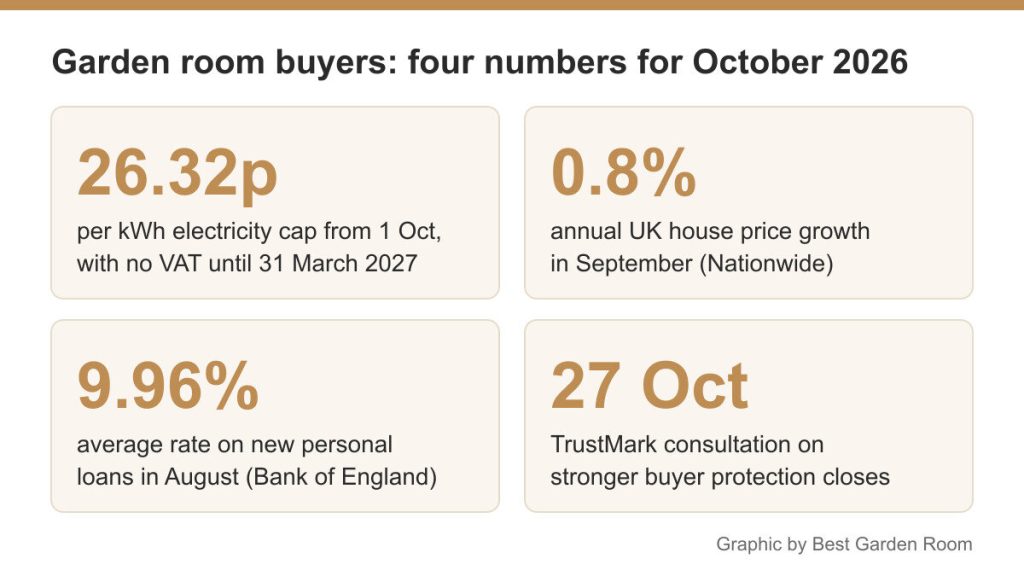
Four things changed for garden room buyers over the last fortnight. Running a heater got slightly cheaper, house price growth slowed sharply, borrowing costs edged up, and the schemes meant to protect you from bad builders are being reworked. None of it comes from garden room firms themselves, because the sector has no trade press, but all of it changes the sums.
Electricity capped at 26.32p a kWh from 1 October, with no VAT until March
Ofgem’s price cap for 1 October to 31 December 2026 sets electricity for Direct Debit customers at an average of 26.32p per kWh with a 54.83p daily standing charge. There is no VAT on household electricity from 1 October 2026 to 31 March 2027. The typical household cap is £1,723 a year, up 4%, but that rise comes from gas: gas went from 7.33p to 7.97p per kWh.
Why it matters: most garden rooms are heated by electricity. A 2kW panel heater running for four hours uses 8kWh, which is about £2.11 a day at the new rate, or around £46 over 22 working days. Our winter running costs page and heating comparison show how insulation and heater choice change that figure. Source: Ofgem, energy price cap unit rates and standing charges.
House price growth halves to 0.8%
Nationwide’s September index shows UK annual house price growth at 0.8%, down from 1.6% in August, with prices down 0.2% on the month. The average price was £274,251. In the quarterly regional figures, London was up 0.4% on the year, the Outer South East was flat at 0.0%, and the Outer Metropolitan area around London fell 0.2%.
Why it matters: across most of the South East, house prices are no longer rising. If a garden room is being sold to you as an investment that adds value, ask for the evidence. It is easier to justify on how much you will use it, or against the cost of an extension or renting an office. See do garden rooms add value. Source: Nationwide House Price Index, September 2026.
Personal loan rates nudge up to 9.96%
The Bank of England’s Money and Credit figures for August show the effective rate on new personal loans rose to 9.96%, from 9.86% in July. Net consumer credit borrowing rose to £2.5 billion. Mortgage approvals for house purchase fell to 54,900, below the average of about 60,100 over the previous six months.
Why it matters: many garden rooms are paid for with a personal loan or with the finance offered by the builder. At close to 10%, borrowing £20,000 over five years costs several thousand pounds in interest. Compare any builder finance offer against the high street rate before you sign. Our garden room finance page sets out the options. Source: Bank of England, Money and Credit, August 2026.
TrustMark consults on stronger protection, and the Approved Code gets operators
TrustMark, the government-endorsed quality scheme for home improvement work, is consulting on changes that include a single point of contact for consumers when things go wrong and stronger financial protection for work done under the scheme. Responses close at 11:59pm on 27 October 2026. Separately, the government’s Approved Code for trusted traders, which launched in August with the Trusted Payments app for staged payments, now has sector operators: kbbreview reported on 2 October that the fitted interiors body BiFIS will run the register for its installers.
Why it matters: a garden room is usually paid for in large stages to a firm you have never used before, so deposit protection is the biggest risk you take. Until these schemes reach garden room builders, keep asking for staged payments tied to finished work and an insurance-backed deposit. See how we compare garden room companies. Sources: TrustMark consultation page; kbbreview, 2 October 2026.
Related guides
- Garden Room News: Rates Held, Materials Up 5.9%
- Garden Room News: Staged Payments Arrive, Timber Stays Dear
- Garden Room News: New NPPF Lands, PD Rules Unchanged
- Garden Room News: Mid-July 2026
- Garden Room News: Mid-July 2026
- Garden Room News: Early July 2026
- Garden Room Planning News: Late June 2026
- Garden Room News: June 2026