

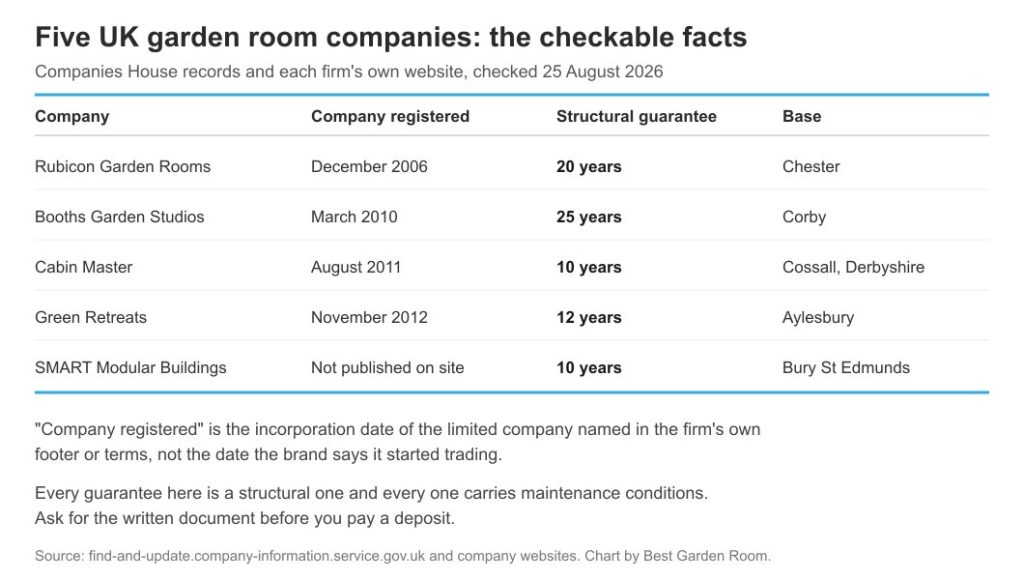
Searching for the best garden room companies in the UK turns up a lot of lists and very little you can check. Ranges get called premium, guarantees industry-leading, and almost none of it is verifiable before you hand over a deposit. This comparison is built the other way round: five established UK garden room companies judged on what is on the record. For each we looked up the limited company behind the brand on Companies House, read the guarantee it actually publishes, and noted where it is based. Where a company publishes nothing, that is stated rather than filled in.
How these five were chosen
This is not a ranking of build quality. Nobody can rank that without dismantling one of each, and any list claiming to has ranked marketing instead.
What can be established is durability as a business and clarity as a supplier. A garden room is usually paid for substantially up front, installed by the company that sold it, and covered by that company’s own guarantee rather than any external scheme. So: has this company traded long enough to have honoured guarantees, does it put its guarantee in public, and does it say who it legally is?
The five below cover different parts of the country and different build approaches. There are good regional builders in every county who never appear in a national list.
The five companies compared
Rubicon Garden Rooms
The longest-established of the five. Rubicon Garden Rooms Limited was incorporated in December 2006 and works out of a showroom at Penyffordd near Chester, covering Cheshire, North Wales, Merseyside and Greater Manchester. It publishes a 20-year guarantee.
What sets Rubicon apart is how much technical detail sits on public pages: separate pages on structure, foundations, roofing, internal walls and U-values, plus a direct page arguing against structural insulated panels in favour of timber frame. You need not agree with it to find it useful. A company that publishes a technical argument it can be held to is easier to interrogate than one that publishes only photographs.
Booths Garden Studios
Booths Garden Studios Limited was incorporated in March 2010, is registered in Corby, Northamptonshire, and has a showroom in Lancashire with coverage into Scotland. It publishes the longest guarantee here, 25 years, and is upfront about why: its buildings are steel, UPVC and glass rather than timber, and its own page argues that most of the market offers ten years because timber rots and those materials do not.
Take that seriously, then check it against your own taste: a building in steel and UPVC does not look like a cedar-clad one. Booths also rents its buildings rather than only selling them, worth a look if you want a garden office without the capital outlay.
Cabin Master
Registered in August 2011 and based at Cossall in Derbyshire, Cabin Master runs what it calls the largest garden room show sites in the UK, with over 50 buildings on display near Nottingham, open seven days a week. If you want to walk into a dozen buildings in an afternoon rather than judge from a brochure, that beats any specification sheet.
Its guarantee is the most instructive document of the five, because it is published in full. The structure carries ten years, but the document is explicit that individual elements carry different periods depending on each materials supplier, and that cover is conditional on maintenance. External redwood treated with preservative is expected to get another coat within 12 months, then annual treatment for two years and every two years after. Skip it and the guarantee is invalidated. Almost every timber garden room guarantee has a clause like this. Cabin Master is one of the few firms that shows it before you buy.
Green Retreats
Green Retreats Limited was incorporated in November 2012 and operates from Westcott Venture Park near Aylesbury, with showrooms in Buckinghamshire and Twickenham. Its FAQ states a 12-year structural guarantee and says the buildings are designed to last over 30 years.
It is the most retail of the five: five named ranges with from-prices on the range pages, a finance calculator, a free site survey, and Kevin McCloud as a brand ambassador. Published starting prices are useful at the shortlist stage, letting you rule buildings out before booking a survey. Treat them as starting points, since quotes move a long way once electrics, groundworks, glazing and access are priced in.
SMART Modular Buildings
Based at Fornham St Martin near Bury St Edmunds, SMART offers six named ranges and installs nationwide using in-house teams rather than subcontractors. Its FAQ states a ten-year structural warranty across every product, and it runs an online configurator and a virtual showroom, useful if Suffolk is a long drive.
One gap worth noting: its public pages, including terms and privacy, carry no company registration number, so you cannot look the trading entity up before you enquire. That is not evidence of anything wrong, and plenty of good firms have untidy footers. It does mean asking for the registered name and number in writing and checking it yourself before paying a deposit, which applies to any supplier that does not publish it.
Why the guarantee carries more weight than it would on an extension
A garden room is one of the few substantial buildings you can put on your property with no independent inspection of the work at all. Planning Portal guidance is that building regulations approval is not normally required for a detached outbuilding under 15 square metres with no sleeping accommodation. Between 15 and 30 square metres, approval is still not normally required provided there is no sleeping accommodation and the building is either at least one metre from every boundary or constructed substantially of non-combustible materials. Standard garden rooms are designed to sit inside those limits, which is why “no planning permission needed” appears on every company’s homepage.
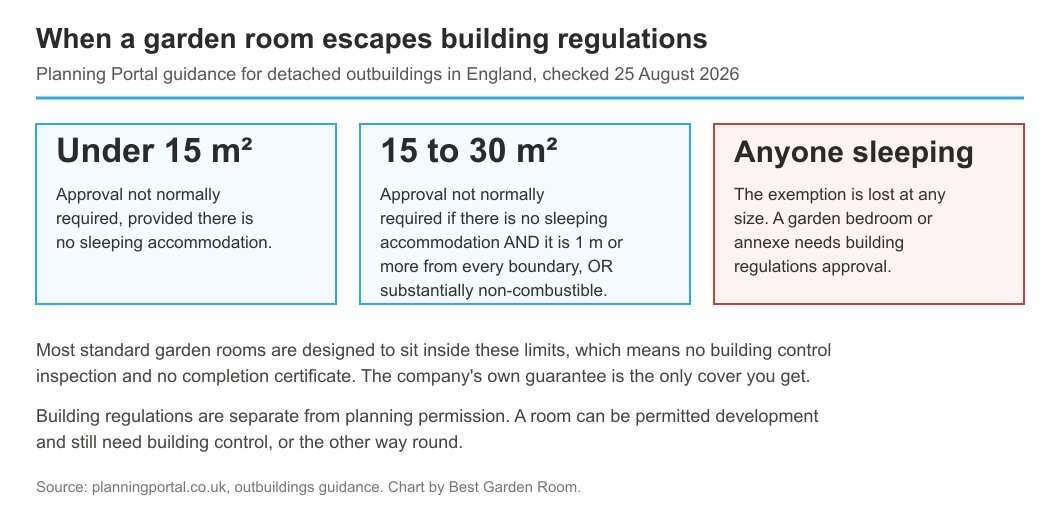
The consequence is less advertised. No building regulations application means no building control inspection, no completion certificate, and no third party who ever checked the foundations, insulation or electrics against a standard. Unlike an extension, there is no NHBC or equivalent structural warranty behind it either. The company’s own guarantee is the entire safety net, which is why its length, its exclusions and the health of the company behind it are the specification that matters.
Building regulations and planning permission are separate systems. A garden room can be permitted development and still need building control approval, most obviously the moment anyone sleeps in it. Planning a garden bedroom or annexe, and the exemption is gone at any size.
Six checks to run before you pay a deposit
1. Look the company up on Companies House. Search the registered name from the website footer at Companies House. Check the incorporation date against how long the brand claims to have traded, that accounts are filed on time, and that there is no new company behind the same brand name. A brand rebuilt inside a new limited company is a guarantee that quietly restarted.
2. Ask for the guarantee document, not the number. “25-year guarantee” is a headline. The document tells you which parts get which period, what maintenance you must do, and what voids it. Read it before the deposit.
3. Ask whether the guarantee is insurance-backed. Most are not. An uninsured guarantee is only as good as the company still existing, which is why check one matters.
4. Get the deposit terms in writing. Ask what it secures and what happens to it if the survey finds access or ground conditions that change the price. Paying by credit card gives Section 75 protection on transactions over £100.
5. Confirm what is not in the quote. Groundworks, electrical supply from the house, the electrical certificate, tree removal and making good the lawn after a delivery vehicle are the usual gaps. Ask for each by name.
6. Visit a finished building, not just a showroom. A show building is assembled on level ground by the company’s best team. Ask to see a customer installation, ideally one that has been through a winter. Condensation, roof drainage and door alignment show up in year two, not week one.
Frequently asked questions
Who are the best garden room companies in the UK?
There is no single answer, because the market is regional and installation quality varies by team rather than by brand. The five here all pass the checkable tests: an established limited company, a published structural guarantee, and a place you can visit. Rubicon has traded longest, Booths publishes the longest guarantee at 25 years, Cabin Master has the largest show site, Green Retreats publishes prices, SMART installs nationwide in-house.
How long a guarantee should a garden room come with?
Ten years is the market standard for a timber building and the figure most companies quote. Twelve is above average. The two longest here, 20 and 25 years, each come with a reason attached: a build system that avoids timber, or a company trading since 2006. What matters more than the headline is whether the guarantee is structural only, what maintenance it requires of you, and whether it is insurance-backed.
Do I need planning permission for a garden room?
Usually not. Most garden rooms are designed to fall within permitted development, which is why companies advertise them that way. The rules tighten for conservation areas, listed buildings, land in front of the house, and anything over 2.5 metres tall within two metres of a boundary. Building regulations are a separate question with its own thresholds.
Are the prices on company websites realistic?
The from-prices are real, but they are for the smallest building in a range in its base specification. A realistic budget adds groundworks, the electrical supply and certificate, better glazing, insulation upgrades for year-round use, heating, and any access difficulty at your property. Get two full written quotes rather than comparing headline figures.
Should I choose a national company or a local builder?
A national supplier gives you a showroom, a documented specification and a guarantee from a company big enough to still exist in ten years. A good local builder can often build to a higher specification for the money and is easier to get back on site. Run the same six checks on both.
What size garden room can I have without building regulations?
Under 15 square metres with no sleeping accommodation is normally outside building regulations. Between 15 and 30 square metres you are normally still exempt if there is no sleeping accommodation and the building is either a metre or more from every boundary or built substantially from non-combustible materials. Check the current position on the Planning Portal, and treat any sleeping use as outside the exemption entirely.
More on specification, costs and planning is on Best Garden Room.
Related guides
- Garden Room Planning Permission UK: The 30m² and 50% Rules Explained
- How Much Does a Garden Room Cost to Run in Winter? Real UK Figures
- Garden Room vs Extension: Honest Cost, Value and When Each Wins
- How Much Does It Cost to Run Electrics to a Garden Room in 2026?
- Ground Screws vs Concrete Base: Which Garden Room Foundation Is Right for You?
- Do Garden Rooms Need Building Regulations? The 15, 30 and 1m Rules Explained
- Prefab vs Bespoke Garden Rooms: Which Is Right for You?
- Garden Room Buying Mistakes: 12 Costly Errors to Avoid
- How to Buy a Garden Room: The Complete UK Buyer’s Guide (2026)
- What to Look for in a Garden Room: 15 Things to Check Before You Buy
- Buying a Second-Hand Garden Room: Is It Worth It?
- Garden Room Kits vs Fully Installed: Should You Self-Build or Buy Turnkey?
- Garden Room Deposits, Contracts and Deliverables: Protecting Your Money
- How Long Does a Garden Room Last? Lifespan and Maintenance
- Garden Room Cost Per Square Metre: 2026 UK Rates Explained
- How Much Does a Garden Room Cost in the UK? (2026 Price Guide)
- Garden Room Prices by Size: From 3x3m to 8x4m and Beyond
- How Much Does a Garden Office Cost? (2026 UK Breakdown)
- How Much Does a Garden Room with a Bathroom Cost?
- Hidden Garden Room Costs: Foundations, VAT and the Extras Quotes Miss
- Garden Room Finance: Loans, Mortgages and Payment Options Explained
- Do Garden Rooms Add Value to Your House? What the UK Resale Data Shows
- Permitted Development Rights for Garden Rooms: Size, Height and the 2m Boundary Rule
- Do Garden Rooms Affect Council Tax? Business Rates and Reassessment
- How a Garden Room Is Built: Foundations to Finish (UK Guide)
- SIPs vs Timber Frame Garden Rooms: Which Construction Is Better?
- How Close to a Boundary Can a Garden Room Be? UK Rules Explained
- How to Apply for Garden Room Planning Permission: Step by Step
- Can You Build a Garden Room on Decking, Slabs or a Patio?
- Is a Garden Room Cheaper Than an Extension? 2026 Cost Comparison
- Garden Room Cladding: Cedar vs Composite vs Larch vs Render
- Garden Room Roof Guide: Flat vs Pitched and the Best Materials
- Garden Room Windows and Doors: Bifold, Sliding and Glazing
- How to Build a Garden Room: A DIY Step-by-Step Guide (UK)
- How Long Does It Take to Build a Garden Room?
- How to Make a Garden Room Usable All Year Round
- Garden Room Insulation: Best Materials and U-Values for the UK
- How to Heat a Garden Room: 9 Options Compared by Cost and Warmth
- Best Heating for a Garden Office: Warm Without a Huge Bill
- Air Conditioning for Garden Rooms: Cooling and Heating in One
- Stopping Condensation and Damp in a Garden Room (UK Guide)
- How to Get Wi-Fi in a Garden Office: 6 Ways That Actually Work
- Garden Office Ideas: Designing the Perfect Work-From-Home Space
- Garden Room Ideas: 20 Popular Uses to Inspire Your Build
- Garden Room Annexe: Rules, Costs and How to Build One
- Garden Bar Ideas: The Height Rules, Power and Layout
- Garden Room Business: What Changes Once Clients Visit
- Garden Studio Ideas: Sizes, Light and the 2.5m Rule
- Garden Room Lighting: IP20 Inside, IP65 Out, Part P Rules
- Landscaping Around a Garden Room: the 30cm Decking Trap
- Garden Room Design: Why 2.5m Decides Everything
- Garden Room Planning Permission: the 2.5m Boundary Rule
- Garden Saunas UK: Planning, Building Regs and Electrics
- Garden Room Electrics: The Rules Change on 15 Oct 2026
- Golf Simulator Garden Room: The 2.5m Rule That Stops It
- Garden Screens: the 2m Rule, and Why Trellis Counts
- Cheap Garden Rooms: What 19mm Walls Really Get You
- Green Retreats Review: 12-Year Cover, 60% Upfront
- Booths Garden Studios Review: Steel Build, 25 Years
- Eden Garden Rooms Review: £23,500 Start, 10-Year Cover
- Green Retreats vs Booths: 25-Year Steel or Timber?
- Garden Rooms London: 6 Companies and the 2.5m Limit
- Garden Room Bedroom: Why a Bed Changes the Rules
- Do I Need Planning Permission for a Garden Shed? Usually Not
- Garden Gym Ideas: Sizes, Ceilings and the 2.5m Height Rule
- Garden Gazebo Rules: 2.5m Near a Boundary, 4m Max
- Garden Arch: Wood or Metal, and the 2.7m Height Rule
- Garden Arbour: Sizes That Seat Two, and Wood vs Metal
- Wooden Garden Gates: Sizes, UC4 Posts and the 1m Rule
- Summer House Interior Ideas: 9 That Work in Winter
- Garden Trellis Panels: the 2m Rule Most Buyers Miss
- Garden Shelters: Six Types and When You Need Permission
- Garden Greenhouses: Glass Gives 90% Light, Plastic 80%
- Summer House Doors and Windows: 4mm Toughened or Styrene?
- Log Stores: Size, Siting and the 20% Moisture Rule
- Garden Shed Roof: Felt, EPDM or Onduline by Pitch
- Insulated Garden Shed: The 25mm Gap That Stops Damp
- Composite Garden Sheds: Rot-Proof, But Check These 6 Things
- How to Build a Garden Shed: Base, Frame and Roof in 5 Steps
- Garden Workshop: Size, Base, Power and the Planning Rules
- Plastic Garden Sheds: Who They Suit and 6 Checks First
- Metal Garden Sheds: Stop Condensation Before You Buy
- Garden Shed Storage Ideas: 12 That Free Up Floor Space
- Wooden Garden Sheds: 7 Specs That Decide How Long They Last
- Corner Summer House: The 2.5m Height Limit Explained