

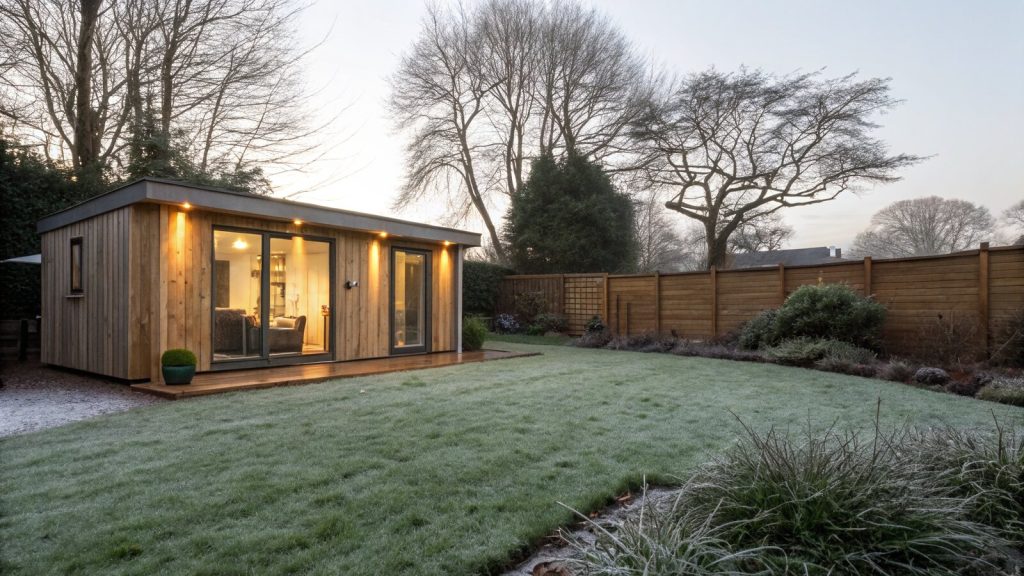
Ask ten garden room companies how much their building costs to heat and you will get ten per-hour heater figures and no real answer. “A 1kW heater costs about 26p an hour” is true, but it tells you nothing about your actual winter bill, because it ignores the one thing that decides everything: how well the building holds heat. A poorly insulated room runs that heater twice as long, and twice as often, to reach the same temperature. The heater is rarely the problem. The spec is.
This guide ties garden room running costs to the actual insulation and glazing spec, then gives you worked yearly winter totals for a well-built versus a badly built 12m² room. Once you see the gap, you will understand why the cheap quote often costs more to live with.
The single number that controls your winter bill
Heat leaks out of a building through its walls, roof, floor, windows and doors. The rate it leaks at is measured as a U-value: watts of heat lost per square metre for every degree of temperature difference, written as W/m²K. Lower is better. A wall with a U-value of 0.18 loses heat at less than half the rate of one at 0.40.
Your heater’s only job in winter is to replace the heat that escapes. A leaky building loses more, so the heater works harder and longer for the same comfort. That is the whole story behind your bill. Two garden rooms that look identical, with the same heater, can have winter running costs that differ by two or three times, purely because of what is inside the walls.
England’s Approved Document L (Conservation of fuel and power) sets demanding U-value targets for new-build homes: the notional new dwelling sits around 0.18 W/m²K for walls, near 0.11 for roofs and around 0.13 for floors. A garden room under 15m² with no sleeping use usually sits outside Building Regulations, so a builder is free to insulate it as thinly as they like. A good builder still aims to match or beat new-build wall and roof standards. A cheap one does not, and you only find out in January. As a sensible buyer benchmark, a quality garden room targets roughly 0.18 W/m²K in the walls, around 0.16 or better in the roof and about 0.20 to 0.25 in the floor.
What “well insulated” actually means in a garden room
Insulation is sold by thickness and material. Most quality garden rooms use rigid boards because they have a very low thermal conductivity, so a thinner board does the work of much thicker mineral wool. The two materials you will see named most are PIR (brands like Celotex and Kingspan Therma) at around 0.022 W/mK, and phenolic board (Kingspan Kooltherm) at around 0.018 to 0.020 W/mK, which performs slightly better for the same thickness. The depth fitted in each part of the building is what matters:
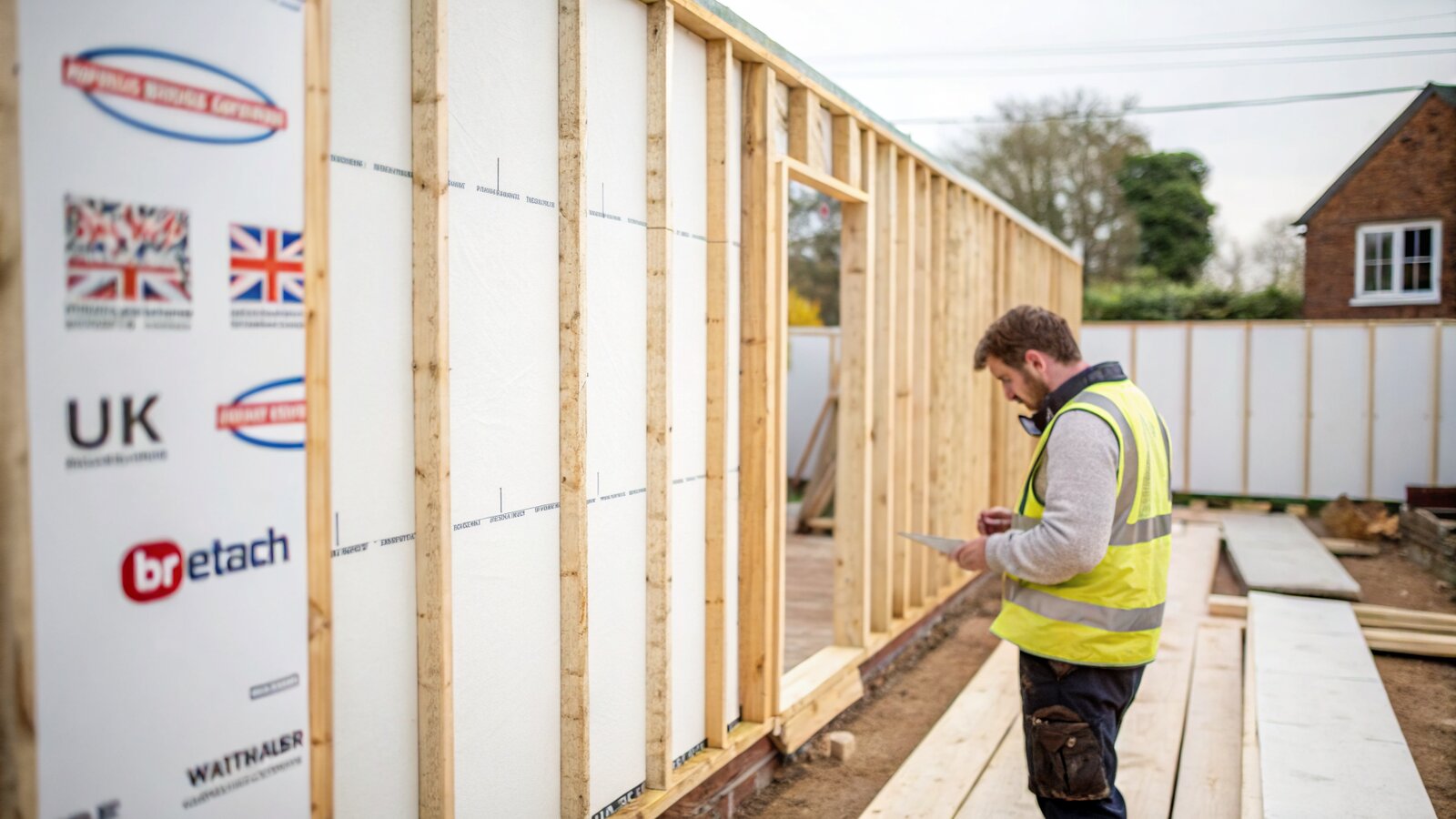
- Walls: a budget room might run 25mm to 50mm of rigid board, or just mineral wool stuffed in a thin frame. A well-built room uses a deeper stud, often 70mm to 100mm, filled with PIR or phenolic, getting the wall U-value down towards or below 0.18.
- Roof: the biggest heat-loss path because warm air rises. Budget builds skimp here most. A good roof carries 100mm to 150mm of rigid board, sometimes more, to reach roughly 0.16 or lower.
- Floor: often forgotten. Around 100mm of rigid board under the floor deck keeps the room comfortable to stand on and stops cold rising through your feet, targeting about 0.20 to 0.25.
- Glazing: double glazing is the floor, not the ceiling. Argon-filled units with a low-emissivity (Low-E) coating and a warm-edge spacer bar perform far better than plain double glazing. A wall of cheap glass is a giant hole in your insulation no matter how good the board behind it.
Two other things quietly wreck running costs: air leakage and thermal bridging. Gaps around door frames, service penetrations and badly taped joints let warm air pour out, so a draughty room never feels warm however long the heater runs. Thermal bridges, where a solid timber or metal member crosses the insulation, create cold lines that pull heat out. A well-detailed build seals the envelope and breaks those bridges. None of this shows in a glossy brochure photo, which is exactly why buyers miss it.
Worked example: a 12m² room over a real UK winter
Let us price two versions of the same 4m by 3m garden room used as a home office. We will assume a UK heating season of roughly five months (November to March) and the room heated to a comfortable temperature for about four hours a day on working days, which works out near 600 heating hours across the season. Electricity is charged per kilowatt hour (kWh): the Ofgem price cap unit rate has sat around 26p per kWh through 2026, though it changes every three months and varies by region and tariff, so treat it as a working figure, not a fixed one. You can check the current number on the Ofgem energy price cap page.
The well-insulated room
Walls, roof and floor all hit or beat new-build U-values, glazing is argon-filled Low-E, and the envelope is properly sealed. A room like this needs only a modest heat input to hold temperature. A 1kW to 1.5kW heater is plenty, and once the room is up to temperature the thermostat cycles it on and off, so the average draw across those four hours is closer to 1kW than the heater’s full rating.
Roughly 600 hours at an average 1kW draw is about 600 kWh across the winter. At 26p that is around £150 to £200 for the season, or somewhere near £30 to £40 a month in the coldest stretch. That matches what owners of genuinely well-built rooms report.
The poorly-insulated room
Thin walls, a skimped roof, plain double glazing and draughts around the doors. This room loses heat fast, so two things happen at once. First, you need a bigger heater, often a 2kW oil-filled radiator, just to get warm. Second, that heater barely cycles off because the heat escapes as quickly as it goes in, so the average draw stays high and you tend to switch on earlier and run longer to feel comfortable.
Push the average draw to around 2kW and stretch the runtime, and you are easily at 1,400 to 1,600 kWh across the season. At 26p that is roughly £365 to £415 a year, and in the depths of winter it can hit £100 a month or more. Same room footprint, same heater technology, same family using it. The only difference is the spec, and it has more than doubled the bill.
The lesson buyers rarely hear: the saving you might make by accepting a thinner spec, often a four-figure sum, can come back as £200 to £250 a year, every year, in heating. Over a decade that is most of the saving gone, and you spent ten winters being cold while you paid it. Figures here are illustrative and will vary with your tariff, usage and the weather.
Does the heater type change the answer?
Less than insulation does, but it still matters, mostly for how the heat feels and how fast you get it.
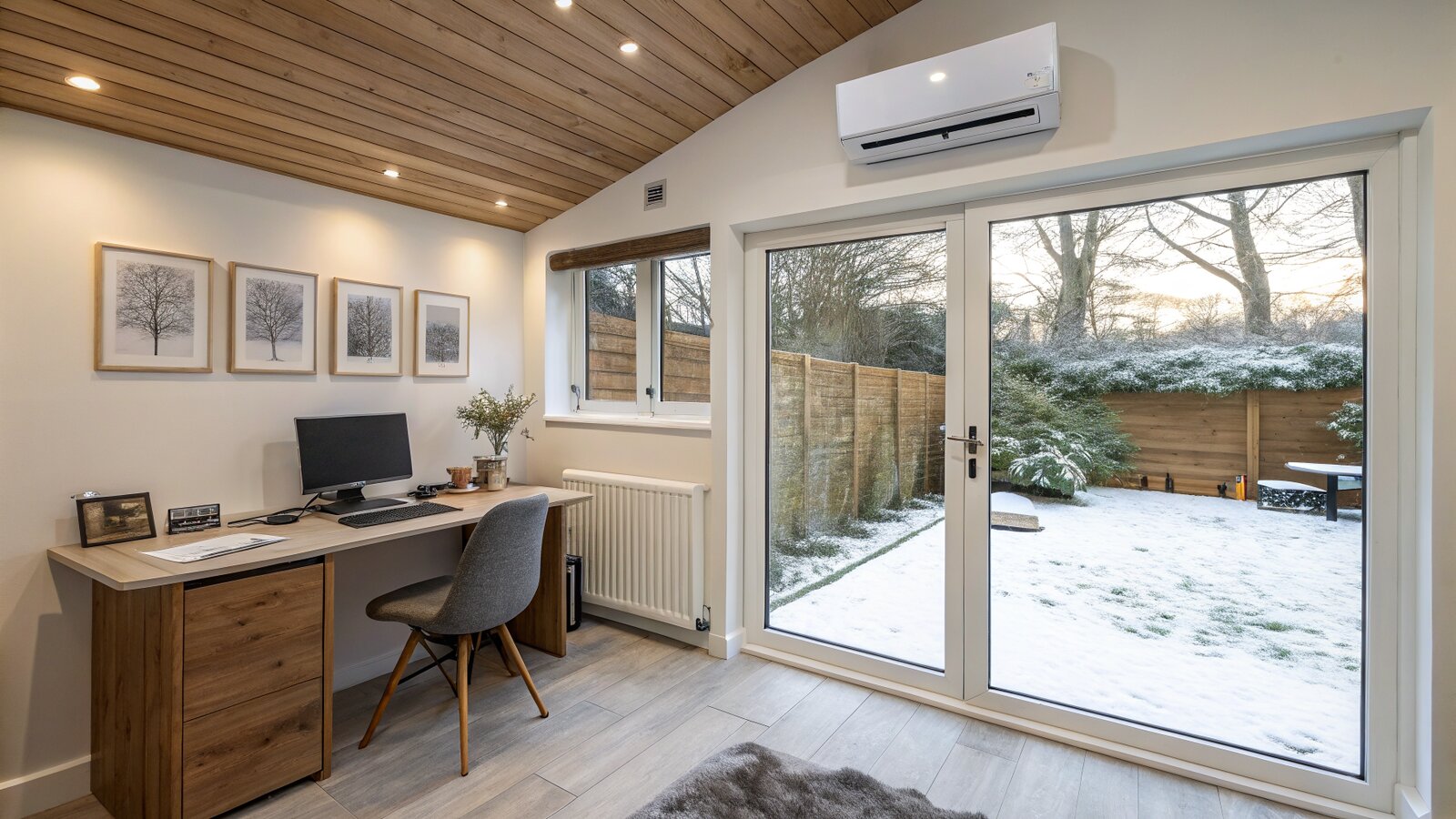
- Electric panel and oil-filled radiators: every watt becomes heat, so they are 100% efficient at the plug. Oil-filled units hold heat after switch-off, which suits long sessions; panel heaters respond faster. Cheap to buy, simple to plug in, and the workhorse of most garden rooms.
- Infrared panels: these warm objects and people directly rather than heating the air, so you feel warm quickly and they cope well in slightly draughty rooms. They are still 100% efficient electrically, but the heat fades fast once switched off, so they suit short, occupied bursts rather than holding an empty room warm.
- Air-to-air heat pump (the air conditioning unit in reverse): this is the one that genuinely beats the others on running cost. A heat pump moves heat rather than making it, so for every unit of electricity it can deliver two to three units of heat in mild UK winter conditions, falling closer to two units on the coldest days. In the well-insulated room above, that can drop the heating bill to roughly a third, into the £50 to £70 a year region, while also giving you cooling in summer. It costs more to buy and fit, so it pays back over years, not months.
Notice what does not happen: no heater type rescues a badly insulated room. A heat pump in the leaky room still has to replace all that lost heat, so it just burns through more electricity than it would in a tight building. Spec first, heater second.
Five things that cut running costs more than swapping heaters
- Get the roof and floor spec right at order stage. You cannot easily add roof insulation later. Ask for the board thickness in each element and the target U-values in writing before you sign.
- Pay for better glazing. Argon-filled Low-E units with warm-edge spacers cost a little more and quietly save heat every single winter day.
- Seal the building. Ask how draughts are controlled around doors and service entries. A sealed envelope is free heat retention.
- Use a thermostat and a timer. Heating an empty room to full temperature all day is pure waste. Set a comfortable working temperature and let it hold, rather than blasting a cold room from scratch each morning.
- Consider a heat pump if you will use the room daily and year-round. For occasional use, a plug-in radiator is the sensible spend.
Building Regulations are worth a quick mention here too. A garden room under 15m² with no sleeping use is normally exempt, and between 15m² and 30m² it stays exempt if it has no sleeping accommodation and is either a metre from any boundary or built mainly from non-combustible materials. Either way the electrical work falls under Part P, so use a registered electrician. You can confirm the current position on the Planning Portal outbuildings guidance.
If you want to compare specs properly before you buy, our guides at Best Garden Room walk through what a quality build looks like, and you can read more on insulation, planning and design across the site before you talk to suppliers.
Frequently asked questions
How much does it cost to heat a garden room in winter in the UK?
For a well-insulated 12m² room used as an office a few hours a day, expect roughly £150 to £200 across a five-month heating season, or about £30 to £40 a month at the coldest point, based on an electricity rate near 26p per kWh. A poorly insulated room of the same size can easily cost two to three times that. Your insulation spec matters far more than the heater you choose. These are illustrative figures and your tariff, usage and the weather will move them.
What is the cheapest way to heat a garden room?
For day-to-day running cost, an air-to-air heat pump is usually the cheapest because it delivers two to three units of heat per unit of electricity, but it costs more to install. For lower upfront cost, an oil-filled or panel radiator on a thermostat and timer is hard to beat. Whichever you pick, the cheapest heating of all is heat you never lose, which comes from good insulation and sealed draughts.
Does a garden room need building regulations for insulation?
Usually not. A garden room under 15m² of floor area with no sleeping accommodation typically falls outside Building Regulations, so there is no legal minimum insulation. That is exactly why specs vary so widely. A reputable builder still aims to meet or beat the new-build U-value targets in Approved Document L, so ask for those figures rather than assuming they are met.
How thick should garden room insulation be?
As a rule of thumb for rigid PIR or phenolic boards, aim for around 70mm to 100mm in the walls, 100mm to 150mm in the roof and about 100mm in the floor. Thinner than that, and the room will be noticeably more expensive to heat. The roof is the most important place not to skimp, because that is where most heat escapes.
Is double glazing enough for a garden room?
Plain double glazing is the bare minimum and leaks a lot of heat if you have large windows or bifold doors. Argon-filled units with a Low-E coating and a warm-edge spacer bar perform much better for a small extra cost. With a lot of glass, the glazing quality can affect your winter bill as much as the wall insulation.
Can I use my garden room all year round?
Yes, if it is built to a proper spec. A well-insulated, well-glazed and sealed room stays comfortable through a UK winter on a modest heater, and stays cooler in summer too. The buildings people abandon in winter are almost always the under-insulated ones, where the running cost and the chill make daily use unpleasant.
Related guides
- Garden Room Planning Permission UK: The 30m² and 50% Rules Explained
- Garden Room vs Extension: Honest Cost, Value and When Each Wins
- How Much Does It Cost to Run Electrics to a Garden Room in 2026?
- Ground Screws vs Concrete Base: Which Garden Room Foundation Is Right for You?
- Do Garden Rooms Need Building Regulations? The 15, 30 and 1m Rules Explained
- Prefab vs Bespoke Garden Rooms: Which Is Right for You?
- Garden Room Buying Mistakes: 12 Costly Errors to Avoid
- How to Buy a Garden Room: The Complete UK Buyer’s Guide (2026)
- What to Look for in a Garden Room: 15 Things to Check Before You Buy
- Buying a Second-Hand Garden Room: Is It Worth It?
- Garden Room Kits vs Fully Installed: Should You Self-Build or Buy Turnkey?
- Garden Room Deposits, Contracts and Deliverables: Protecting Your Money
- How Long Does a Garden Room Last? Lifespan and Maintenance
- Garden Room Cost Per Square Metre: 2026 UK Rates Explained
- How Much Does a Garden Room Cost in the UK? (2026 Price Guide)
- Garden Room Prices by Size: From 3x3m to 8x4m and Beyond
- How Much Does a Garden Office Cost? (2026 UK Breakdown)
- How Much Does a Garden Room with a Bathroom Cost?
- Hidden Garden Room Costs: Foundations, VAT and the Extras Quotes Miss
- Garden Room Finance: Loans, Mortgages and Payment Options Explained
- Do Garden Rooms Add Value to Your House? What the UK Resale Data Shows
- Permitted Development Rights for Garden Rooms: Size, Height and the 2m Boundary Rule
- Do Garden Rooms Affect Council Tax? Business Rates and Reassessment
- How a Garden Room Is Built: Foundations to Finish (UK Guide)
- SIPs vs Timber Frame Garden Rooms: Which Construction Is Better?
- How Close to a Boundary Can a Garden Room Be? UK Rules Explained
- How to Apply for Garden Room Planning Permission: Step by Step
- Can You Build a Garden Room on Decking, Slabs or a Patio?
- Is a Garden Room Cheaper Than an Extension? 2026 Cost Comparison
- Garden Room Cladding: Cedar vs Composite vs Larch vs Render
- Garden Room Roof Guide: Flat vs Pitched and the Best Materials
- Garden Room Windows and Doors: Bifold, Sliding and Glazing
- How to Build a Garden Room: A DIY Step-by-Step Guide (UK)
- How Long Does It Take to Build a Garden Room?
- How to Make a Garden Room Usable All Year Round
- Garden Room Insulation: Best Materials and U-Values for the UK
- How to Heat a Garden Room: 9 Options Compared by Cost and Warmth
- Best Heating for a Garden Office: Warm Without a Huge Bill
- Air Conditioning for Garden Rooms: Cooling and Heating in One
- Stopping Condensation and Damp in a Garden Room (UK Guide)
- How to Get Wi-Fi in a Garden Office: 6 Ways That Actually Work
- Garden Office Ideas: Designing the Perfect Work-From-Home Space
- Garden Room Ideas: 20 Popular Uses to Inspire Your Build
- Garden Room Annexe: Rules, Costs and How to Build One
- Garden Bar Ideas: The Height Rules, Power and Layout
- Garden Room Business: What Changes Once Clients Visit
- Garden Studio Ideas: Sizes, Light and the 2.5m Rule
- Garden Room Lighting: IP20 Inside, IP65 Out, Part P Rules
- Landscaping Around a Garden Room: the 30cm Decking Trap
- Garden Room Design: Why 2.5m Decides Everything
- Garden Room Planning Permission: the 2.5m Boundary Rule
- Garden Saunas UK: Planning, Building Regs and Electrics
- Best Garden Room Companies UK: Guarantees of 10 to 25 Years
- Garden Room Electrics: The Rules Change on 15 Oct 2026
- Golf Simulator Garden Room: The 2.5m Rule That Stops It
- Garden Screens: the 2m Rule, and Why Trellis Counts
- Cheap Garden Rooms: What 19mm Walls Really Get You
- Green Retreats Review: 12-Year Cover, 60% Upfront
- Booths Garden Studios Review: Steel Build, 25 Years
- Eden Garden Rooms Review: £23,500 Start, 10-Year Cover
- Green Retreats vs Booths: 25-Year Steel or Timber?
- Garden Rooms London: 6 Companies and the 2.5m Limit
- Garden Room Bedroom: Why a Bed Changes the Rules
- Do I Need Planning Permission for a Garden Shed? Usually Not
- Garden Gym Ideas: Sizes, Ceilings and the 2.5m Height Rule
- Garden Gazebo Rules: 2.5m Near a Boundary, 4m Max
- Garden Arch: Wood or Metal, and the 2.7m Height Rule
- Garden Arbour: Sizes That Seat Two, and Wood vs Metal
- Wooden Garden Gates: Sizes, UC4 Posts and the 1m Rule
- Summer House Interior Ideas: 9 That Work in Winter
- Garden Trellis Panels: the 2m Rule Most Buyers Miss
- Garden Shelters: Six Types and When You Need Permission
- Garden Greenhouses: Glass Gives 90% Light, Plastic 80%
- Summer House Doors and Windows: 4mm Toughened or Styrene?
- Log Stores: Size, Siting and the 20% Moisture Rule
- Garden Shed Roof: Felt, EPDM or Onduline by Pitch
- Insulated Garden Shed: The 25mm Gap That Stops Damp
- Composite Garden Sheds: Rot-Proof, But Check These 6 Things
- How to Build a Garden Shed: Base, Frame and Roof in 5 Steps
- Garden Workshop: Size, Base, Power and the Planning Rules
- Plastic Garden Sheds: Who They Suit and 6 Checks First
- Metal Garden Sheds: Stop Condensation Before You Buy
- Garden Shed Storage Ideas: 12 That Free Up Floor Space
- Wooden Garden Sheds: 7 Specs That Decide How Long They Last
- 8×6 Garden Shed: Real Floor Size, Door Width and Base
- 6×4 Garden Shed: 59cm Door, 118cm Deep and What Fits
- Small Garden Shed: 88.5cm Wide Inside and What Fits