

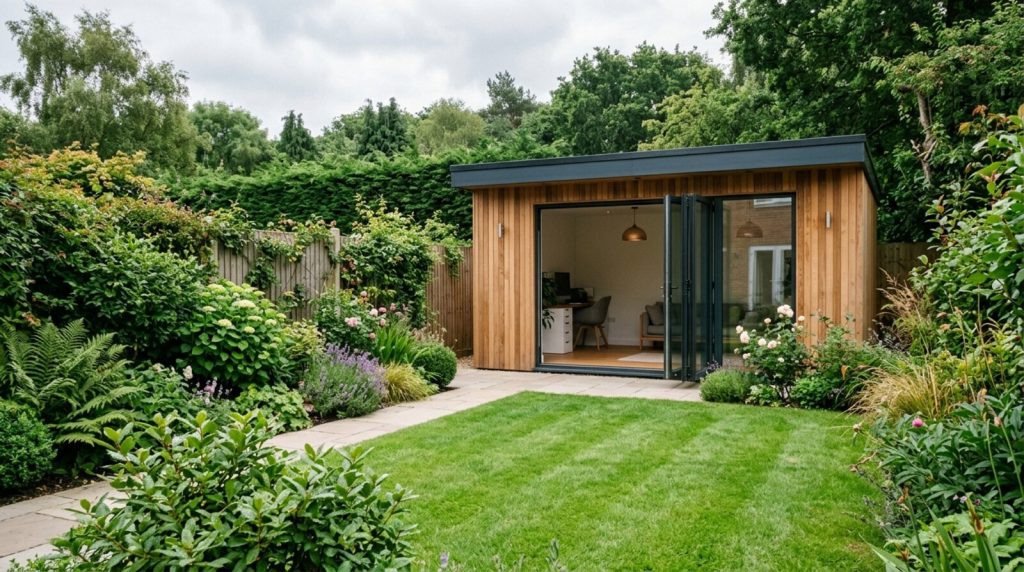
Once you have decided you want a garden room, the next fork in the road is how it gets built. Broadly there are two routes: a prefabricated or modular building made largely in a factory and assembled on site in days, or a bespoke structure designed for your plot and built from the ground up in your garden. Both can give you a warm, usable room. They differ in price, lead time, how far you can push the design, and how forgiving they are of an awkward site. This guide walks through the trade-offs so you can match the route to your garden and your budget.
How each type is designed and built
A prefabricated garden room is engineered to a set of standard models. Many use structural insulated panels (SIPs), which are factory-bonded sandwiches of insulation between two boards, or factory-built timber-framed cassettes. The panels or modules arrive flat-packed or part-assembled, and a small crew puts the shell up on a prepared base, often reaching weathertight stage within a few days. Because the work is repeated across many units, factory quality control tends to be consistent and dimensions are precise.
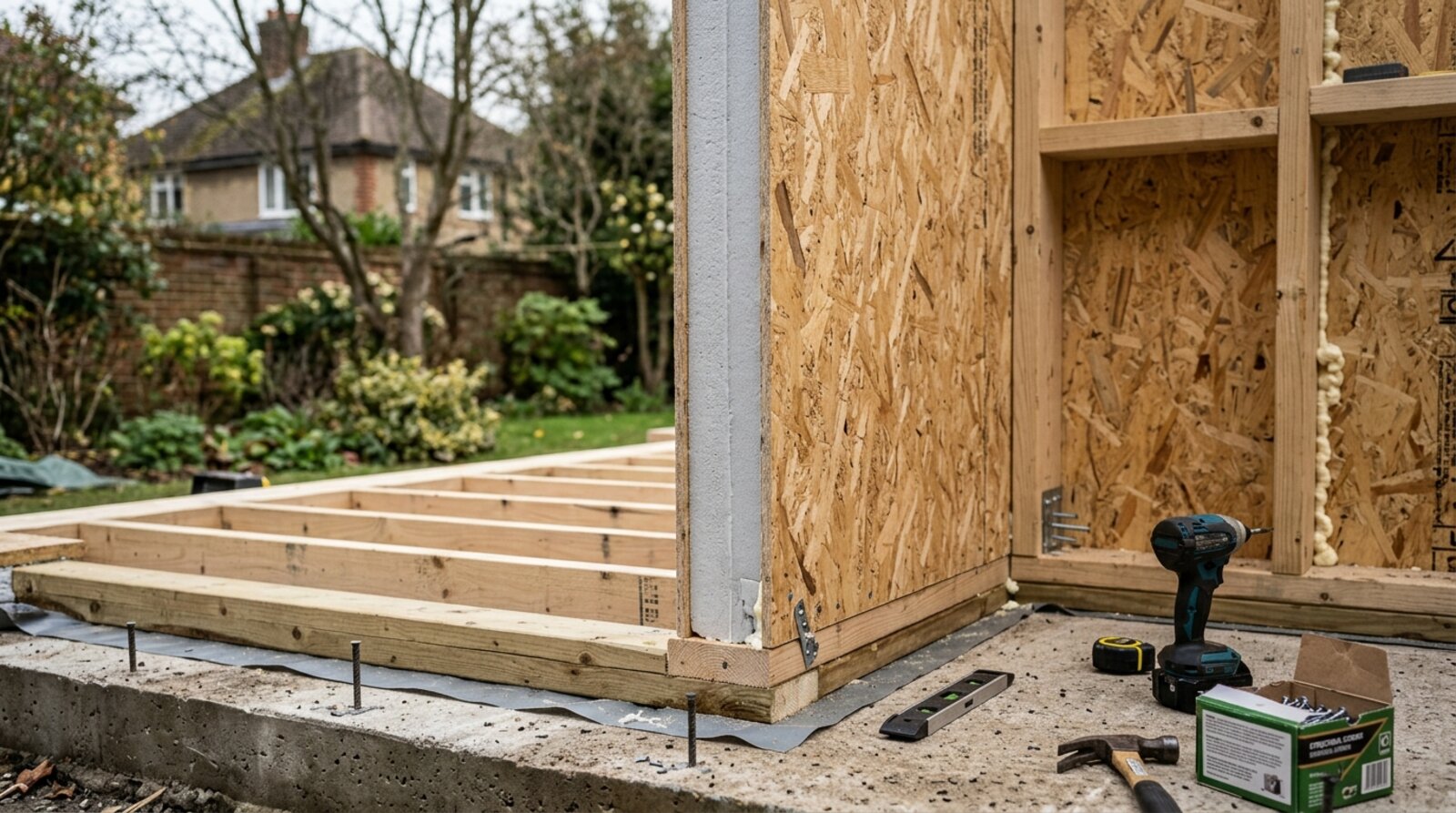
A bespoke garden room is usually a site-built timber frame, drawn up for your specific garden and then constructed in place. The builder sets out the base, raises the frame, insulates between and over the studs, then clads, glazes and fits out. This takes longer on site but gives the team room to adjust as they go, work around obstacles, and build to shapes a standard model cannot accommodate. Some bespoke firms also use SIPs cut to a one-off design, which blends factory precision with a tailored layout.
Neither method is inherently better built. A well-specified prefab can outperform a poorly executed site build, and the reverse is equally true. What matters is the insulation thickness, the airtightness, the quality of the windows and doors, and the workmanship at the junctions where heat and damp escape.
Lead time and disruption
Prefab usually wins on speed. Once your slab or pad foundation is ready, a modular shell can go up and be made weathertight quickly, with first and second fix following over the next week or two. The factory build happens in parallel with your groundworks, so the visible on-site phase is short and the mess is limited.
A bespoke build keeps tradespeople in your garden for longer because more of the work happens on site. That is the cost of flexibility: every adjustment, every custom detail and every awkward junction is handled in place. If you need the room finished fast, or you cannot tolerate weeks of activity outside the back door, that is a point in favour of prefab. If the timetable is relaxed and the result matters more than the speed, the site-built route is less of a constraint.
Cost and what drives it
Prices for garden rooms vary so widely that any single figure would mislead you, so treat all numbers as indicative and get written quotes. As a rule, an off-the-shelf prefab in a standard size is the cheaper starting point because the design is already paid for and the build is repeatable. Bespoke carries a design premium and more on-site labour, so it generally costs more for a comparable footprint.
The gap narrows once you specify a prefab heavily. Upgrades to glazing, cladding, electrics, heating, bathrooms and bi-fold doors add up fast, and a fully loaded modular unit can land close to a mid-spec bespoke build. The main cost drivers on either route are the same: floor area, the amount of glazing, the insulation and airtightness spec, the foundation type (a sloping or soft site costs more to prepare), and the finish quality inside and out. Groundworks and access are easy to underestimate, so ask for them to be itemised rather than buried in a single headline price.
Design flexibility and site constraints
This is where the two routes diverge most. Prefab models come in fixed sizes and layouts, and customisation is often limited to finishes, glazing positions and a handful of options. That is fine for a rectangular lawn with clear access. It becomes a problem if your plot is an unusual shape, slopes noticeably, or has restricted access.
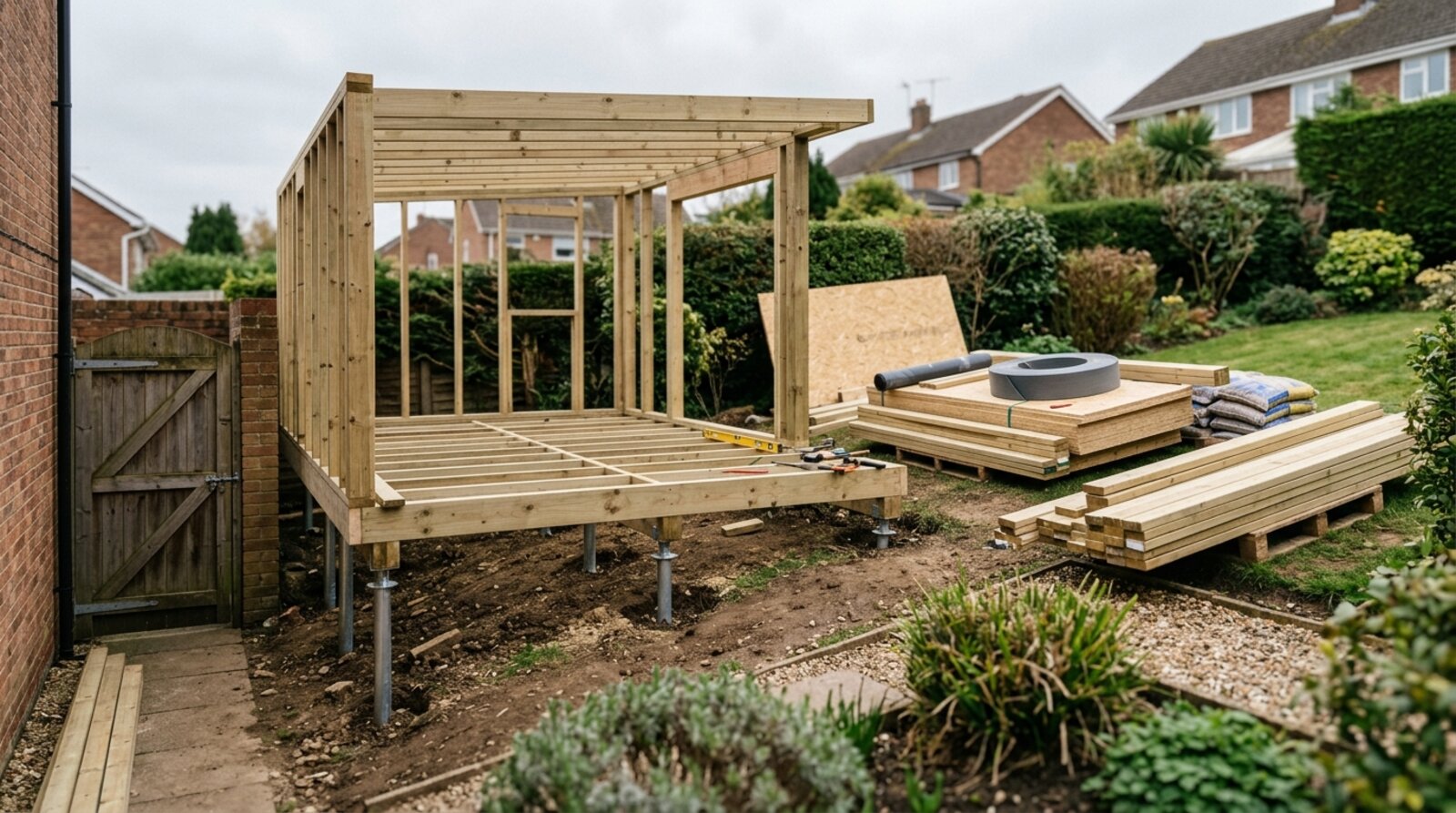
Access is the practical sticking point. Large factory panels or pre-built modules have to reach the back of the garden, sometimes needing a crane lift over the house or wide side access. A site-built timber frame arrives as manageable components that two people can carry through a standard gate, which is often the deciding factor for terraced houses and tight urban gardens. Sloping ground, curved walls, a footprint that has to hug a boundary or work around a tree: these favour bespoke, because the design is drawn around the constraint rather than dropped onto it.
Insulation and build quality
If you want to use the room all year, the thermal spec is what keeps it comfortable and cheap to heat. SIP-based prefabs are well suited to year-round use because the continuous insulation and tight panel joints reduce draughts and heat loss. A good bespoke timber frame achieves the same comfort, but it usually needs a thicker build-up and depends more on careful workmanship to get the airtightness right.
Whichever route you choose, ask specific questions: what insulation is used and how thick is it in the walls, roof and floor; how is the building made airtight; what is the U-value of the glazing; and what stops condensation and damp. A glossy brochure photo tells you nothing about how warm the room is in February. The numbers and the detailing do.
Planning permission and building regulations
The rules are the same for both types, because they govern the building and its use, not how it was manufactured. In England, most garden rooms are built under permitted development as outbuildings, which means no planning application is needed if you stay within the limits. The headline constraints include keeping the building single storey, not covering more than half the land around the original house with outbuildings, not placing it forward of the principal elevation, and a strict height cap: within two metres of a boundary, the total height must not exceed 2.5 metres. Conservation areas, national parks, Areas of Outstanding Natural Beauty and listed buildings carry tighter rules, so check your designation. Always confirm the current rules on the Planning Portal outbuildings guidance or with your local planning authority.
Building regulations are separate from planning and deal with how safely the structure is built. Approval will not normally apply if the floor area is under 15 square metres and there is no sleeping accommodation. Between 15 and 30 square metres, you will not normally need approval provided there is no sleeping accommodation and the building is either at least one metre from any boundary or built substantially of non-combustible materials. Any sleeping accommodation, such as using the room as a guest bedroom or annexe, brings building regulations into play whatever the size. Electrical work should be carried out to the relevant standards by a competent person regardless of the building’s size. A reputable supplier on either route will be clear about which rules apply to your specific design.
Warranties and installer due diligence
A warranty is only as good as the company standing behind it, so check both. Many suppliers offer guarantees in the region of five to ten years, often with separate cover on items such as the roof membrane, windows and doors. Read what is actually covered and for how long, and whether labour is included or just materials.
The bigger risk is a company ceasing to trade before or during your build, which is why deposit protection and an insurance-backed guarantee matter. Schemes run by bodies such as the Consumer Protection Association and the Independent Warranty Association protect a deposit and back the workmanship guarantee if the firm goes under. Before you pay anything, do the basics: get references and recent addresses you can visit or call, read independent reviews, confirm the deposit is protected, and never hand over a large sum without that cover in place. Apply the same diligence to a small bespoke builder and a large modular brand; size is no guarantee of survival.
Which type suits which buyer
If your garden is a reasonable rectangle with decent access, you want a standard size, your budget is the main constraint and you want the room up quickly, a prefab modular building is the sensible default. You get factory consistency, a short on-site phase and a clear price.
If your plot is an unusual shape, slopes, has tight access, or you want a specific look, layout or high specification that the standard models cannot deliver, bespoke earns its premium. You are paying for a building designed around your constraints rather than one you have to design your garden around. For more guides on choosing and specifying a garden room, see Best Garden Room.
Frequently asked questions
Is a prefab garden room worse quality than a bespoke one?
Not necessarily. Quality depends on the insulation, airtightness, glazing and workmanship, not on whether the building was made in a factory or on site. A well-specified prefab can be warmer and more consistent than a poorly built bespoke room. Ask for the actual specification rather than judging by category.
Do prefab and bespoke garden rooms follow different planning rules?
No. Planning permission and building regulations apply to the building and how it is used, not how it was manufactured. The same permitted development limits and the same building regulation thresholds apply to both. Check the current rules on the Planning Portal or with your local authority before you commit.
Can I get a prefab garden room into a garden with no side access?
It depends on the unit. Large panels or pre-built modules may need a crane lift over the house, which adds cost and may not be possible on every property. If access is genuinely restricted, a site-built timber frame that arrives as carryable components is often the more practical option.
Which is faster to install?
Prefab is usually quicker on site. Once the base is ready, a modular shell can reach weathertight stage in a few days because much of the work was done in the factory. A bespoke build keeps tradespeople in the garden for longer because more of the construction happens in place.
How do I protect my deposit?
Use a supplier covered by a recognised deposit protection and insurance-backed guarantee scheme, such as those run by the Consumer Protection Association or the Independent Warranty Association. These protect your money and the workmanship guarantee if the company stops trading. Confirm the protection is in place in writing before you pay.
Do I need building regulations approval for my garden room?
Often not, if the floor area is under 15 square metres with no sleeping accommodation, or between 15 and 30 square metres with no sleeping accommodation and either at least one metre from a boundary or built substantially of non-combustible materials. Any sleeping use triggers approval at any size, and electrical work should always meet the relevant standards.
Related guides
- Garden Room Planning Permission UK: The 30m² and 50% Rules Explained
- How Much Does a Garden Room Cost to Run in Winter? Real UK Figures
- Garden Room vs Extension: Honest Cost, Value and When Each Wins
- How Much Does It Cost to Run Electrics to a Garden Room in 2026?
- Ground Screws vs Concrete Base: Which Garden Room Foundation Is Right for You?
- Do Garden Rooms Need Building Regulations? The 15, 30 and 1m Rules Explained
- Garden Room Buying Mistakes: 12 Costly Errors to Avoid
- Garden Room News: June 2026
- How to Buy a Garden Room: The Complete UK Buyer’s Guide (2026)
- What to Look for in a Garden Room: 15 Things to Check Before You Buy
- Buying a Second-Hand Garden Room: Is It Worth It?
- Garden Room Kits vs Fully Installed: Should You Self-Build or Buy Turnkey?
- Garden Room Deposits, Contracts and Deliverables: Protecting Your Money
- How Long Does a Garden Room Last? Lifespan and Maintenance
- Garden Room Cost Per Square Metre: 2026 UK Rates Explained
- How Much Does a Garden Room Cost in the UK? (2026 Price Guide)
- Garden Room Prices by Size: From 3x3m to 8x4m and Beyond
- How Much Does a Garden Office Cost? (2026 UK Breakdown)
- Garden Room Planning News: Late June 2026
- How Much Does a Garden Room with a Bathroom Cost?
- Hidden Garden Room Costs: Foundations, VAT and the Extras Quotes Miss
- Garden Room Finance: Loans, Mortgages and Payment Options Explained
- Garden Room News: Early July 2026
- Do Garden Rooms Add Value to Your House? What the UK Resale Data Shows
- Permitted Development Rights for Garden Rooms: Size, Height and the 2m Boundary Rule
- Do Garden Rooms Affect Council Tax? Business Rates and Reassessment
- Garden Room News: Mid-July 2026
- How a Garden Room Is Built: Foundations to Finish (UK Guide)
- SIPs vs Timber Frame Garden Rooms: Which Construction Is Better?
- How Close to a Boundary Can a Garden Room Be? UK Rules Explained
- How to Apply for Garden Room Planning Permission: Step by Step
- Can You Build a Garden Room on Decking, Slabs or a Patio?
- Is a Garden Room Cheaper Than an Extension? 2026 Cost Comparison
- Garden Room News: Mid-July 2026
- Garden Room Cladding: Cedar vs Composite vs Larch vs Render
- Garden Room Roof Guide: Flat vs Pitched and the Best Materials
- Garden Room Windows and Doors: Bifold, Sliding and Glazing
- How to Build a Garden Room: A DIY Step-by-Step Guide (UK)
- How Long Does It Take to Build a Garden Room?
- How to Make a Garden Room Usable All Year Round
- Garden Room Insulation: Best Materials and U-Values for the UK
- How to Heat a Garden Room: 9 Options Compared by Cost and Warmth
- Best Heating for a Garden Office: Warm Without a Huge Bill
- Air Conditioning for Garden Rooms: Cooling and Heating in One
- Stopping Condensation and Damp in a Garden Room (UK Guide)
- How to Get Wi-Fi in a Garden Office: 6 Ways That Actually Work
- Garden Office Ideas: Designing the Perfect Work-From-Home Space
- Garden Room Ideas: 20 Popular Uses to Inspire Your Build
- Garden Room Annexe: Rules, Costs and How to Build One
- Garden Bar Ideas: The Height Rules, Power and Layout
- Garden Room Business: What Changes Once Clients Visit
- Garden Studio Ideas: Sizes, Light and the 2.5m Rule
- Garden Room Lighting: IP20 Inside, IP65 Out, Part P Rules
- Landscaping Around a Garden Room: the 30cm Decking Trap
- Garden Room Design: Why 2.5m Decides Everything
- Garden Room Planning Permission: the 2.5m Boundary Rule
- Garden Room News: New NPPF Lands, PD Rules Unchanged
- Garden Saunas UK: Planning, Building Regs and Electrics
- Best Garden Room Companies UK: Guarantees of 10 to 25 Years
- Garden Room Electrics: The Rules Change on 15 Oct 2026
- Golf Simulator Garden Room: The 2.5m Rule That Stops It
- Garden Screens: the 2m Rule, and Why Trellis Counts
- Cheap Garden Rooms: What 19mm Walls Really Get You
- Green Retreats Review: 12-Year Cover, 60% Upfront
- Booths Garden Studios Review: Steel Build, 25 Years
- Eden Garden Rooms Review: £23,500 Start, 10-Year Cover
- Green Retreats vs Booths: 25-Year Steel or Timber?
- Garden Rooms London: 6 Companies and the 2.5m Limit
- Garden Room Bedroom: Why a Bed Changes the Rules
- Do I Need Planning Permission for a Garden Shed? Usually Not
- Garden Room News: Staged Payments Arrive, Timber Stays Dear
- Garden Gym Ideas: Sizes, Ceilings and the 2.5m Height Rule
- Garden Gazebo Rules: 2.5m Near a Boundary, 4m Max
- Garden Arch: Wood or Metal, and the 2.7m Height Rule
- Garden Arbour: Sizes That Seat Two, and Wood vs Metal
- Wooden Garden Gates: Sizes, UC4 Posts and the 1m Rule
- Garden Room News: Rates Held, Materials Up 5.9%
- Summer House Interior Ideas: 9 That Work in Winter
- Garden Trellis Panels: the 2m Rule Most Buyers Miss
- Garden Shelters: Six Types and When You Need Permission
- Garden Greenhouses: Glass Gives 90% Light, Plastic 80%
- Summer House Doors and Windows: 4mm Toughened or Styrene?
- Log Stores: Size, Siting and the 20% Moisture Rule
- Garden Shed Roof: Felt, EPDM or Onduline by Pitch
- Insulated Garden Shed: The 25mm Gap That Stops Damp
- Composite Garden Sheds: Rot-Proof, But Check These 6 Things
- How to Build a Garden Shed: Base, Frame and Roof in 5 Steps
- Garden Room News: Power 26.32p a kWh, VAT-Free to March
- Garden Workshop: Size, Base, Power and the Planning Rules
- Plastic Garden Sheds: Who They Suit and 6 Checks First
- Metal Garden Sheds: Stop Condensation Before You Buy
- Garden Shed Storage Ideas: 12 That Free Up Floor Space
- Wooden Garden Sheds: 7 Specs That Decide How Long They Last
- 8×6 Garden Shed: Real Floor Size, Door Width and Base
- 6×4 Garden Shed: 59cm Door, 118cm Deep and What Fits
- Small Garden Shed: 88.5cm Wide Inside and What Fits
- Garden Room News: Building Control Fees Change 6 Nov
- 6×10 Garden Shed: 295 x 182.6cm Inside, and What Fits
- Bike Shed for Garden: Sizes, Ground Anchors and the Locks
- Shed With Log Store: Sizes, Layout and the 2.5m Rule
- Garden Bin Storage: Sizes, Lids and the Front Garden Rule