

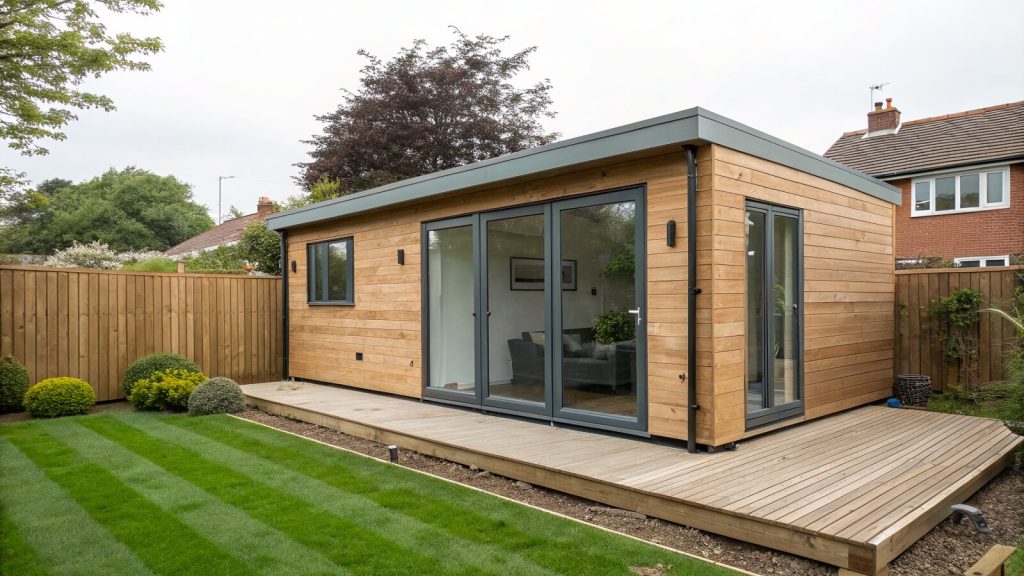
Two buyers want the same thing: a warm, dry, usable garden room for an office, gym or studio. One orders a flat-pack kit and assembles it over a few weekends. The other pays a company to turn up, build it and hand over the keys. The end result can look similar, but the route to get there is very different in effort, risk and cost. This guide sets out exactly what a garden room kit and a fully installed turnkey build each include, where the savings actually come from, and which choice fits which kind of buyer.
What each route actually includes
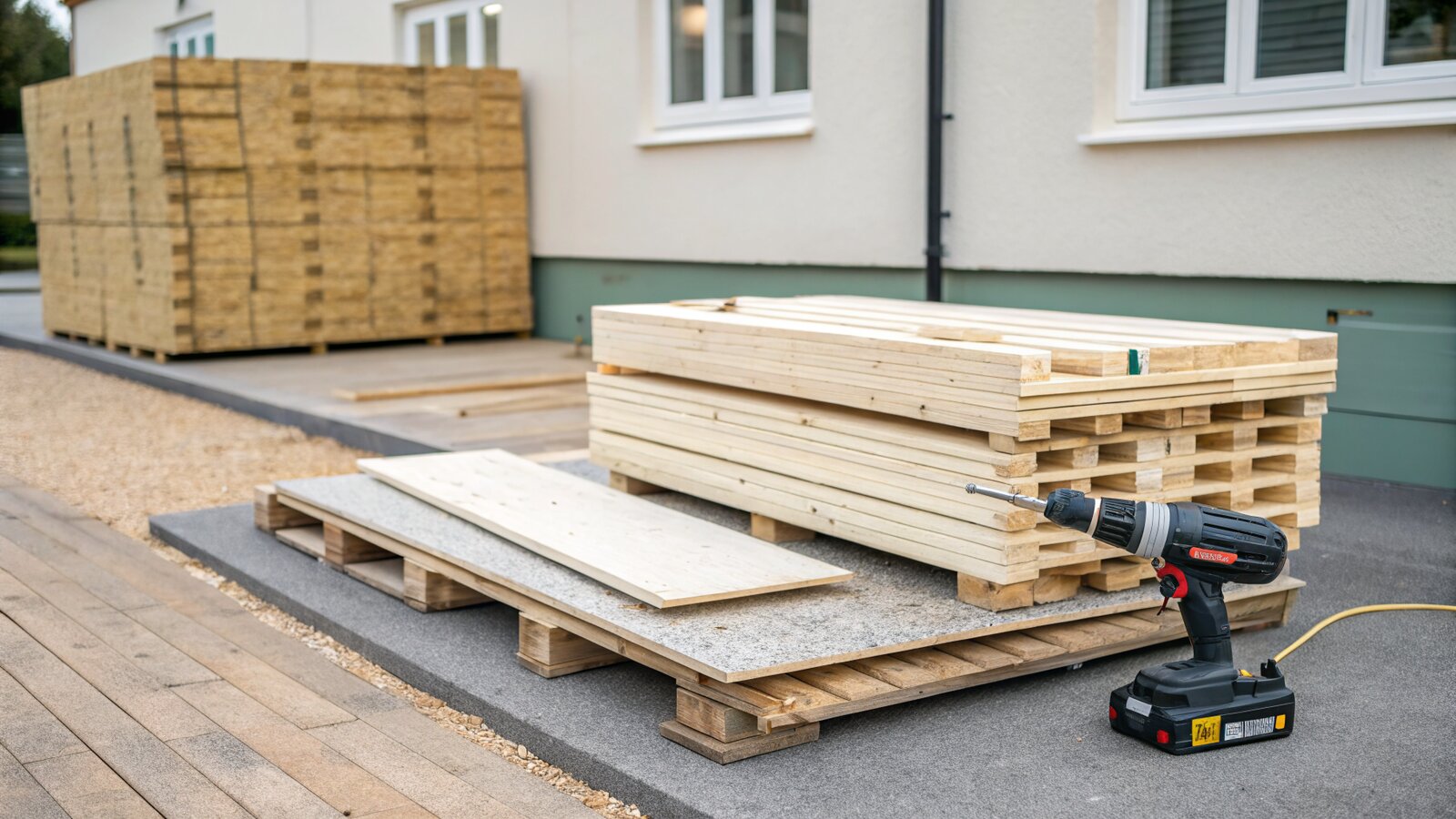
A garden room kit is a supply-only package. You receive the structural components, usually pre-cut timber frame sections or a SIPs (structurally insulated panel) shell, cladding, a roof system, doors, glazing and often insulation, delivered to your driveway on a pallet. From that point everything is your responsibility: laying the base, assembling the structure, weatherproofing it, fitting out the inside and arranging power. Some kits are genuinely comprehensive; others are little more than a frame and a cladding pack, so the spec sheet matters enormously.
A fully installed (turnkey) garden room is a managed project. The company surveys your garden, supplies the building, prepares the base, erects the structure, installs the electrics through a qualified electrician, fits insulation and internal finishes, and hands over a finished room you can plug into and use. You are buying a result rather than a box of parts.
The headline difference is labour and coordination. A kit shifts both onto you. A turnkey build keeps them with the supplier, and that is precisely what you pay extra for.
The skills, tools, time and help a kit really demands
Garden room kits are marketed as accessible, and some panel systems do go up quickly. The honest picture is that a self-build is a serious carpentry and construction project, not flat-pack furniture. You are working to fine tolerances on a structure that has to stay square, level, watertight and warm for decades.
Realistically you need to be confident with:
- Setting out and getting a base dead level and square, because every later stage depends on it.
- Timber framing, fixing cladding, and cutting and detailing around openings.
- Installing a breather membrane, flashings and a roof covering so water cannot track in at junctions.
- Fitting insulation correctly and managing vapour control to avoid condensation and damp.
- Hanging doors and setting glazing so they seal and operate properly.
You will want a decent tool kit: a mitre or circular saw, a good drill driver, a long spirit level or laser level, clamps and safe access equipment. Most kits are not a solo job. Panels and large glazed doors are heavy and awkward, so plan for at least one capable helper, and two or three for lifting wall panels or roof sections. A straightforward small kit might take an experienced pair several full weekends; a larger build, or a first attempt, can stretch much longer once weather, fit-out and snagging are added in.
Foundations and base prep: whose job is it?
With a kit, the base is almost always your problem, and it is the part most self-builders underestimate. The structure will only ever be as good as what it sits on. Common options are a concrete slab, a screw-pile and timber frame system, or an engineered ground-screw base. Each has to be level, load-bearing and able to keep the building off wet ground. Get it wrong and you inherit doors that will not close, sloping floors and long-term moisture problems.
A turnkey installer normally includes base design and construction in the price, sizes it for the building and the ground conditions, and takes responsibility if it fails. If your garden has a slope, soft soil, tree roots or poor drainage, that transfer of responsibility is worth a lot.
Electrics: a qualified electrician, not a DIY job
This is the single clearest dividing line, and it is not a matter of preference. Running a new electrical circuit out to a garden room is notifiable work under Part P of the Building Regulations in England and Wales, and the installation must meet BS 7671, the national wiring standard. Part P covers a home and its garden and outbuildings, so a garden room is firmly inside its scope.
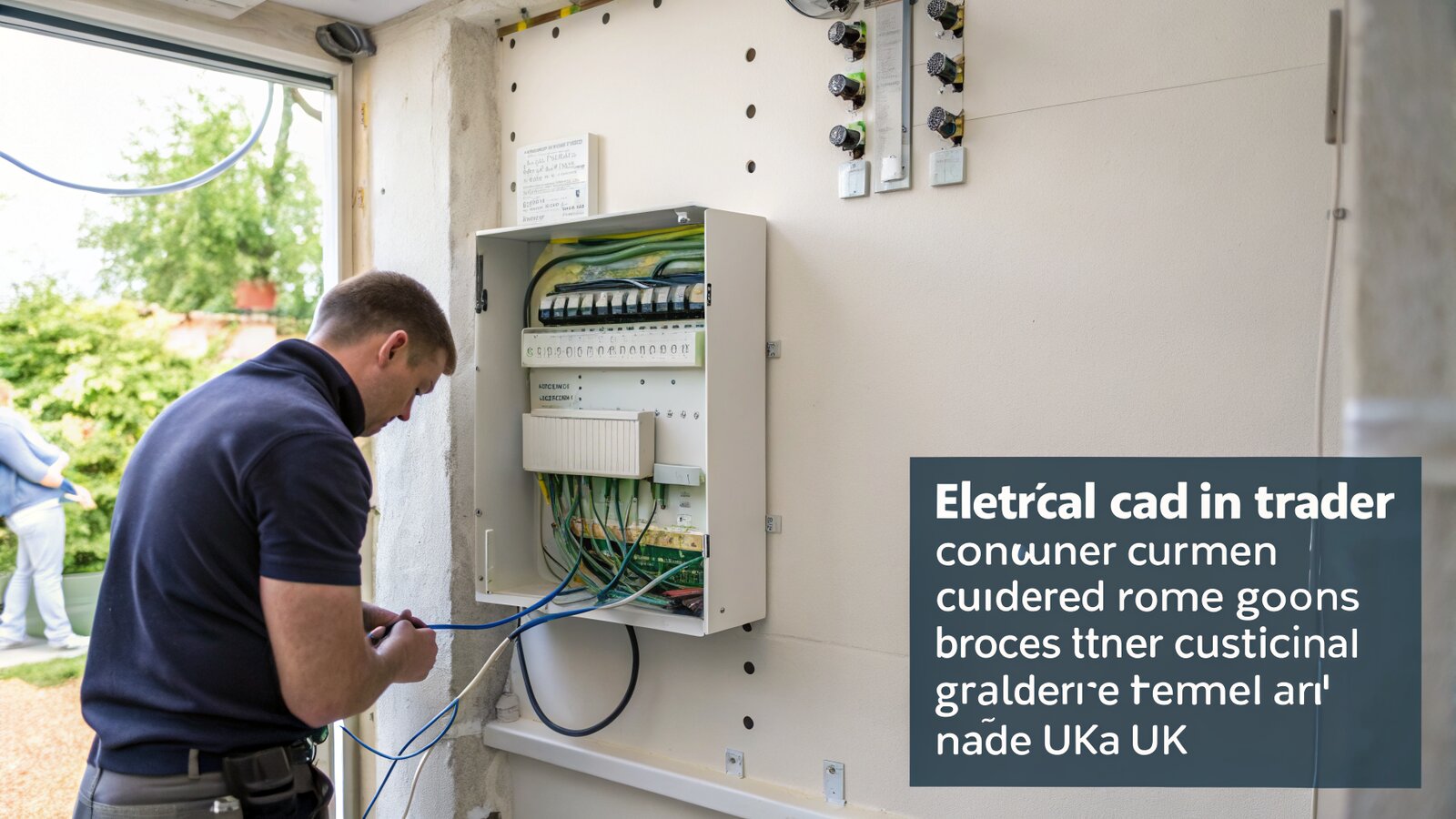
That means the work has to be done by an electrician registered with a competent person scheme (such as NICEIC or NAPIT) who can self-certify it, or it must be notified to your local authority building control before it starts. The electrician should issue a BS 7671 electrical installation certificate on completion. Electrical Safety First sets this out plainly in its guidance on Part P of the Building Regulations.
So even on a kit self-build, the electrics are not a corner you can cut with DIY. A turnkey supplier folds a qualified electrician and the certification into the project. A kit buyer has to source, schedule and pay one separately, and keep the certificate safe for resale and insurance.
Insulation and weatherproofing: where quality gaps appear
A garden room you can use in January is defined by its insulation and its detailing, not its cladding. A reputable turnkey installer builds the same warm-roof and insulated-floor-and-wall spec on every job, with the membranes, flashings and junctions detailed by people who do it weekly. A kit can match that, but only if it is specified well and you execute the details correctly. The risks sit in the gaps: a membrane lapped the wrong way, a flashing left short, a thermal bridge at a junction, or insulation stuffed in rather than fitted snugly. None of these show on day one; they show up as a cold room, damp patches or mould a winter or two later. If you self-build, study the weatherproofing and vapour-control details as hard as the frame.
The real cost gap, and the hidden costs
A kit is cheaper on paper, sometimes substantially, and almost all of that saving is labour you are no longer paying for. That is genuine money saved if you have the skills and time. The risk is treating the kit price as the finished price, because a self-build carries costs the headline figure leaves out:
- The base: groundworks, concrete or ground screws, and any drainage or levelling.
- A qualified electrician for the supply, circuit, certification and any consumer-unit work.
- Internal fit-out: plasterboard or lining, flooring, decorating, and any heating.
- Tool hire or purchase, skip hire and waste disposal.
- Delivery, and the cost of fixing mistakes, which can erase the saving fast.
A turnkey quote bundles most of this into one figure. It is dearer, but it is closer to a true all-in cost with far less to go wrong. Add up the kit honestly before you assume it wins on price, and value your own weekends realistically.
Warranty and liability: who carries the risk?
On a turnkey build, one company is accountable for the whole thing. If the base sinks, a wall leaks or the room runs cold, you have a single point of contact and, usually, a structural and workmanship guarantee covering the finished building. That single line of responsibility is a large part of the value.
With a kit, responsibility is split. The supplier warrants the components against manufacturing defects, but not how you put them together. If a leak comes from the way you detailed a flashing rather than a faulty part, that is on you. Spread the work across a kit supplier, a separate groundworker and a separate electrician and you can end up with each party pointing at the others. Keep every certificate, receipt and instruction, because they matter if you sell or claim.
Planning and building regs apply either way
Buying a kit does not exempt you from the rules; the building still has to comply however it is built. Most garden rooms are put up under permitted development, which keeps them within set limits: single storey, a maximum eaves height of 2.5 metres, and a maximum overall height of 4 metres for a dual-pitched roof or 3 metres for any other roof. If any part of the building sits within 2 metres of a boundary, the total height is capped at 2.5 metres. It must not be forward of the principal elevation of the house, and outbuildings must not cover more than half the land around the original house. Designated areas such as conservation areas, National Parks and Areas of Outstanding Natural Beauty have tighter rules, and a garden room cannot be used as self-contained living accommodation under permitted development.
Building regulations are separate. An outbuilding under 15 square metres of internal floor area with no sleeping accommodation does not normally need approval. Between 15 and 30 square metres it is still usually exempt, provided there is no sleeping accommodation and it sits at least one metre from any boundary or is built substantially of non-combustible materials. Add sleeping accommodation, or go over 30 square metres, and building regulations come into play. The official position is on the Planning Portal pages on building regulations for outbuildings. A good turnkey supplier designs within these limits as standard; as a kit buyer you have to check them yourself before you order. For a wider view of buying, planning and building garden rooms, see our garden room guides.
The verdict: who each route suits
A kit suits a confident, practical builder with the right tools, a willing helper or two, time across several weekends, and a realistic plan for the base and a qualified electrician. If that is you, the labour saving is real and a self-build can be very satisfying.
A fully installed turnkey build suits almost everyone else: anyone short on time, construction skills or appetite for risk, anyone with a tricky sloping or soft garden, and anyone who values a single point of responsibility and a guaranteed result over saving on labour. You pay more, but you buy out the hard parts and the liability. Be honest about your skills, your time and your tolerance for things going wrong, and the right answer becomes clear.
Frequently asked questions
Can I do the electrics in my garden room myself?
No. A new circuit supplying a garden room is notifiable work under Part P of the Building Regulations in England and Wales and must meet BS 7671. It has to be carried out by an electrician registered with a competent person scheme who can self-certify it, or notified to building control beforehand. This applies whether you self-build a kit or buy turnkey.
Is a garden room kit actually cheaper than a fully installed one?
The kit price is lower, mainly because you are not paying for labour. But the finished cost has to include the base, a qualified electrician, internal fit-out, tools, waste disposal and the cost of any mistakes. Once those are added, the gap narrows. Price the whole job, not just the box of parts.
Do I need planning permission or building regs for a garden room kit?
The rules apply however the room is built. Most garden rooms go up under permitted development within set height, position and coverage limits. Building regulations do not normally apply below 15 square metres, and usually not between 15 and 30 square metres with no sleeping accommodation and the right boundary distance or non-combustible construction. Sleeping use or going over 30 square metres triggers building regs.
How long does a self-build kit take compared with a turnkey install?
A kit can be delivered in a few weeks, but the build then runs at the pace of your weekends, the weather and your tradespeople. A turnkey installer often has a longer wait for a slot, but the actual build is usually a matter of days to a couple of weeks once it starts.
Who is responsible if a kit-built garden room leaks or runs cold?
You are, if the fault is in how you assembled it rather than a defective component. Kit suppliers warrant the parts, not your workmanship. With a turnkey build, one company carries responsibility for the whole structure and its guarantee, which is a major reason people pay the premium.
What base does a garden room kit need?
It needs a level, load-bearing base that keeps the building off wet ground, commonly a concrete slab, a screw-pile timber base or engineered ground screws. With a kit this is your responsibility, and it is the most common thing self-builders underestimate. A turnkey supplier normally designs and builds the base as part of the project.
Related guides
- Garden Room Planning Permission UK: The 30m² and 50% Rules Explained
- How Much Does a Garden Room Cost to Run in Winter? Real UK Figures
- Garden Room vs Extension: Honest Cost, Value and When Each Wins
- How Much Does It Cost to Run Electrics to a Garden Room in 2026?
- Ground Screws vs Concrete Base: Which Garden Room Foundation Is Right for You?
- Do Garden Rooms Need Building Regulations? The 15, 30 and 1m Rules Explained
- Prefab vs Bespoke Garden Rooms: Which Is Right for You?
- Garden Room Buying Mistakes: 12 Costly Errors to Avoid
- Garden Room News: June 2026
- How to Buy a Garden Room: The Complete UK Buyer’s Guide (2026)
- What to Look for in a Garden Room: 15 Things to Check Before You Buy
- Buying a Second-Hand Garden Room: Is It Worth It?
- Garden Room Deposits, Contracts and Deliverables: Protecting Your Money
- How Long Does a Garden Room Last? Lifespan and Maintenance
- Garden Room Cost Per Square Metre: 2026 UK Rates Explained
- How Much Does a Garden Room Cost in the UK? (2026 Price Guide)
- Garden Room Prices by Size: From 3x3m to 8x4m and Beyond
- How Much Does a Garden Office Cost? (2026 UK Breakdown)
- Garden Room Planning News: Late June 2026
- How Much Does a Garden Room with a Bathroom Cost?
- Hidden Garden Room Costs: Foundations, VAT and the Extras Quotes Miss
- Garden Room Finance: Loans, Mortgages and Payment Options Explained
- Garden Room News: Early July 2026
- Do Garden Rooms Add Value to Your House? What the UK Resale Data Shows
- Permitted Development Rights for Garden Rooms: Size, Height and the 2m Boundary Rule
- Do Garden Rooms Affect Council Tax? Business Rates and Reassessment
- Garden Room News: Mid-July 2026
- How a Garden Room Is Built: Foundations to Finish (UK Guide)
- SIPs vs Timber Frame Garden Rooms: Which Construction Is Better?
- How Close to a Boundary Can a Garden Room Be? UK Rules Explained
- How to Apply for Garden Room Planning Permission: Step by Step
- Can You Build a Garden Room on Decking, Slabs or a Patio?
- Is a Garden Room Cheaper Than an Extension? 2026 Cost Comparison
- Garden Room News: Mid-July 2026
- Garden Room Cladding: Cedar vs Composite vs Larch vs Render
- Garden Room Roof Guide: Flat vs Pitched and the Best Materials
- Garden Room Windows and Doors: Bifold, Sliding and Glazing
- How to Build a Garden Room: A DIY Step-by-Step Guide (UK)
- How Long Does It Take to Build a Garden Room?
- How to Make a Garden Room Usable All Year Round
- Garden Room Insulation: Best Materials and U-Values for the UK
- How to Heat a Garden Room: 9 Options Compared by Cost and Warmth
- Best Heating for a Garden Office: Warm Without a Huge Bill
- Air Conditioning for Garden Rooms: Cooling and Heating in One
- Stopping Condensation and Damp in a Garden Room (UK Guide)
- How to Get Wi-Fi in a Garden Office: 6 Ways That Actually Work
- Garden Office Ideas: Designing the Perfect Work-From-Home Space
- Garden Room Ideas: 20 Popular Uses to Inspire Your Build
- Garden Room Annexe: Rules, Costs and How to Build One
- Garden Bar Ideas: The Height Rules, Power and Layout
- Garden Room Business: What Changes Once Clients Visit
- Garden Studio Ideas: Sizes, Light and the 2.5m Rule
- Garden Room Lighting: IP20 Inside, IP65 Out, Part P Rules
- Landscaping Around a Garden Room: the 30cm Decking Trap
- Garden Room Design: Why 2.5m Decides Everything
- Garden Room Planning Permission: the 2.5m Boundary Rule
- Garden Room News: New NPPF Lands, PD Rules Unchanged
- Garden Saunas UK: Planning, Building Regs and Electrics
- Best Garden Room Companies UK: Guarantees of 10 to 25 Years
- Garden Room Electrics: The Rules Change on 15 Oct 2026
- Golf Simulator Garden Room: The 2.5m Rule That Stops It
- Garden Screens: the 2m Rule, and Why Trellis Counts
- Cheap Garden Rooms: What 19mm Walls Really Get You
- Green Retreats Review: 12-Year Cover, 60% Upfront
- Booths Garden Studios Review: Steel Build, 25 Years
- Eden Garden Rooms Review: £23,500 Start, 10-Year Cover
- Green Retreats vs Booths: 25-Year Steel or Timber?
- Garden Rooms London: 6 Companies and the 2.5m Limit
- Garden Room Bedroom: Why a Bed Changes the Rules
- Do I Need Planning Permission for a Garden Shed? Usually Not
- Garden Room News: Staged Payments Arrive, Timber Stays Dear
- Garden Gym Ideas: Sizes, Ceilings and the 2.5m Height Rule
- Garden Gazebo Rules: 2.5m Near a Boundary, 4m Max
- Garden Arch: Wood or Metal, and the 2.7m Height Rule
- Garden Arbour: Sizes That Seat Two, and Wood vs Metal
- Wooden Garden Gates: Sizes, UC4 Posts and the 1m Rule
- Garden Room News: Rates Held, Materials Up 5.9%
- Summer House Interior Ideas: 9 That Work in Winter