

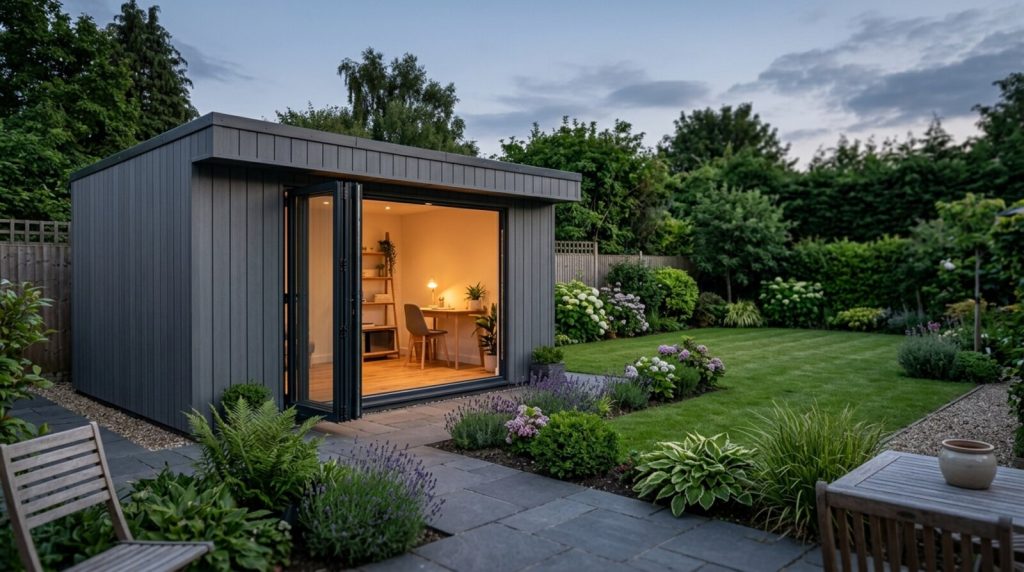
A garden room is a significant purchase, often costing as much as a small extension, yet the market is full of structures that look identical in a brochure but perform nothing alike once the temperature drops. The difference between a building you use every day of the year and one that sits empty from October to March usually comes down to specifications the salesperson never volunteers. This checklist walks through the 15 things worth confirming in writing before you hand over a deposit, with the UK planning and building regulation figures that actually apply.
Structure and build quality
1. Insulation specification and U-values
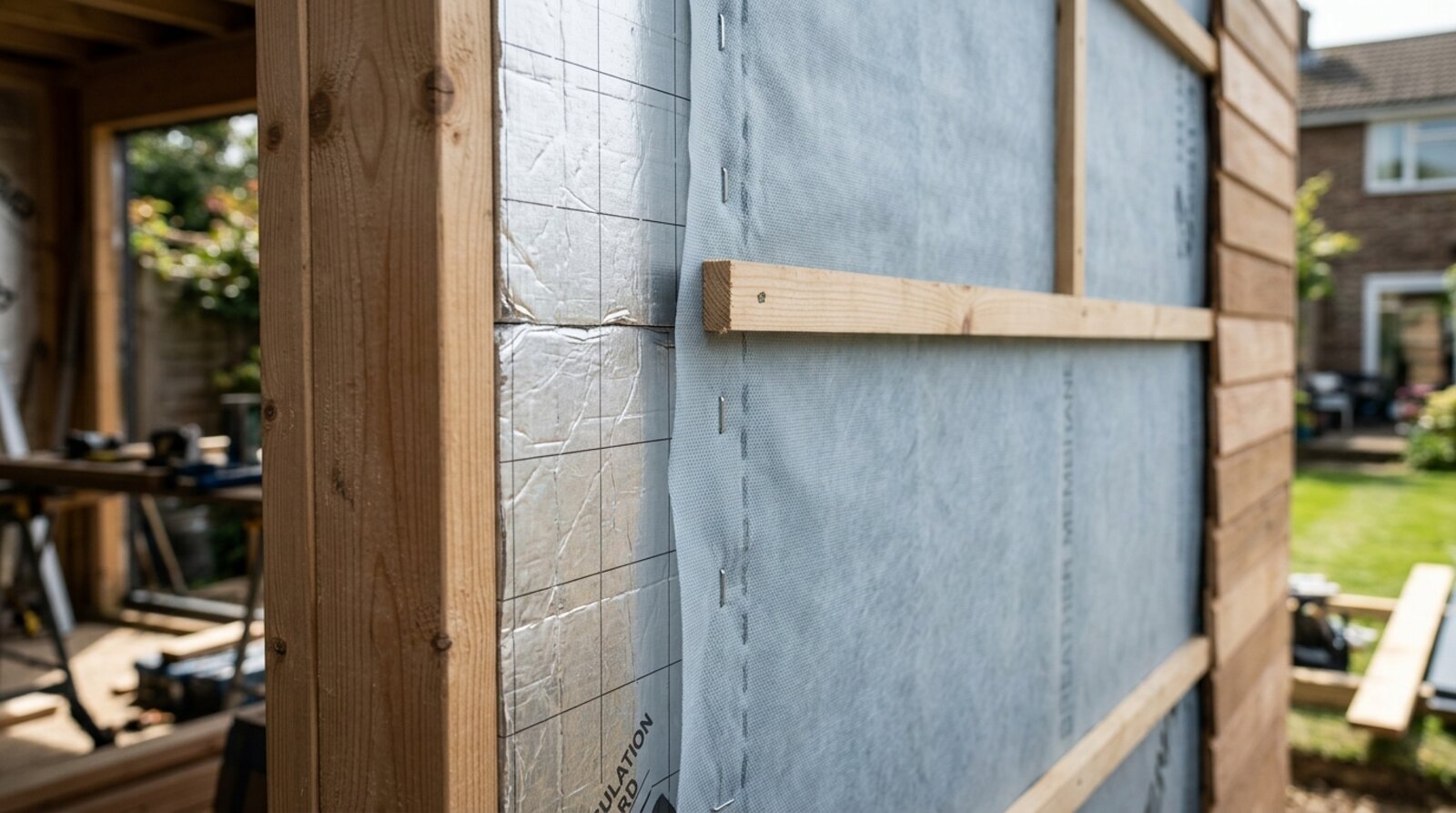
Insulation is the single biggest factor in whether a garden room is usable in winter. Ask for the U-value of the walls, floor and roof, not just the thickness of the insulation. A U-value measures heat loss, and lower is better. As a rough guide, walls and roofs that comply with current new-build standards sit around 0.18 to 0.20 W/m2K, and a well-built garden room should aim to be in that territory rather than far above it. Be wary of any quote that only states “fully insulated” without numbers. The insulation type matters too: rigid PIR or PUR boards and structural insulated panels outperform basic mineral wool for a given thickness.
2. The wall system: SIPs versus timber frame
Most UK garden rooms use either a traditional studded timber frame packed with insulation or structural insulated panels (SIPs), where a rigid insulation core is bonded between two boards. SIPs tend to give a stronger thermal performance for a slimmer wall and reduce cold bridging, where heat escapes through the timber studs. A good timber frame can still perform very well if the studs are deep and the insulation is continuous. What you want to avoid is a thin frame with a single layer of low-grade insulation. Ask exactly how thick the wall build-up is and what sits inside it.
3. Glazing, U-values and bifold quality
Glazing is often the weakest point in the envelope. Look for at least double glazing with a thermally broken aluminium or uPVC frame, and ask for the window U-value (good units sit near 1.2 to 1.4 W/m2K). If bifold or sliding doors are part of the design, the brand and gasket quality matter as much as the glass. Cheap bifolds can drop, stick and leak draughts within a couple of years. Argon-filled units and a low-emissivity coating help considerably.
4. Cladding material and maintenance
Cladding sets the look but also the upkeep. Western red cedar weathers to a silver-grey and needs little maintenance, though it costs more. Treated softwood (such as larch or thermowood) is cheaper but may need recoating. Composite and fibre-cement cladding are close to maintenance-free but read differently. Ask what the cladding is, whether it needs annual treatment, and what the substructure behind it is made of. A handsome finish over a poor frame is a false economy.
5. Roof type and water management
Most garden rooms have a flat or very low-pitch roof finished with EPDM rubber, fibreglass (GRP) or a single-ply membrane. EPDM is durable and commonly carries long guarantees. Check there is a clear fall to move water off the roof, that guttering and a downpipe are included, and where the water actually drains to. Standing water and missing gutters are a common source of early failure and damp.
Foundations, services and comfort
6. Foundations: ground screws versus concrete
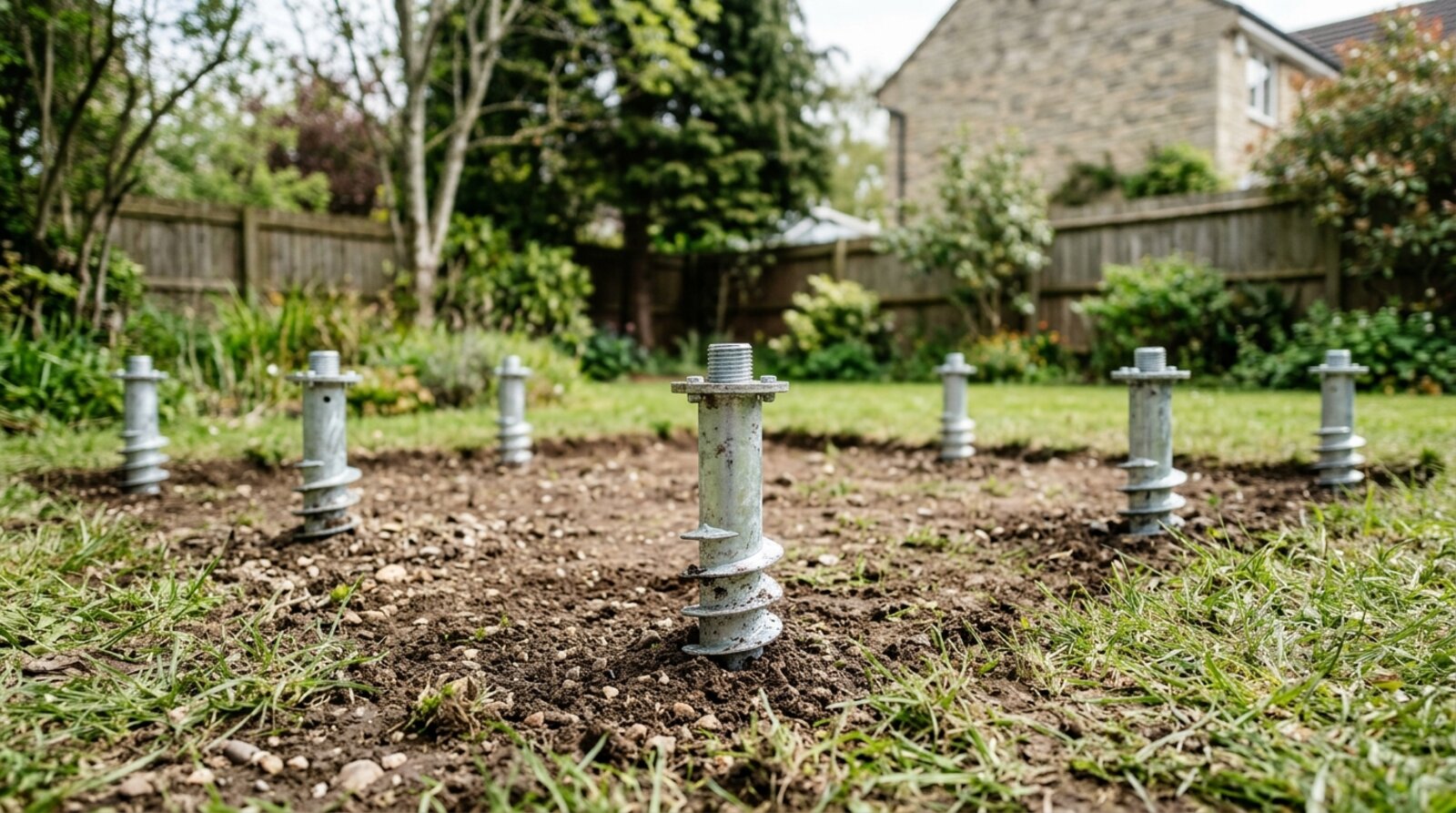
The base carries everything above it. Galvanised ground screws are quick to install, cause little mess and suit most gardens, while a concrete slab or pad foundations may be better on sloping or unstable ground. Either can be sound when done properly. Ask which the company recommends for your specific site, how the building is fixed down, and whether the ground will be surveyed first. A base that is undersized or poorly levelled will telegraph problems into the floor and doors.
7. Site suitability and access for delivery
Before any of this matters, the building has to reach your garden. Confirm how the units or panels arrive and how they get from the road to the install spot. A narrow side return, a locked rear access, overhead cables or a long carry can all add cost or rule out a flat-pack delivery entirely. A reputable supplier will carry out a site survey and flag access issues in writing rather than discovering them on install day.
8. Electrics and Part P sign-off
Running power to a garden room is notifiable work under the building regulations. The new circuit and any consumer unit in the building must comply with Part P and the wiring standard BS 7671, and the work should be carried out or certified by an electrician registered with a government-approved competent person scheme. You should receive an Electrical Installation Certificate. The IET sets out how Part P applies in England and Wales on its Part P FAQ pages. Confirm who supplies and certifies the electrics, and whether the price includes the armoured cable run from your house.
9. Heating and cooling for year-round use
A well-insulated room needs surprisingly little heating, but it still needs some. Ask what is included and what is extra. Electric panel heaters are simple, while an air-source heat pump (air conditioning unit) is more efficient and adds cooling for summer, which a south-facing glazed room will need. Underfloor heating is comfortable but is best decided before the floor goes down. Match the heating to how you intend to use the space.
10. Internal head height
Planning rules cap the external height, which squeezes the inside. Once the roof build-up and floor are accounted for, internal head height can be tighter than you expect. Ask for the finished internal ceiling height, not the external. Anything under about 2.3 metres can feel low, especially in a deeper room. This is also where the permitted development height limits below start to bite.
Planning, regulations and the company
11. Planning permission and permitted development limits
Many garden rooms are built under permitted development, meaning no planning application is needed, but only if they stay within the limits. According to the Planning Portal, an outbuilding must be single storey with a maximum eaves height of 2.5 metres and a maximum overall height of 3 metres for a flat roof or 4 metres for a dual-pitched roof. Crucially, if the building sits within 2 metres of a boundary, its total height must not exceed 2.5 metres. Outbuildings and other additions must not cover more than half the area of land around the original house, and verandas, balconies and raised platforms are not allowed. Different rules apply in conservation areas, on listed properties and where an Article 4 direction is in force, so check your own situation rather than assuming.
12. Building regulations thresholds
Permitted development and building regulations are separate things, and a building can be exempt from one but not the other. The building regulations generally do not apply to an outbuilding with a floor area under 15 square metres that contains no sleeping accommodation. Between 15 and 30 square metres, approval is usually not needed provided there is no sleeping accommodation and the building is either at least 1 metre from any boundary or built substantially from non-combustible materials. Anything over 30 square metres, or any building with sleeping accommodation, will need to comply. If you intend to use the room as an occasional bedroom or annexe, factor compliance in from the start.
13. Warranty length and what it actually covers
Garden room warranties range widely, and the headline number tells you little on its own. A “10-year warranty” might cover only the structural frame while excluding glazing, cladding finish, the roof membrane and electrics. Ask for the warranty in writing and read what is included, what is excluded, and whether it is insurance-backed so it survives the company going out of business. A guarantee from a firm that may not exist in three years is worth very little.
14. Company track record and deposit protection
The garden room sector has its share of firms that take a deposit and disappear. Before paying anything, check how long the company has traded, read independent reviews, and ask to see completed installations or speak to recent customers. Keep the upfront deposit reasonable, get a written contract that sets out the specification, payment stages and a completion date, and pay by a method that gives you some protection. Staged payments tied to delivery and install milestones are safer than a large sum paid in advance.
15. Lead time and what the price includes
Quoted lead times can stretch from a few weeks to several months depending on demand and whether the build is bespoke. Get the lead time in writing and ask what could delay it. Just as important, pin down exactly what the headline price includes: base and groundworks, delivery, installation, electrics, decoration, flooring and VAT. Comparing two quotes is only meaningful once you know they cover the same scope. The cheapest figure on paper is often the one with the most exclusions.
Work through these 15 checks and you will quickly separate the suppliers selling a genuine all-year building from those selling a summerhouse with better marketing. For more buying guides and comparisons, visit the Best Garden Room homepage.
Frequently asked questions
Do I need planning permission for a garden room?
Often not. Most garden rooms can be built under permitted development if they stay within the limits: single storey, maximum eaves height of 2.5 metres, maximum overall height of 3 metres for a flat roof or 4 metres for a dual-pitched roof, and no more than 2.5 metres total height if within 2 metres of a boundary. They also must not cover more than half the land around the original house. Conservation areas, listed buildings and Article 4 areas have tighter rules, so always check with your local planning authority.
What U-value should a good garden room have?
Aim for walls and roof around 0.18 to 0.20 W/m2K and glazing near 1.2 to 1.4 W/m2K, broadly in line with current new-build standards. A building at or near these figures will hold heat well and stay usable in winter. Treat any quote that refuses to give U-values, and only says “fully insulated”, with caution.
Do garden rooms need building regulations approval?
Not always. A garden building under 15 square metres with no sleeping accommodation is generally exempt. Between 15 and 30 square metres it is usually exempt too, provided it has no sleeping accommodation and is either at least 1 metre from a boundary or built mainly from non-combustible materials. Buildings over 30 square metres, or any used for sleeping, must comply with building regulations.
Are ground screws better than a concrete base?
Neither is universally better. Ground screws are fast, low-mess and suit most level gardens, while a concrete slab or pad foundation can be the safer choice on sloping or soft ground. The right answer depends on your soil and site, so ask the supplier to assess the ground and recommend a base rather than applying a one-size-fits-all approach.
Does the electrical work need certifying?
Yes. Running a new circuit to a garden room is notifiable work and must meet Part P of the building regulations and the wiring standard BS 7671. The work should be done or certified by an electrician registered with a government-approved competent person scheme, and you should be given an Electrical Installation Certificate when it is complete.
How much deposit should I pay upfront?
Keep it modest and use staged payments tied to delivery and installation rather than paying a large sum in advance. Check the company’s trading history and reviews first, get a written contract setting out the specification and completion date, and pay by a method that offers some buyer protection in case anything goes wrong.
Related guides
- Garden Room Planning Permission UK: The 30m² and 50% Rules Explained
- How Much Does a Garden Room Cost to Run in Winter? Real UK Figures
- Garden Room vs Extension: Honest Cost, Value and When Each Wins
- How Much Does It Cost to Run Electrics to a Garden Room in 2026?
- Ground Screws vs Concrete Base: Which Garden Room Foundation Is Right for You?
- Do Garden Rooms Need Building Regulations? The 15, 30 and 1m Rules Explained
- Prefab vs Bespoke Garden Rooms: Which Is Right for You?
- Garden Room Buying Mistakes: 12 Costly Errors to Avoid
- Garden Room News: June 2026
- How to Buy a Garden Room: The Complete UK Buyer’s Guide (2026)
- Buying a Second-Hand Garden Room: Is It Worth It?
- Garden Room Kits vs Fully Installed: Should You Self-Build or Buy Turnkey?
- Garden Room Deposits, Contracts and Deliverables: Protecting Your Money
- How Long Does a Garden Room Last? Lifespan and Maintenance
- Garden Room Cost Per Square Metre: 2026 UK Rates Explained
- How Much Does a Garden Room Cost in the UK? (2026 Price Guide)
- Garden Room Prices by Size: From 3x3m to 8x4m and Beyond
- How Much Does a Garden Office Cost? (2026 UK Breakdown)
- Garden Room Planning News: Late June 2026
- How Much Does a Garden Room with a Bathroom Cost?
- Hidden Garden Room Costs: Foundations, VAT and the Extras Quotes Miss
- Garden Room Finance: Loans, Mortgages and Payment Options Explained
- Garden Room News: Early July 2026
- Do Garden Rooms Add Value to Your House? What the UK Resale Data Shows
- Permitted Development Rights for Garden Rooms: Size, Height and the 2m Boundary Rule
- Do Garden Rooms Affect Council Tax? Business Rates and Reassessment
- Garden Room News: Mid-July 2026
- How a Garden Room Is Built: Foundations to Finish (UK Guide)
- SIPs vs Timber Frame Garden Rooms: Which Construction Is Better?
- How Close to a Boundary Can a Garden Room Be? UK Rules Explained
- How to Apply for Garden Room Planning Permission: Step by Step
- Can You Build a Garden Room on Decking, Slabs or a Patio?
- Is a Garden Room Cheaper Than an Extension? 2026 Cost Comparison
- Garden Room News: Mid-July 2026
- Garden Room Cladding: Cedar vs Composite vs Larch vs Render
- Garden Room Roof Guide: Flat vs Pitched and the Best Materials
- Garden Room Windows and Doors: Bifold, Sliding and Glazing
- How to Build a Garden Room: A DIY Step-by-Step Guide (UK)
- How Long Does It Take to Build a Garden Room?
- How to Make a Garden Room Usable All Year Round
- Garden Room Insulation: Best Materials and U-Values for the UK
- How to Heat a Garden Room: 9 Options Compared by Cost and Warmth
- Best Heating for a Garden Office: Warm Without a Huge Bill
- Air Conditioning for Garden Rooms: Cooling and Heating in One
- Stopping Condensation and Damp in a Garden Room (UK Guide)
- How to Get Wi-Fi in a Garden Office: 6 Ways That Actually Work
- Garden Office Ideas: Designing the Perfect Work-From-Home Space
- Garden Room Ideas: 20 Popular Uses to Inspire Your Build
- Garden Room Annexe: Rules, Costs and How to Build One
- Garden Bar Ideas: The Height Rules, Power and Layout
- Garden Room Business: What Changes Once Clients Visit
- Garden Studio Ideas: Sizes, Light and the 2.5m Rule
- Garden Room Lighting: IP20 Inside, IP65 Out, Part P Rules
- Landscaping Around a Garden Room: the 30cm Decking Trap
- Garden Room Design: Why 2.5m Decides Everything
- Garden Room Planning Permission: the 2.5m Boundary Rule
- Garden Room News: New NPPF Lands, PD Rules Unchanged
- Garden Saunas UK: Planning, Building Regs and Electrics
- Best Garden Room Companies UK: Guarantees of 10 to 25 Years
- Garden Room Electrics: The Rules Change on 15 Oct 2026
- Golf Simulator Garden Room: The 2.5m Rule That Stops It
- Garden Screens: the 2m Rule, and Why Trellis Counts
- Cheap Garden Rooms: What 19mm Walls Really Get You
- Green Retreats Review: 12-Year Cover, 60% Upfront
- Booths Garden Studios Review: Steel Build, 25 Years
- Eden Garden Rooms Review: £23,500 Start, 10-Year Cover
- Green Retreats vs Booths: 25-Year Steel or Timber?
- Garden Rooms London: 6 Companies and the 2.5m Limit
- Garden Room Bedroom: Why a Bed Changes the Rules
- Do I Need Planning Permission for a Garden Shed? Usually Not
- Garden Room News: Staged Payments Arrive, Timber Stays Dear
- Garden Gym Ideas: Sizes, Ceilings and the 2.5m Height Rule
- Garden Gazebo Rules: 2.5m Near a Boundary, 4m Max
- Garden Arch: Wood or Metal, and the 2.7m Height Rule
- Garden Arbour: Sizes That Seat Two, and Wood vs Metal
- Wooden Garden Gates: Sizes, UC4 Posts and the 1m Rule
- Garden Room News: Rates Held, Materials Up 5.9%
- Summer House Interior Ideas: 9 That Work in Winter