

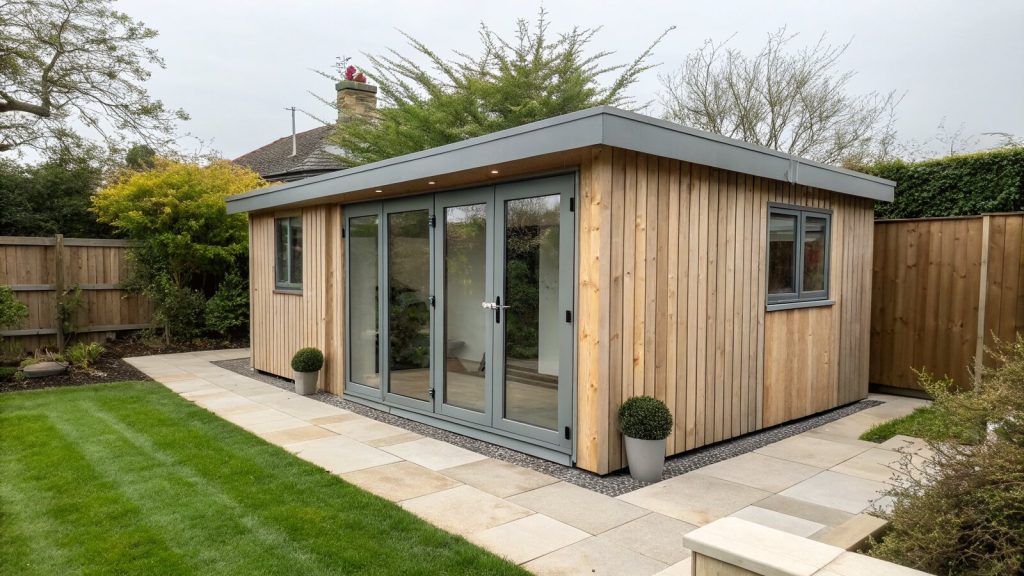
How long does a garden room last is worth asking before you spend, because the honest answer ranges from about 10 years to well over 30. A flat-packed summerhouse-grade timber building sits at the short end. A properly insulated timber-frame structure on engineered foundations, with a quality roof and durable cladding, sits at the long end. The gap is not luck: it comes down to a handful of components, how they are specified, and whether anyone looks after them once the installers have left.
This guide sets out realistic lifespan figures by build quality, names the parts that tend to fail first, explains what warranties actually cover, and lists the maintenance that quietly adds years. Where a figure is given, it is drawn from material manufacturers and trade sources rather than sales copy.
Typical lifespan by build quality
Garden buildings fall into three broad tiers, and lifespan tracks closely with how they are made.
- Budget (roughly 10 to 15 years): Lighter timber sections, thin cladding, basic felt roofing and often a simple paving-slab base. These are closer to a summerhouse than a year-round room, and the margins for neglect are small.
- Mid-range (roughly 20 to 30 years): A proper insulated timber frame, a breathable build-up, EPDM or fibreglass roofing, and a slab or screw-pile foundation. With sensible upkeep, this is where most homeowners end up.
- Premium (30 years and beyond): Engineered frame, high-grade insulation, long-life cladding such as cedar or fibre cement, a quality flat-roof membrane and foundations rated for decades. Several established UK makers quote a design life of 60 years or more for the structure when maintained.
The single biggest determinant is whether the building is a true insulated structure or a thin-walled shed dressed up to look like one. That difference is covered at the end.
The components that fail first
A garden room rarely fails as a whole. One part ages faster than the rest, lets water in, and damage spreads from there. These are the usual suspects, in roughly the order they cause trouble.
The flat roof membrane
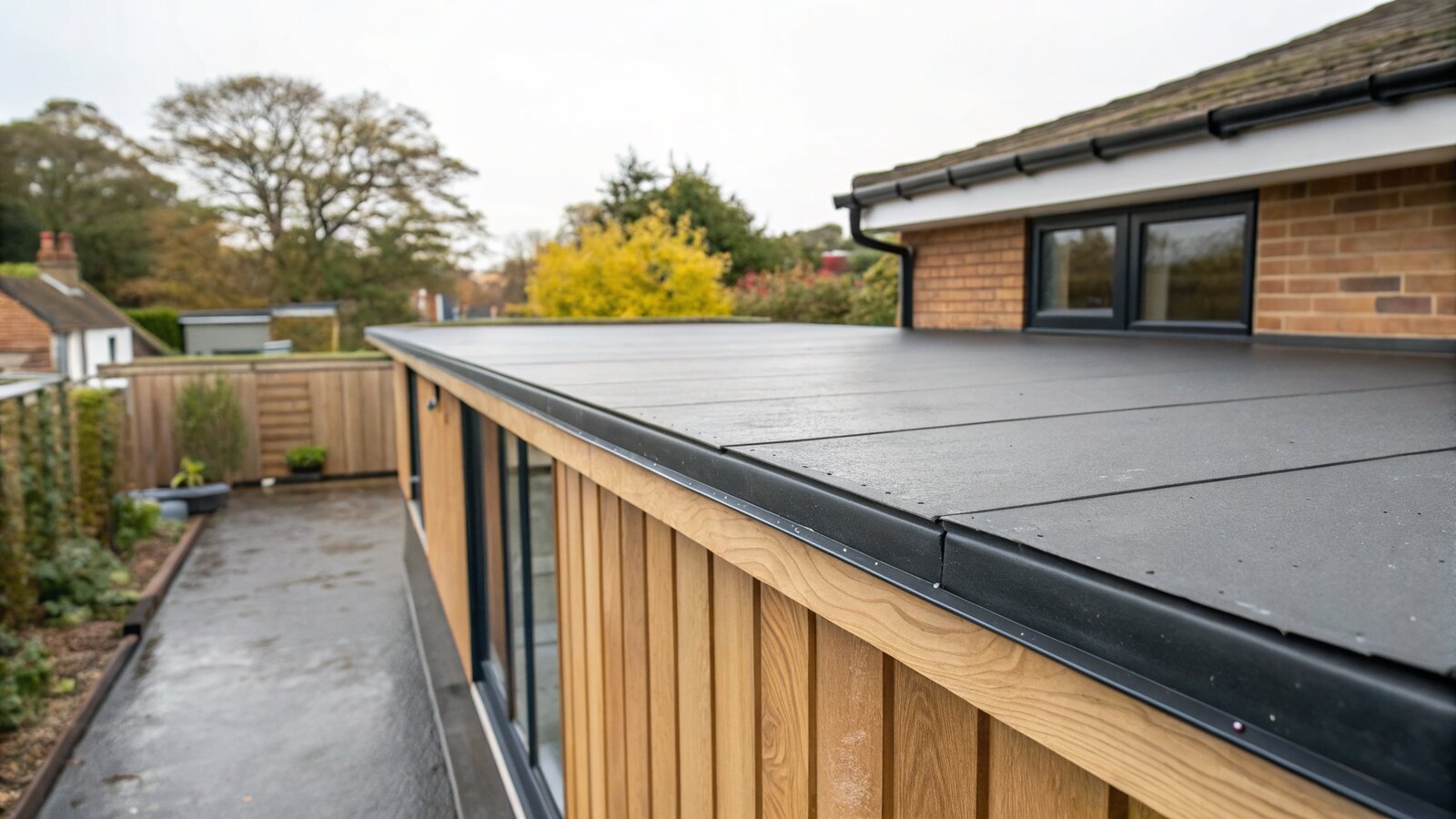
Most garden rooms have a flat or very low-pitch roof, so the covering works hardest. The two common quality options are EPDM rubber and GRP fibreglass.
- EPDM rubber: A correctly installed and maintained EPDM membrane has a life expectancy widely quoted at around 50 years by suppliers such as Rubber4Roofs, with installer-backed guarantees commonly running to about 20 years. It is a single sheet with few joints, which is part of why it lasts.
- GRP fibreglass: Kit guarantees are often a conservative 10 to 15 years, while the practical life with good installation is frequently 30 years or more. GRP is rigid and hard-wearing but more prone to hairline cracking than rubber if the deck below moves.
- Felt: Found on budget buildings. It is the weak link, typically needing replacement long before rubber or fibreglass, which is why it pulls the budget tier down.
Whatever the covering, ponding water, blocked outlets and lifted edges are what shorten its life, not the material itself.
Cladding
Cladding is cosmetic and protective at once. How long it lasts depends entirely on the type.
- Western red cedar: Naturally durable and well suited to the UK. Correctly detailed cedar cladding is widely cited at 40 to 60 years. Left untreated it weathers to a silver-grey, which is a finish, not a fault.
- Larch: Durable and cost-effective, though it weathers less evenly than cedar and can develop a more varied patina depending on sun and rain exposure.
- Composite and fibre cement: Lower maintenance and very long-lived. Fibre cement boards such as Cedral are quoted by suppliers with service lives beyond 50 years, and good composite carries long colour and shape guarantees.
- Painted softwood: The cheapest and the most demanding. It relies on regular recoating; skip that and it is usually the first thing to look tired.
Glazing seals and doors
Double-glazed units are durable, but the seals are not eternal. Failed units that mist internally are a common ageing sign at the 10 to 20 year mark. Aluminium frames outlast uPVC and timber for weather resistance. Glazing and door systems usually carry their own 5 to 10 year manufacturer warranties, separate from the building.
Foundations
Foundations rarely fail outright, but the wrong choice for the ground undermines everything above. Two options dominate.
- Concrete: A poured slab or piers last for decades with no maintenance and suit larger or heavier builds. The trade-off is excavation, spoil and curing time.
- Ground screws: Galvanised steel screws driven into the ground. Hot-dip galvanising to ISO 1461 gives a long design life, often quoted beyond 60 years, and many installers offer long performance guarantees. They suit sloping or awkward sites and avoid digging.
Both can outlast the building they support when matched to the soil. Problems come from skipping a ground assessment, not from the method.
What garden room warranties cover
A warranty is not a lifespan promise; it is the period the maker will fix specified faults for free. Cover is usually split by component, and the lengths vary.
- Structure: A 10-year structural guarantee is the common standard from established UK companies, covering manufacturing defects and structural failure under normal use. Some quote longer.
- Roof: Often 10 to 20 years depending on the system, with premium membranes attracting the longer end.
- Cladding: Natural timber tends to come with shorter cover, often 10 to 15 years, while high-grade composite can run to 25 years or more for colour and shape stability.
- Glazing and doors: Typically 5 to 10 years from the unit manufacturer.
- Workmanship: A separate installer guarantee, frequently 1 to 3 years.
Two questions matter more than the headline number. First, is it backed by anything if the company stops trading? An insurance-backed guarantee survives the firm going under; a paper promise does not. Second, what voids it? Most warranties require you to keep up basic maintenance, so neglecting the cladding or roof can quietly cancel your cover.
The maintenance that extends life
A mid-range room kept dry and ventilated will outlast a premium one that is ignored. None of this is difficult.
- Treat the cladding on schedule: Painted or oiled timber needs recoating; check the product interval. Cedar and larch can be left to silver if you prefer, but they still benefit from being kept clean.
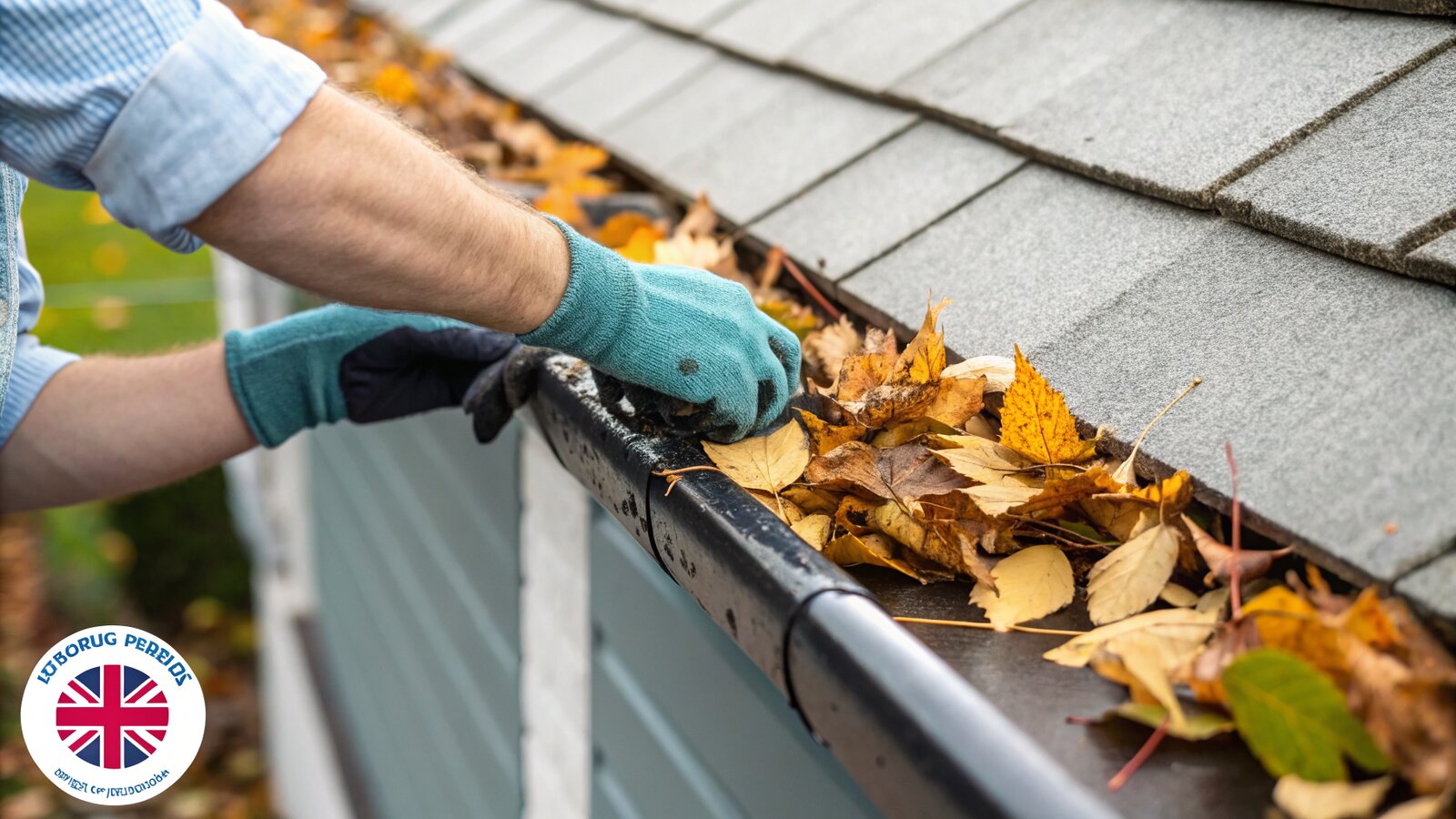
- Clear gutters and roof outlets: Leaves and moss block drainage, water sits, and a flat roof that ponds ages fast. A twice-yearly clear in autumn and spring is enough for most.
- Inspect the roof: Look for lifted edges, splits, cracks in GRP or debris on rubber. Small fixes done early stop a covering needing full replacement.
- Ventilate to control condensation: This is the one most owners get wrong. An insulated, airtight room with no air movement traps moisture, and condensation behind the lining causes damp and rot. Trickle vents, an occasional open window, or background mechanical ventilation keep the interior above dew point. A vapour control layer in the build-up does the same job from inside the wall.
- Check seals and fixings: Reseal around doors and windows when sealant perishes, and tighten anything that has worked loose.
For a quick overview of build quality, cladding choices and planning, the Best Garden Room homepage pulls together buying and build guidance in one place.
Signs your garden room is ageing
Catch these early and most are cheap fixes. Ignore them and they become the reason a building reaches the end of its life sooner than it should.
- Misted or condensation-filled double-glazed units (failed seals).
- Soft, spongy or discoloured timber, especially low down or near the roof edge (water ingress).
- Standing water on the roof hours after rain, or visible splits and lifts in the covering.
- A musty smell or black spotting on internal linings (poor ventilation and damp).
- Cladding that is cracking, cupping or shedding paint in sheets rather than weathering evenly.
- Doors and windows that stick or no longer close squarely (frame or foundation movement).
Why a quality insulated build lasts longer
The difference between a 12-year building and a 30-year one is mostly invisible once finished. A summerhouse-grade structure uses thin single-skin walls, little or no insulation, a basic roof and a simple base. It heats and cools quickly, sweats with condensation, and has no second line of defence when water finds a way in.
A quality insulated room is built more like a small house: a breathable wall build-up with insulation and a vapour control layer, a proper flat-roof membrane, durable cladding on battens with an air gap behind, and engineered foundations. That build-up manages moisture instead of trapping it, which is the real reason it lasts, and it stays usable year-round rather than becoming a damp store at the bottom of the garden.
One planning note: keeping a garden room within the Planning Portal outbuilding rules (single storey, eaves no higher than 2.5 metres, and not forward of the main house) usually means no planning application, but it has no bearing on how long the building lasts. Durability is set by specification and upkeep, not the planning route.
Frequently asked questions
How long does a garden room last on average?
A mid-range insulated garden room typically lasts 20 to 30 years with normal maintenance. Budget summerhouse-grade buildings sit nearer 10 to 15 years, while premium builds from established makers are often rated for a 60-year structural life when properly looked after.
What is the first part of a garden room to fail?
Usually the roof covering or the weakest cladding, because they take the most weather. Felt roofs and painted softwood show their age first. Failed double-glazing seals, which mist internally, are another common early sign at the 10 to 20 year mark.
How long does an EPDM rubber roof last on a garden room?
A correctly installed and maintained EPDM membrane is widely quoted at around a 50-year life expectancy, with installer-backed guarantees often running to about 20 years. GRP fibreglass kits often carry 10 to 15 year guarantees but commonly last 30 years or more in practice.
Do ground screws last as long as a concrete base?
Yes, in suitable ground. Galvanised steel ground screws are often quoted with a design life beyond 60 years thanks to hot-dip galvanising, comparable to concrete. The right choice depends on the soil and the building weight, so a ground assessment matters more than the method.
What maintenance makes a garden room last longer?
Keep the cladding treated to its schedule, clear gutters and roof outlets twice a year, inspect the roof covering for splits or ponding, and ventilate to stop condensation. Neglecting these is also a common way to void a warranty.
What warranty should a garden room come with?
Expect a 10-year structural guarantee as a baseline, 10 to 20 years on the roof, shorter cover on natural timber cladding, 5 to 10 years on glazing, and a separate workmanship guarantee. Check whether it is insurance-backed so it survives the company closing.
Related guides
- Garden Room Planning Permission UK: The 30m² and 50% Rules Explained
- How Much Does a Garden Room Cost to Run in Winter? Real UK Figures
- Garden Room vs Extension: Honest Cost, Value and When Each Wins
- How Much Does It Cost to Run Electrics to a Garden Room in 2026?
- Ground Screws vs Concrete Base: Which Garden Room Foundation Is Right for You?
- Do Garden Rooms Need Building Regulations? The 15, 30 and 1m Rules Explained
- Prefab vs Bespoke Garden Rooms: Which Is Right for You?
- Garden Room Buying Mistakes: 12 Costly Errors to Avoid
- Garden Room News: June 2026
- How to Buy a Garden Room: The Complete UK Buyer’s Guide (2026)
- What to Look for in a Garden Room: 15 Things to Check Before You Buy
- Buying a Second-Hand Garden Room: Is It Worth It?
- Garden Room Kits vs Fully Installed: Should You Self-Build or Buy Turnkey?
- Garden Room Deposits, Contracts and Deliverables: Protecting Your Money
- Garden Room Cost Per Square Metre: 2026 UK Rates Explained
- How Much Does a Garden Room Cost in the UK? (2026 Price Guide)
- Garden Room Prices by Size: From 3x3m to 8x4m and Beyond
- How Much Does a Garden Office Cost? (2026 UK Breakdown)
- Garden Room Planning News: Late June 2026
- How Much Does a Garden Room with a Bathroom Cost?
- Hidden Garden Room Costs: Foundations, VAT and the Extras Quotes Miss
- Garden Room Finance: Loans, Mortgages and Payment Options Explained
- Garden Room News: Early July 2026
- Do Garden Rooms Add Value to Your House? What the UK Resale Data Shows
- Permitted Development Rights for Garden Rooms: Size, Height and the 2m Boundary Rule
- Do Garden Rooms Affect Council Tax? Business Rates and Reassessment
- Garden Room News: Mid-July 2026
- How a Garden Room Is Built: Foundations to Finish (UK Guide)
- SIPs vs Timber Frame Garden Rooms: Which Construction Is Better?
- How Close to a Boundary Can a Garden Room Be? UK Rules Explained
- How to Apply for Garden Room Planning Permission: Step by Step
- Can You Build a Garden Room on Decking, Slabs or a Patio?
- Is a Garden Room Cheaper Than an Extension? 2026 Cost Comparison
- Garden Room News: Mid-July 2026
- Garden Room Cladding: Cedar vs Composite vs Larch vs Render
- Garden Room Roof Guide: Flat vs Pitched and the Best Materials
- Garden Room Windows and Doors: Bifold, Sliding and Glazing
- How to Build a Garden Room: A DIY Step-by-Step Guide (UK)
- How Long Does It Take to Build a Garden Room?
- How to Make a Garden Room Usable All Year Round
- Garden Room Insulation: Best Materials and U-Values for the UK
- How to Heat a Garden Room: 9 Options Compared by Cost and Warmth
- Best Heating for a Garden Office: Warm Without a Huge Bill
- Air Conditioning for Garden Rooms: Cooling and Heating in One
- Stopping Condensation and Damp in a Garden Room (UK Guide)
- How to Get Wi-Fi in a Garden Office: 6 Ways That Actually Work
- Garden Office Ideas: Designing the Perfect Work-From-Home Space
- Garden Room Ideas: 20 Popular Uses to Inspire Your Build
- Garden Room Annexe: Rules, Costs and How to Build One
- Garden Bar Ideas: The Height Rules, Power and Layout
- Garden Room Business: What Changes Once Clients Visit
- Garden Studio Ideas: Sizes, Light and the 2.5m Rule
- Garden Room Lighting: IP20 Inside, IP65 Out, Part P Rules
- Landscaping Around a Garden Room: the 30cm Decking Trap
- Garden Room Design: Why 2.5m Decides Everything
- Garden Room Planning Permission: the 2.5m Boundary Rule
- Garden Room News: New NPPF Lands, PD Rules Unchanged
- Garden Saunas UK: Planning, Building Regs and Electrics
- Best Garden Room Companies UK: Guarantees of 10 to 25 Years
- Garden Room Electrics: The Rules Change on 15 Oct 2026
- Golf Simulator Garden Room: The 2.5m Rule That Stops It
- Garden Screens: the 2m Rule, and Why Trellis Counts
- Cheap Garden Rooms: What 19mm Walls Really Get You
- Green Retreats Review: 12-Year Cover, 60% Upfront
- Booths Garden Studios Review: Steel Build, 25 Years
- Eden Garden Rooms Review: £23,500 Start, 10-Year Cover
- Green Retreats vs Booths: 25-Year Steel or Timber?
- Garden Rooms London: 6 Companies and the 2.5m Limit
- Garden Room Bedroom: Why a Bed Changes the Rules
- Do I Need Planning Permission for a Garden Shed? Usually Not
- Garden Room News: Staged Payments Arrive, Timber Stays Dear
- Garden Gym Ideas: Sizes, Ceilings and the 2.5m Height Rule
- Garden Gazebo Rules: 2.5m Near a Boundary, 4m Max
- Garden Arch: Wood or Metal, and the 2.7m Height Rule
- Garden Arbour: Sizes That Seat Two, and Wood vs Metal
- Wooden Garden Gates: Sizes, UC4 Posts and the 1m Rule
- Garden Room News: Rates Held, Materials Up 5.9%
- Summer House Interior Ideas: 9 That Work in Winter
- Garden Trellis Panels: the 2m Rule Most Buyers Miss
- Garden Shelters: Six Types and When You Need Permission
- Garden Greenhouses: Glass Gives 90% Light, Plastic 80%
- Summer House Doors and Windows: 4mm Toughened or Styrene?
- Log Stores: Size, Siting and the 20% Moisture Rule