

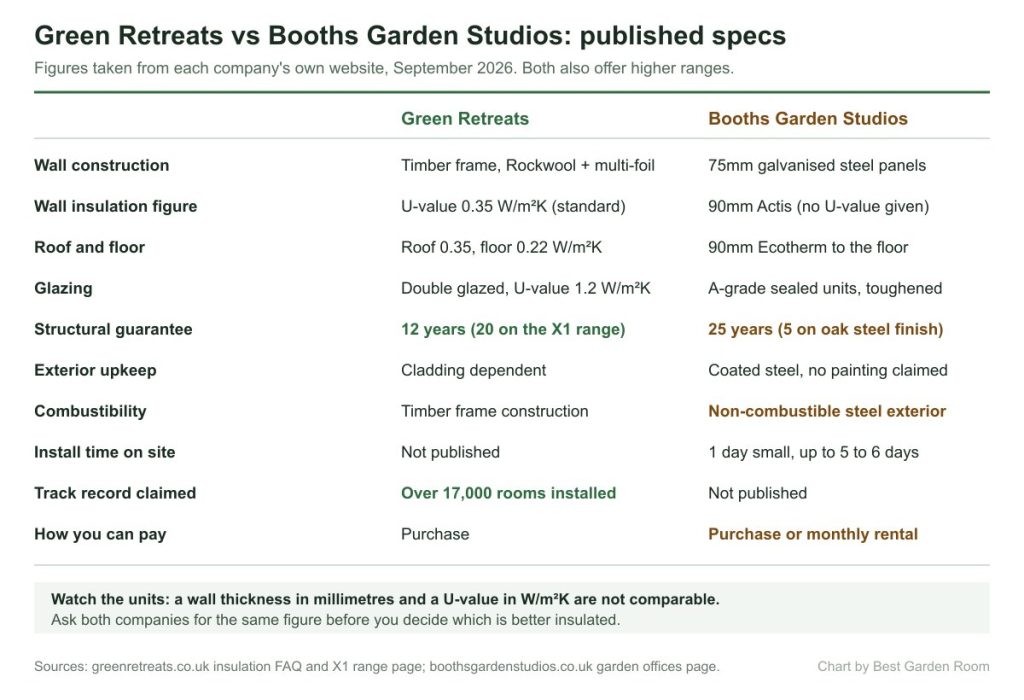
Green Retreats vs Booths Garden Studios is one of the few genuine head-to-heads in the UK garden room market, because the two companies have solved the same problem in opposite ways. Green Retreats builds a timber-framed room with mineral wool insulation and sells the volume story: over 17,000 rooms installed, showrooms in Buckinghamshire and Twickenham. Booths builds a steel-panel shell finished in a coated plastic skin and sells longevity: a 25-year structural guarantee and a claim of no painting or staining for the life of the building.
That is not a small distinction. It changes the guarantee, the upkeep, the way the building looks in ten years, and in one specific case it changes whether your garden room needs Building Regulations approval at all. All the figures below come from each company’s own published specifications, checked in September 2026.
The headline difference: a steel shell against a timber frame
Booths states on its garden offices page that its walls are 75mm galvanised steel-clad panels, made from Corus or Tata steel and finished in a leather-effect plastic coating. Inside, walls and ceilings are white MDF and floors are commercial-grade waterproof vinyl. The whole exterior is metal.
Green Retreats builds conventionally: a timber frame with A-star fire-rated Rockwool insulation and a reflective multi-foil breather membrane called PhotonWrap, with high-density polyurethane in a double steel-backed roof. Cladding is chosen from a range, so the outside can look like cedar, composite or painted board.
The upshot is aesthetic before it is technical. A Booths building looks like a very well-made modular unit. A Green Retreats building looks like a small piece of contemporary architecture. Both are defensible. Which you prefer will probably settle the decision faster than any specification will.
Guarantees: 25 years against 12
Booths offers a 25-year structural guarantee on the building, with a shorter five years on oak steel finishes. Green Retreats gives a 12-year structural guarantee across its standard ranges, rising to 20 years on the top X1 range, and says its buildings are designed to last over 30 years.
Booths wins that comparison on paper, and it is a real advantage. Two cautions before you weigh it too heavily. First, “structural” is a narrower word than it sounds: ask both companies in writing what it covers and, more importantly, what it excludes, since glazing units, door gear, coatings and electrics are commonly outside the headline figure. Second, a guarantee is only worth the company behind it. Check both firms at Companies House and ask whether the guarantee is insurance-backed, which means it survives the company failing.
Insulation: they publish different numbers on purpose
This is where most buyers get misled, and it is not either company’s fault.
Green Retreats publishes U-values: walls 0.35, roof 0.35 and floor 0.22 W/m²K, with glazing at 1.2. A U-value is the finished thermal performance of the whole build-up, so it is directly comparable between buildings.
Booths publishes thicknesses: 90mm Actis in the walls and ceiling, 90mm Ecotherm in the floor. That tells you what went in, not what comes out. A thick layer of one material can perform worse than a thinner layer of another, and multi-foil products in particular perform very differently depending on the air gaps either side of them.
You cannot compare 90mm against 0.35 W/m²K. Ask both companies for the same figure. If a supplier will not give you a wall U-value, that is information in itself. For context, Green Retreats’ standard 0.35 wall is a long way off the roughly 0.18 expected of a new house wall, which is entirely legal because a garden room under 30m² is normally outside Building Regulations. It does mean a standard-spec room costs more to heat than the marketing suggests. Green Retreats’ X1 range quotes a wall U-value of 0.14, which is genuinely good, so the gap within one company’s own catalogue is wider than the gap between the two companies.
The boundary rule that can decide it for you
Here is the point almost nobody raises, and it can settle the choice outright.
Under Class 6 of Schedule 2 to the Building Regulations 2010, a detached single-storey building up to 30m² with no sleeping accommodation is exempt from Building Regulations if it is either more than one metre from the boundary of its curtilage, or constructed substantially of non-combustible material. Buildings under 15m² are exempt regardless.
So if your plot forces a room of between 15 and 30m² to sit within a metre of a fence, a timber-framed building takes you into a Building Regulations application while a substantially non-combustible one may not. Booths’ galvanised steel exterior is squarely aimed at that situation.
Do not treat that as an automatic pass. “Substantially of non-combustible material” is a judgement about the whole building, not the outer skin alone, and internal MDF linings and coatings are part of the picture. Put the question to your local building control team before you order, and get the answer in writing. But if your garden is tight, ask both companies about it early, because it can decide the whole thing.
Glazing, and how each one feels inside
Booths fits low-energy A-grade sealed units it describes as thermally equivalent to triple glazing, with toughened glass and enhanced sound insulation. Green Retreats quotes a glazing U-value of 1.2 W/m²K on its standard specification, and the X1 range adds acoustic laminated glass and insurance-grade locks as standard.
Note again that one company gives you a number and the other gives you a comparison. “Thermally equivalent to triple glazing” is a claim you can ask to see backed with a U-value or a window energy rating.
Inside, Booths is the more standardised product: white MDF walls and ceiling, vinyl floor, a clean finish that suits an office or a therapy room. Green Retreats offers more freedom over layout and finish, which matters more if the room is going to be a living space rather than a workspace.
Maintenance and how each ages
Booths claims zero maintenance for 25 years or more, with no painting or staining and only an occasional wipe down. For a coated steel exterior that is a credible claim rather than a marketing one.
A timber-clad Green Retreats building depends on the cladding you choose. Cedar will silver unless it is treated, painted board needs recoating on a cycle, and composite cladding sits in between. None of that is a fault, but it is a real, recurring job, and if nobody in the household is going to do it then the low-maintenance route is the honest choice.
Buying or renting
Booths offers its studios to rent monthly as well as to buy, with maintenance included. Green Retreats sells its buildings.
Renting suits a specific case: a business that wants the cost as an operating expense, a temporary need such as childcare or a two-year work-from-home arrangement, or a rented property where you cannot leave a permanent building behind. For a homeowner planning to stay put, buying almost always works out better, and a garden room is one of the few outbuildings that can add value at sale.
Which should you choose?
- Choose Booths if the room must sit within a metre of a boundary, you want the longest structural guarantee available, you do not want to maintain the outside, or renting suits your circumstances better than buying.
- Choose Green Retreats if appearance matters to you, you want a timber-clad building that reads as architecture rather than a unit, you want a specific layout, or you want the option of a very high insulation specification through the X1 range.
- Get both to quote if you are undecided. Ask each for the wall U-value, the full written guarantee terms, the lead time and the site preparation you will have to pay for separately. Those four answers separate garden room companies far more reliably than the brochure does.
Our individual write-ups go into more detail on each: the Green Retreats review and the Booths Garden Studios review.
Frequently asked questions
Is Booths or Green Retreats better insulated?
You cannot tell from the published figures, because they are not the same kind of figure. Green Retreats publishes U-values (walls 0.35 W/m²K on the standard range, 0.14 on the X1). Booths publishes insulation thicknesses (90mm Actis in walls and ceiling). Ask both for a wall U-value and compare those.
Which company gives the longer guarantee?
Booths, on paper: 25 years structural, against 12 years from Green Retreats on standard ranges and 20 years on the X1. Ask each for the written terms, since “structural” typically excludes glazing, door gear and electrics, and check whether the cover is insurance-backed.
Does a steel garden room avoid Building Regulations?
It can. A detached single-storey building up to 30m² with no sleeping accommodation is exempt if it is over one metre from the boundary or built substantially of non-combustible material. A non-combustible building can therefore sit closer to a fence and stay exempt. Confirm it with your local building control before ordering.
Do either of them need planning permission?
Usually not. Most garden rooms are permitted development as long as they are single storey, within the height limits, used for purposes incidental to the house and not covering more than half the garden. Conservation areas, listed buildings and any sleeping use change the answer. Green Retreats says permission is rarely needed for its buildings and will handle an application where one is required.
How long does installation take?
Booths publishes one day for small studios, two to three days for larger units and five to six days for the biggest. Green Retreats does not publish a standard on-site build time, so ask when you quote. On-site time is not the same as lead time, which is measured in weeks for both.
Can you rent a garden room instead of buying one?
Booths offers monthly rental with maintenance included, which is unusual in this market. Green Retreats sells outright. Renting suits temporary needs and rented homes; if you are staying put, buying is normally the better value.
For more on how to compare any two suppliers on the same terms, start with our guide to what to look for in a garden room, or browse the rest of Best Garden Room.
Related guides
- Garden Room Planning Permission UK: The 30m² and 50% Rules Explained
- How Much Does a Garden Room Cost to Run in Winter? Real UK Figures
- Garden Room vs Extension: Honest Cost, Value and When Each Wins
- How Much Does It Cost to Run Electrics to a Garden Room in 2026?
- Ground Screws vs Concrete Base: Which Garden Room Foundation Is Right for You?
- Do Garden Rooms Need Building Regulations? The 15, 30 and 1m Rules Explained
- Prefab vs Bespoke Garden Rooms: Which Is Right for You?
- Garden Room Buying Mistakes: 12 Costly Errors to Avoid
- Garden Room News: June 2026
- How to Buy a Garden Room: The Complete UK Buyer’s Guide (2026)
- What to Look for in a Garden Room: 15 Things to Check Before You Buy
- Buying a Second-Hand Garden Room: Is It Worth It?
- Garden Room Kits vs Fully Installed: Should You Self-Build or Buy Turnkey?
- Garden Room Deposits, Contracts and Deliverables: Protecting Your Money
- How Long Does a Garden Room Last? Lifespan and Maintenance
- Garden Room Cost Per Square Metre: 2026 UK Rates Explained
- How Much Does a Garden Room Cost in the UK? (2026 Price Guide)
- Garden Room Prices by Size: From 3x3m to 8x4m and Beyond
- How Much Does a Garden Office Cost? (2026 UK Breakdown)
- Garden Room Planning News: Late June 2026
- How Much Does a Garden Room with a Bathroom Cost?
- Hidden Garden Room Costs: Foundations, VAT and the Extras Quotes Miss
- Garden Room Finance: Loans, Mortgages and Payment Options Explained
- Garden Room News: Early July 2026
- Do Garden Rooms Add Value to Your House? What the UK Resale Data Shows
- Permitted Development Rights for Garden Rooms: Size, Height and the 2m Boundary Rule
- Do Garden Rooms Affect Council Tax? Business Rates and Reassessment
- Garden Room News: Mid-July 2026
- How a Garden Room Is Built: Foundations to Finish (UK Guide)
- SIPs vs Timber Frame Garden Rooms: Which Construction Is Better?
- How Close to a Boundary Can a Garden Room Be? UK Rules Explained
- How to Apply for Garden Room Planning Permission: Step by Step
- Can You Build a Garden Room on Decking, Slabs or a Patio?
- Is a Garden Room Cheaper Than an Extension? 2026 Cost Comparison
- Garden Room News: Mid-July 2026
- Garden Room Cladding: Cedar vs Composite vs Larch vs Render
- Garden Room Roof Guide: Flat vs Pitched and the Best Materials
- Garden Room Windows and Doors: Bifold, Sliding and Glazing
- How to Build a Garden Room: A DIY Step-by-Step Guide (UK)
- How Long Does It Take to Build a Garden Room?
- How to Make a Garden Room Usable All Year Round
- Garden Room Insulation: Best Materials and U-Values for the UK
- How to Heat a Garden Room: 9 Options Compared by Cost and Warmth
- Best Heating for a Garden Office: Warm Without a Huge Bill
- Air Conditioning for Garden Rooms: Cooling and Heating in One
- Stopping Condensation and Damp in a Garden Room (UK Guide)
- How to Get Wi-Fi in a Garden Office: 6 Ways That Actually Work
- Garden Office Ideas: Designing the Perfect Work-From-Home Space
- Garden Room Ideas: 20 Popular Uses to Inspire Your Build
- Garden Room Annexe: Rules, Costs and How to Build One
- Garden Bar Ideas: The Height Rules, Power and Layout
- Garden Room Business: What Changes Once Clients Visit
- Garden Studio Ideas: Sizes, Light and the 2.5m Rule
- Garden Room Lighting: IP20 Inside, IP65 Out, Part P Rules
- Landscaping Around a Garden Room: the 30cm Decking Trap
- Garden Room Design: Why 2.5m Decides Everything
- Garden Room Planning Permission: the 2.5m Boundary Rule
- Garden Room News: New NPPF Lands, PD Rules Unchanged
- Garden Saunas UK: Planning, Building Regs and Electrics
- Best Garden Room Companies UK: Guarantees of 10 to 25 Years
- Garden Room Electrics: The Rules Change on 15 Oct 2026
- Golf Simulator Garden Room: The 2.5m Rule That Stops It
- Garden Screens: the 2m Rule, and Why Trellis Counts
- Cheap Garden Rooms: What 19mm Walls Really Get You
- Green Retreats Review: 12-Year Cover, 60% Upfront
- Booths Garden Studios Review: Steel Build, 25 Years
- Eden Garden Rooms Review: £23,500 Start, 10-Year Cover
- Garden Rooms London: 6 Companies and the 2.5m Limit
- Garden Room Bedroom: Why a Bed Changes the Rules
- Do I Need Planning Permission for a Garden Shed? Usually Not
- Garden Room News: Staged Payments Arrive, Timber Stays Dear
- Garden Gym Ideas: Sizes, Ceilings and the 2.5m Height Rule
- Garden Gazebo Rules: 2.5m Near a Boundary, 4m Max
- Garden Arch: Wood or Metal, and the 2.7m Height Rule
- Garden Arbour: Sizes That Seat Two, and Wood vs Metal
- Wooden Garden Gates: Sizes, UC4 Posts and the 1m Rule
- Garden Room News: Rates Held, Materials Up 5.9%
- Summer House Interior Ideas: 9 That Work in Winter
- Garden Trellis Panels: the 2m Rule Most Buyers Miss
- Garden Shelters: Six Types and When You Need Permission
- Garden Greenhouses: Glass Gives 90% Light, Plastic 80%
- Summer House Doors and Windows: 4mm Toughened or Styrene?
- Log Stores: Size, Siting and the 20% Moisture Rule
- Garden Shed Roof: Felt, EPDM or Onduline by Pitch
- Insulated Garden Shed: The 25mm Gap That Stops Damp
- Composite Garden Sheds: Rot-Proof, But Check These 6 Things
- How to Build a Garden Shed: Base, Frame and Roof in 5 Steps
- Garden Room News: Power 26.32p a kWh, VAT-Free to March
- Garden Workshop: Size, Base, Power and the Planning Rules
- Plastic Garden Sheds: Who They Suit and 6 Checks First
- Metal Garden Sheds: Stop Condensation Before You Buy
- Garden Shed Storage Ideas: 12 That Free Up Floor Space
- Wooden Garden Sheds: 7 Specs That Decide How Long They Last
- 8×6 Garden Shed: Real Floor Size, Door Width and Base
- 6×4 Garden Shed: 59cm Door, 118cm Deep and What Fits
- Small Garden Shed: 88.5cm Wide Inside and What Fits
- Garden Room News: Building Control Fees Change 6 Nov
- 6×10 Garden Shed: 295 x 182.6cm Inside, and What Fits
- Bike Shed for Garden: Sizes, Ground Anchors and the Locks
- Shed With Log Store: Sizes, Layout and the 2.5m Rule
- Garden Bin Storage: Sizes, Lids and the Front Garden Rule
- Pergola Planning Permission: the 2.5m Boundary Rule