

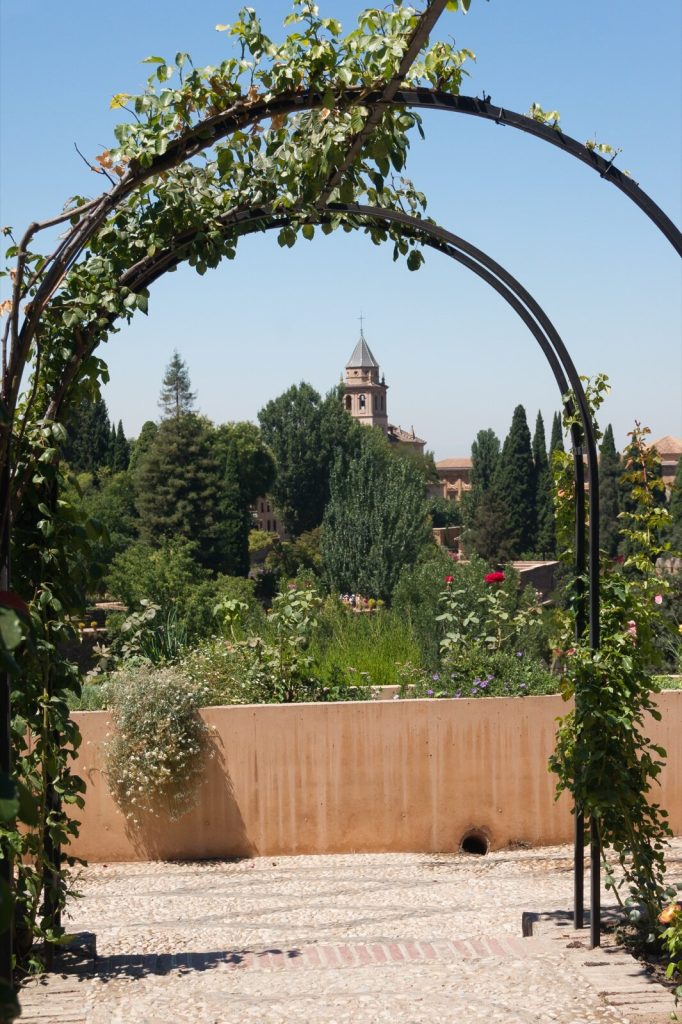
A garden arch is the cheapest structure that changes how a garden feels. Put one over a path and you create a threshold, a sense of moving from one space into another, for a fraction of what a pergola or summer house costs. Get it wrong and it becomes a wobbly frame that snags your head on a wet rose every time you walk through. This page covers wooden and metal garden arches, the dimensions that actually work, how to fix one so it stays put, what to grow over it, and where the planning rules come in.
Garden arch, pergola or arbour: what is the difference?
The three words overlap, and retailers use them loosely, but the distinction is useful when you are buying.
- Garden arch. A single frame, usually four posts or two sides, that you walk through. It frames a path, a gateway or a view.
- Pergola. A series of uprights and crossbeams covering an area or running along a path. Think of it as several arches joined together, often with a flat top.
- Arbour. An arch with a built-in seat, meant for sitting in rather than walking through.
The practical difference is load and scale. An arch carries less than a pergola, so it can be lighter, but it is also more exposed to wind because there is nothing bracing it on either side. If you are weighing up a covered seating area instead, our guide to garden gazebos covers the next size up.
Wooden or metal garden arch?
Wooden garden arches
Timber arches look at home in cottage and traditional gardens and are easy to fix trellis and wires to. Their weakness is the part in the ground. The Royal Horticultural Society’s pergola advice rates larch, Douglas fir and oak as the best timbers, and notes that pine tends to rot more quickly.
Most flat-pack wooden arches are pressure-treated softwood, and here the treatment class matters more than the species. The Wood Protection Association is clear that timber in permanent ground contact, or providing exterior structural support, must reach Use Class 4. Anything less, it says, compromises service life and structural safety. When you buy, look for UC4 on the posts specifically, not just “pressure treated”. Timber treated only to Use Class 3 is meant for above-ground use and will not last in the soil.
Metal garden arches
Metal arches are slimmer, so they read as a line in the garden rather than a structure, which suits modern and small gardens. They are usually steel with a powder-coated or painted finish, sometimes galvanised. Two things decide whether one lasts:
- Tube thickness. A thin tubular arch that flexes when you push it in the shop will flex far more under a mature climber in a gale.
- The coating at the feet. Rust almost always starts where the legs meet the soil, and where the coating was scratched during assembly. Touch up any scratches before the arch goes in.
Budget metal arches are often sold with short ground spikes. On a lawn in a sheltered garden they may be enough; anywhere exposed, or once a climber is established, they are not.
How big should a garden arch be?
The most common mistake is buying an arch that is too low. It looks fine bare. Two summers later the climber hangs down and you are ducking.
The RHS guidance for pergolas, which applies equally to a walk-through arch, is:
- Height. Uprights of around 2.7 metres from ground level, so climbers can trail down without getting in the way.
- Width. Roughly the same as the height, for balance.
- Post size. Timber uprights of at least 5 by 5cm, ideally 8 by 8cm.
Many off-the-shelf arches are lower than 2.7 metres. That is fine over a path you rarely use, or with a light climber you keep trimmed, but for a main route to the back gate buy the tallest you can, and check the internal clearance, not just the overall height, because the headroom under a curved top is lower than the peak.
Width matters too. If a wheelbarrow or mower has to pass through, measure it before you choose, and allow for the climber growing a few centimetres into the opening on each side.
How to fix a garden arch so it stays up
An arch fails in the wind long before it fails from rot. A climber turns it into a sail, and the frame levers against its own footings.
For timber posts, the RHS advice is to set them 45 to 60cm into the soil, treat the bases with preservative, and put 5 to 7cm of coarse gravel in the bottom of each hole for drainage. If you use a concrete or post mix, the Wood Protection Association advises making sure water can drain away from the foot of the post; do not form a concrete “boot” around it, because that holds water against the timber.
For metal arches, choose one of these in rising order of strength:
- The supplied ground spikes, pushed full depth into firm soil.
- Legs set into post holes with gravel and post mix.
- Bolt-down feet fixed to paving or a concrete pad, if the arch goes over a hard path.
Whichever you choose, check every leg is plumb and the arch is square before the mix sets. A twisted frame never looks right once plants are on it.
Do you need planning permission for a garden arch?
Usually not, but there are two sets of rules that can apply, depending on where the arch goes.
A free-standing arch in the back garden is treated like other small garden structures under the outbuilding rules. The Planning Portal’s outbuildings guidance caps anything within two metres of a boundary at 2.5 metres high, and nothing may go forward of the front wall of the house. A 2.7 metre arch set against the back fence would, strictly, exceed that limit; moving it two metres in, or dropping to 2.5 metres, avoids the question.
An arch built into a boundary, framing a gate in a fence or wall, is more likely to be judged as part of the “gate, fence, wall or other means of enclosure”. Under the national permitted development rules those can be up to two metres high, but only one metre where they are next to a road used by vehicles. A tall arch over a front gate onto the street can therefore need permission, even though the same arch at the back would not.
Listed buildings are the exception to everything: the rules for enclosures do not apply within the curtilage of a listed building, so talk to your council first. If you are not sure, a quick email to the planning team costs nothing. The same boundary height limits are covered in more detail in our guide to garden screening.
Garden arch with a gate
An arch over a side or back gate is one of the most satisfying garden projects, because it turns a utility entrance into a feature. A few practical points:
- Do not hang the gate from the arch posts unless the arch is designed for it. A gate swinging on a light arch will loosen the posts within a season. Hang it on its own gate posts, with the arch fixed alongside or over them.
- Allow the full gate swing, plus any climber growth, before you fix the arch.
- Check the height limits above if the gate opens onto a road.
What to grow over a garden arch
Choose the climber before the arch, because the plant decides how strong the frame has to be. The RHS lists roses such as ‘Albéric Barbier’, ‘Albertine’, ‘New Dawn’ and ‘Wedding Day’, along with Clematis montana, honeysuckle and jasmine, as good pergola and arch climbers.
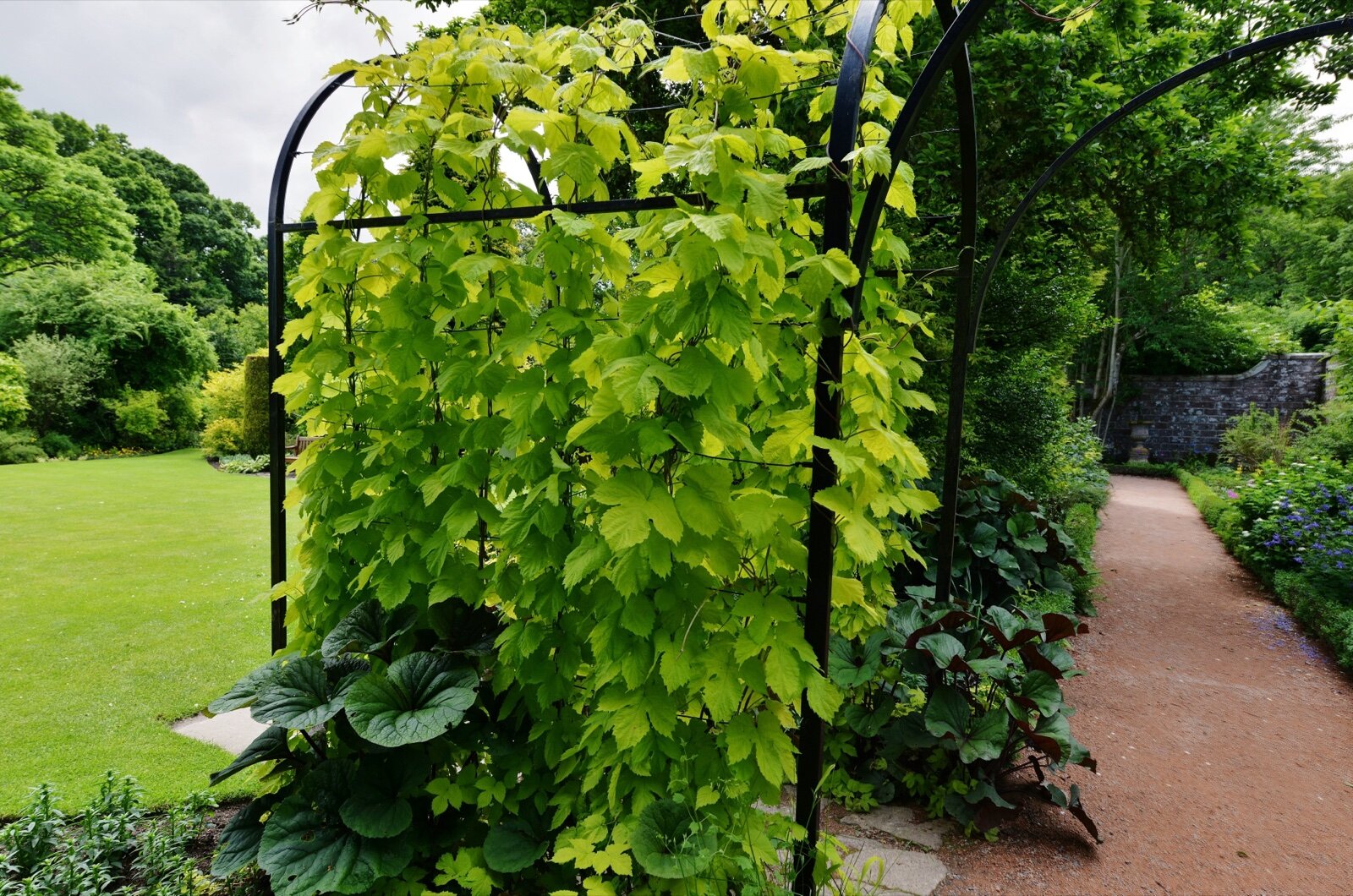
- Roses. The traditional choice. Pick a rambler or climber whose ultimate size fits your arch, and tie stems in horizontally around the frame to encourage flowering.
- Clematis. Light and quick to cover. Clematis montana is very vigorous, so it suits a big, sturdy arch rather than a slim metal one.
- Honeysuckle and jasmine. Scent where you walk past, which is exactly what an arch over a path is for.
- Wisteria. Beautiful, but the RHS notes wisterias can reach more than 10 metres in height and spread. Only plant one on a heavy, deeply set timber or steel structure built for it, never a flat-pack arch.
Plant climbers about 30cm out from the base of the post, on the side that gets rain, and lean them in towards the frame. The soil right at the foot of a post is usually dry and full of gravel or post mix.
For more ideas on buildings and structures that shape a garden, browse the rest of Best Garden Room.
Frequently asked questions
How tall should a garden arch be?
The RHS suggests uprights of around 2.7 metres, so climbers can hang down without getting in the way of people walking through. Check the clearance under the curve, not just the overall height.
How deep should garden arch posts go?
For timber posts, the RHS recommends 45 to 60cm into the soil, with 5 to 7cm of coarse gravel in the bottom of the hole for drainage.
Do you need planning permission for a garden arch?
Usually not. Within two metres of a boundary the outbuilding rules cap height at 2.5 metres, and an arch forming part of a boundary next to a road used by vehicles is limited to one metre. Listed buildings need a conversation with the council first.
Is a wooden or metal garden arch better?
Timber suits traditional gardens and heavy climbers, provided the posts are treated to Use Class 4 for ground contact. Metal is slimmer and suits modern gardens, but budget tubular arches flex under mature plants.
What is the best climber for a small garden arch?
A compact climbing rose, a less vigorous clematis, honeysuckle or jasmine. Avoid wisteria and Clematis montana on a small arch, as both grow large and heavy.
How do you stop a metal garden arch blowing over?
Set the legs in post holes with gravel and post mix, or bolt the feet down to a hard surface. The short ground spikes supplied with budget arches rarely hold once a climber is established.