

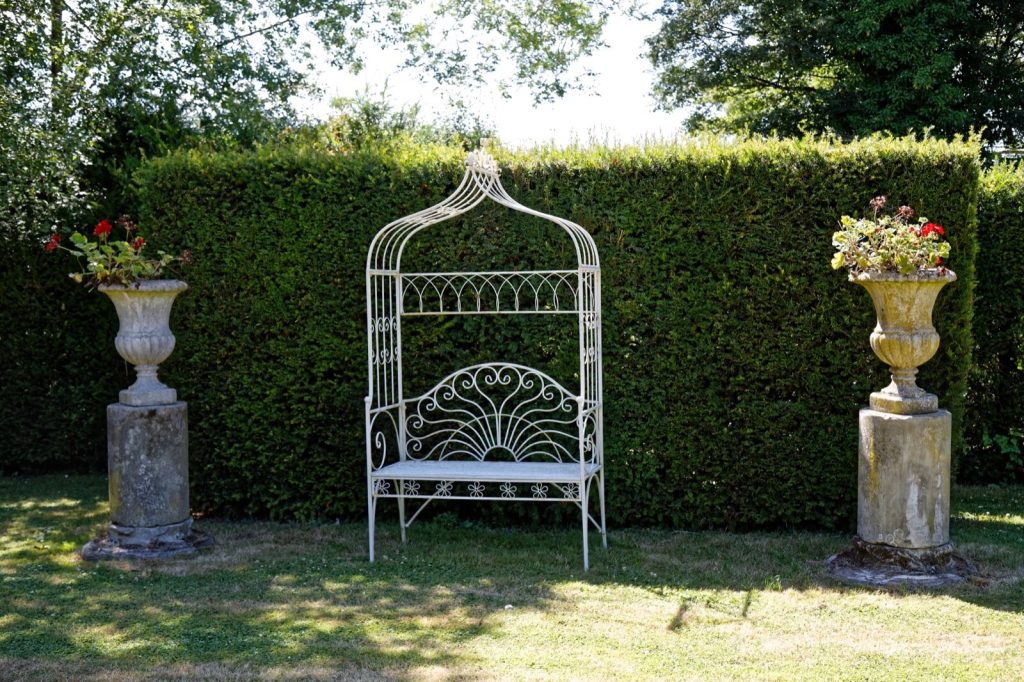
A garden arbour is an arch with a seat built into it: a sheltered bench framed by posts, trellis sides and a roof you can grow plants over. It is the one garden structure designed for sitting still rather than walking through, which changes what matters when you buy one. Seat depth, headroom, where the sun falls at the time you will actually use it, and whether a scented climber can reach the frame all count for more than the look in a product photo. This page covers the types, the sizes that seat two people comfortably, wood against metal, how to fix one down, the planning position and what to grow over it.
Arbour, arch or pergola?
Retailers use the words loosely, so it is worth being clear. An arch is a frame you walk through. A pergola is a run of posts and crossbeams covering a path or a patio. An arbour is an arch-shaped frame with a bench inside, meant as a destination. If you want something to frame a path, our page on garden arches is the better starting point. If you want cover for a table and several chairs, a garden gazebo gives you a full roof.
Types of garden arbour
Arched two-seater
The classic shape: a bench for two, lattice or trellis sides, and a curved or peaked top. Because the top is open, it lets light through and does not block the view across a small garden, which makes it the easiest arbour to fit in a modest plot.
Corner arbour
A triangular or square footprint with the seat wrapping round two sides. These seat three or four and suit a boundary corner, but they are large. One widely sold corner model measures 158 x 158cm on the ground and 210cm high. Many have a slatted roof that looks solid in photos but lets rain straight through.
Arbour with a table
Two facing benches with a table between them, or a single bench with a fold-down table. Good for a morning coffee or a meal for two, but the footprint roughly doubles.
Storage arbour
A seat with a lift-up lid and a box underneath. Useful for cushions, as long as the box has drainage holes and a lid that overlaps the edges, because damp cushions left in a sealed timber box go mouldy.
Swing arbour
A frame with a hanging bench seat. It needs a wide, level spot and a heavier frame, since a swinging load puts far more stress on the joints than a fixed bench.
Garden arbour sizes: what to measure
Most two-seater arbours sold in the UK are roughly 1.2m to 1.6m wide and around 1.95m to 2.1m tall, with a seat height of about 45cm, similar to a dining chair. Single-seaters come in closer to 90cm wide. Before buying, check four measurements on the listing rather than the headline size:
- Internal seat width. The outside width includes the posts and sides. A 1.6m arbour can have an internal bench closer to 1.5m, and two adults need most of that.
- Seat depth. Budget arbours can be as shallow as 50cm overall, which leaves a narrow bench and an upright back. For proper lounging, look for a deeper seat, or plan on cushions.
- Headroom at the front. A 2m overall height includes the roof. The height at the front edge, where you duck in and stand up, can be well under that, and climbers hanging from the top take more off.
- Footprint including planting. Add space either side for a climber in the ground and leave room to walk round it to paint or oil the frame.
Mark the footprint out with canes and string, then sit a chair in it at the time of day you expect to use it. It shows quickly whether the arbour will crowd a path or face next door’s kitchen window.
Wooden or metal garden arbour?
Softwood
Pressure-treated pine or spruce is what most wooden arbours are made from, and it suits cottage and traditional gardens. Look for FSC-certified timber, chunky posts rather than thin battens, and pre-drilled joints, because assembly without them can take a day. Anything that sits in soil or is concreted in should be treated for ground contact, which in the British Standard for preservative treatment is Use Class 4. Ordinary treated timber meant for above-ground use rots at the base far sooner.
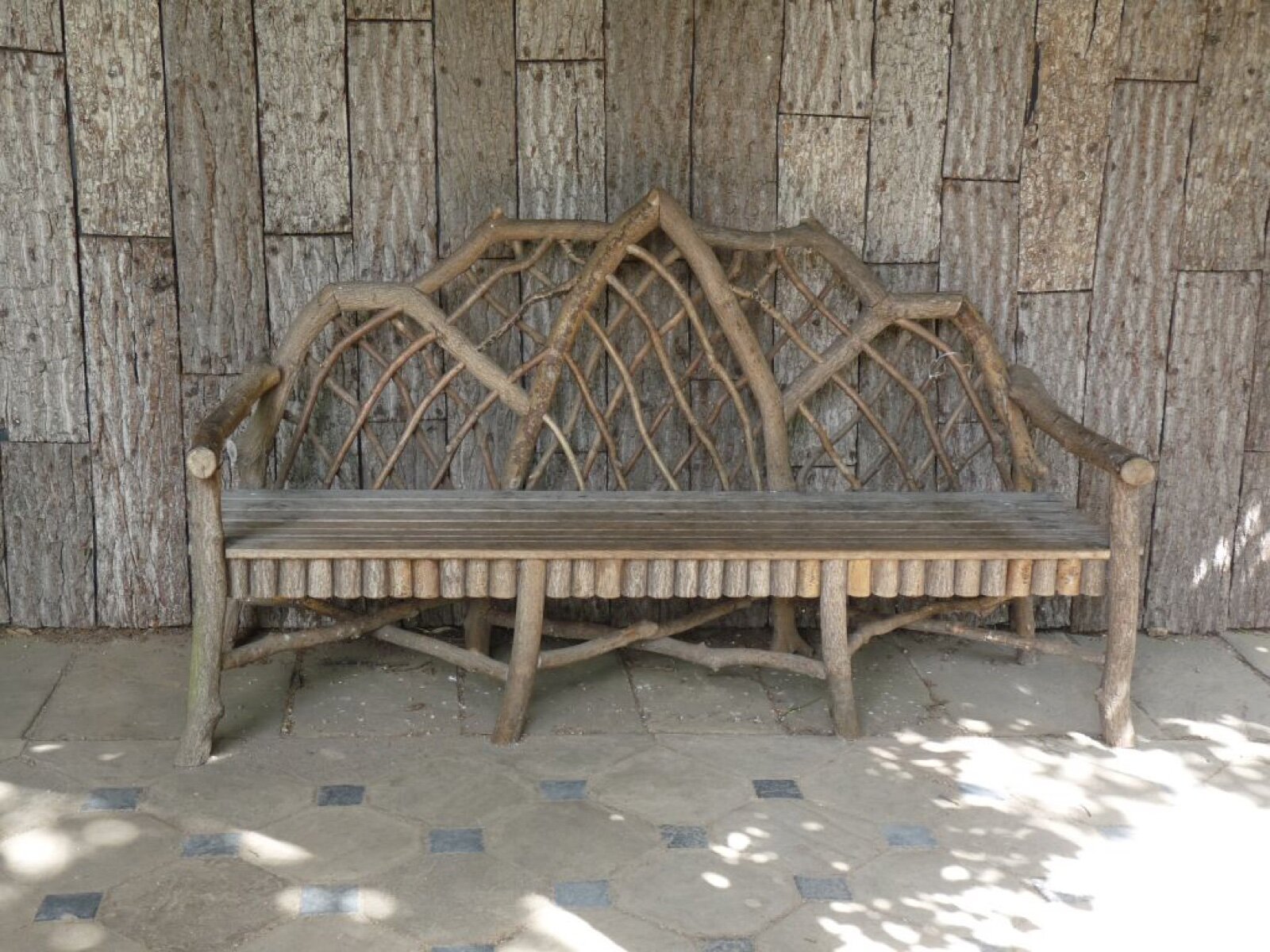
Hardwood
Acacia, eucalyptus and other hardwoods are denser and last longer than softwood without the same level of treatment, and they weather to a silver grey if left unoiled. They are heavier and cost more.
Metal
Powder-coated steel or iron gives a slimmer, more decorative frame, as in the photo at the top of this page. It is lighter to assemble and needs little upkeep beyond washing and touching up chips before rust gets in. The drawback is that a metal bench is cold and hard, so you will want cushions, and a lightweight tubular frame can flex once a mature climber adds weight and catches the wind.
Plastic and composite
Resin arbours never rot, but they suit a patio or roof terrace better than a planted garden, as they do not take a climber well.
Where to put a garden arbour
Think about when you will sit in it. A spot that catches the evening sun, usually on the east side of the garden looking west, suits anyone who uses the garden after work. A morning-sun position suits a coffee. A shady corner is welcome on hot afternoons but will be damp and cool for most of the year, and timber in permanent shade grows algae quickly.
Put the back of the arbour against something: a hedge, a fence, a wall or a planted border. An arbour standing in the middle of a lawn with nothing behind it feels exposed, and the back is where the wind hits hardest. It also helps to have a view to look at, whether that is a border, a pond or just the length of the garden. Our page on garden screening covers how to add privacy if the best spot is overlooked.
Base and fixing
Stand an arbour on a level, firm base. Paving slabs or a small patio are best, because feet sitting on grass sink unevenly and stay wet. A compacted gravel base over a weed membrane is a good cheaper option. Then fix it down: bolt the feet to the paving with masonry anchors, or use ground anchors or post spikes on softer ground. A tall arbour with trellis sides and a climber acts like a sail, and an unfixed one can tip in a storm. Some of the heavier corner models weigh well over 100kg, so assemble them in their final position rather than carrying them there.
Do you need planning permission for a garden arbour?
Usually not. A freestanding arbour in a back garden falls well within the permitted development limits for outbuildings and garden structures. The ones that matter, from the Planning Portal outbuildings guidance, are:
- A maximum height of 2.5 metres for any structure within two metres of a boundary. Most arbours are 2.1m or less.
- Nothing forward of the wall forming the principal elevation of the house, which normally means the front garden.
- Raised platforms no higher than 0.3 metres, so building an arbour on top of a raised deck can change the picture.
- Within the curtilage of a listed building, any outbuilding needs planning permission.
If you live in a conservation area or a flat, or your house has had its permitted development rights removed, check with your council before building anything substantial.
What to grow over an arbour
An arbour is where you sit with your face close to the plants, so scent matters more than on an arch, and thorns matter too.
- Star jasmine (Trachelospermum jasminoides). Evergreen, with very fragrant white flowers in mid to late summer. The RHS rates it H4, hardy in most of the UK, and it does best in a warm, sunny, sheltered spot. It is slow to start, which suits a small frame.
- Honeysuckle. Our native Lonicera periclymenum is most strongly scented in the evening, which is when many people use an arbour.
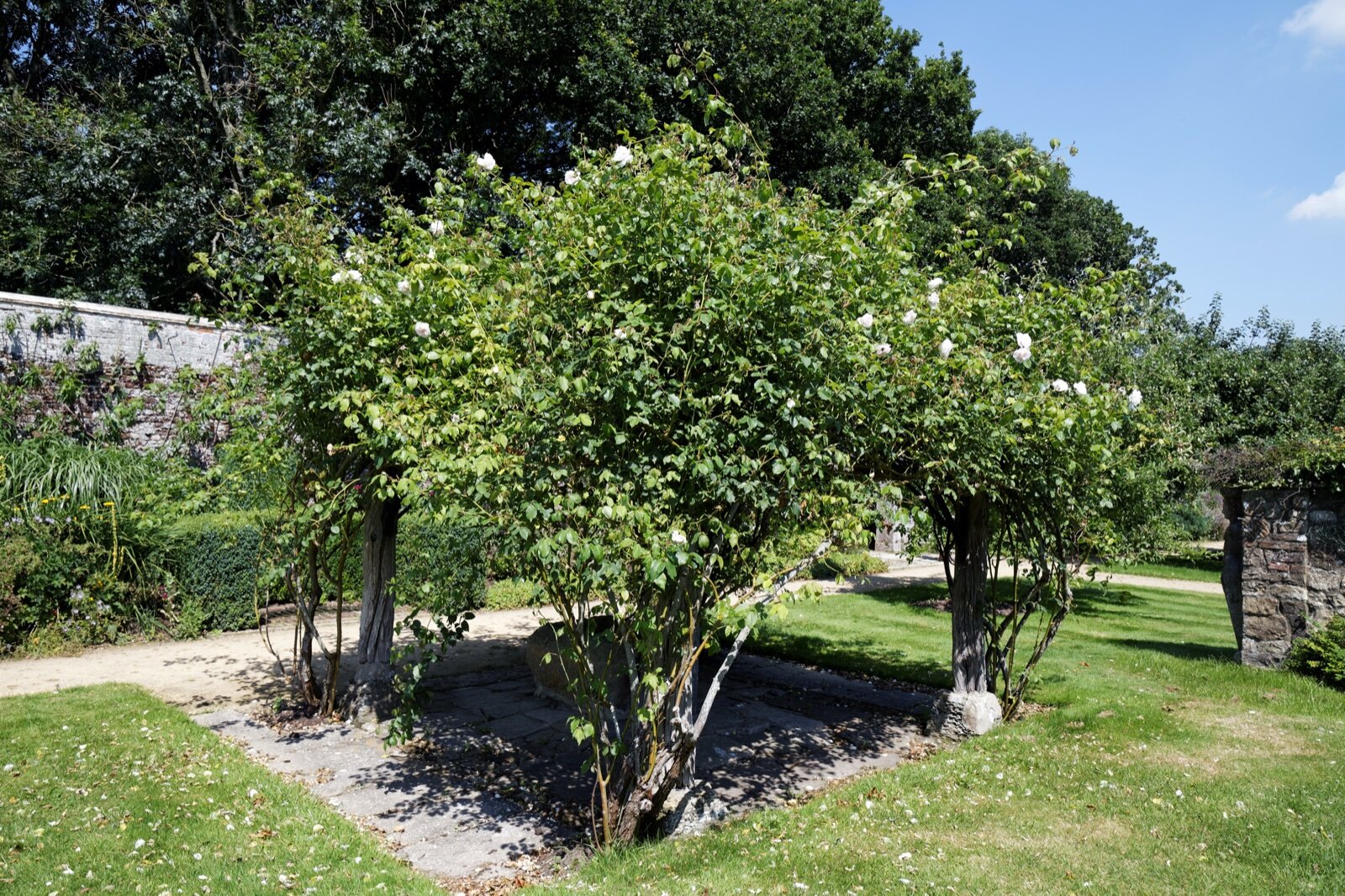
- A thornless climbing rose. ‘Zéphirine Drouhin’ is a long-standing choice for seating because it has no thorns to catch your arm.
- Clematis. Pick a compact variety for a small arbour and avoid Clematis montana, which quickly swamps a light frame.
Plant climbers a short distance from the post, not tight against it, and lean them in on a cane. Avoid wisteria on a bought arbour: it grows heavy enough to distort a lightweight frame.
Looking after a garden arbour
- Softwood: re-coat with a wood preserver, stain or paint every year or two, paying attention to the feet and the top edges, where water sits.
- Hardwood: oil once or twice a year to keep the colour, or leave it to silver.
- Metal: wash with soapy water and touch up any chip in the coating straight away.
- All types: bring cushions in, check bolts and anchors each spring, and cover or wrap the seat over winter if you can.
Frequently asked questions
What is a garden arbour?
A garden arbour is an arch-shaped frame with a built-in bench, usually with trellis sides and an open or slatted roof for climbing plants. Unlike an arch or pergola, it is built for sitting in.
How big is a two-seater garden arbour?
Most are roughly 1.2m to 1.6m wide and about 1.95m to 2.1m tall, with a seat around 45cm high. Check the internal seat width and depth on the listing, as the outside size includes the frame.
Do you need planning permission for an arbour?
Usually not. Permitted development allows garden structures up to 2.5m high within 2m of a boundary, as long as they are not in front of the house. Listed buildings always need permission.
Is a wooden or metal arbour better?
Wood suits traditional gardens and heavier climbers, but needs re-treating. Metal is slimmer and lower maintenance, but colder to sit on, and light frames can flex under a mature climber.
How do you stop a garden arbour blowing over?
Stand it on paving or a firm gravel base and fix it down with masonry bolts, ground anchors or post spikes. An arbour covered in climbers catches a lot of wind.
What is the best climber for a garden arbour?
For a seat, pick scent without thorns: star jasmine, honeysuckle or a thornless rose such as ‘Zéphirine Drouhin’. Avoid wisteria and Clematis montana on a bought arbour.
For more on garden structures, garden rooms and planning, browse the guides on the Best Garden Room homepage.