

Garden room lighting is the part of the build most people leave until the room is finished, and it is the part that decides whether the building gets used after dark. Get it right and a garden office stops feeling like a shed with a desk in it. Get it wrong and you have one glaring ceiling light, a black window at 4pm in December, and a path you cannot see on the way back to the house.
There are three things to settle: how the light is layered inside, which IP rating each fitting needs for where it sits, and who is legally allowed to wire it. The last one catches people out most often, so it is worth reading before you buy anything.
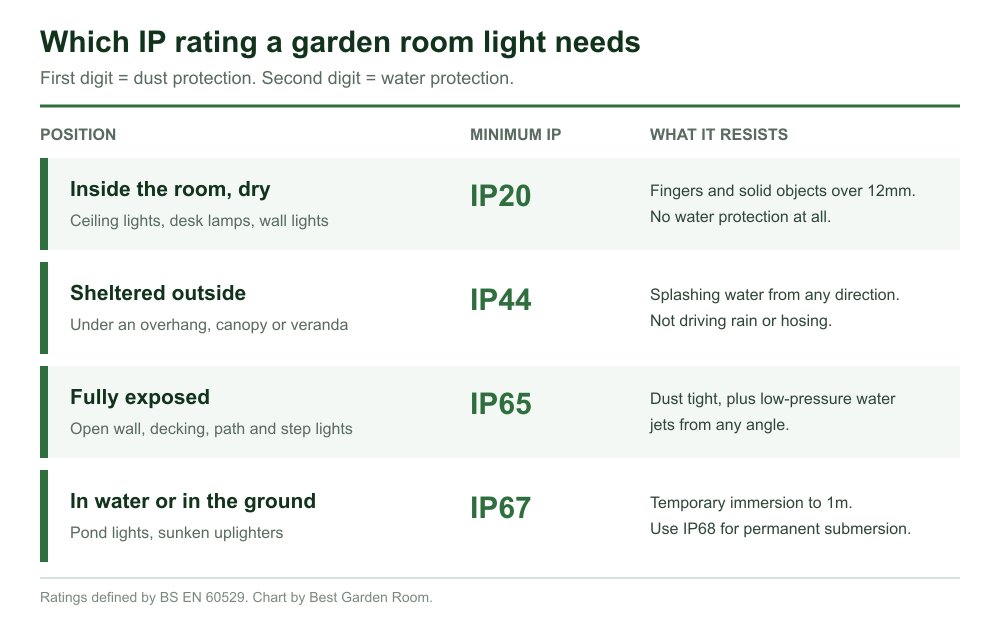
Which IP rating a garden room light needs
IP stands for Ingress Protection, and the two digits are defined by the standard BS EN 60529. The first digit covers solid objects and dust, the second covers water. A fitting rated IP65 is dust tight and will take low-pressure water jets from any angle. A fitting rated IP20 will take a finger poked at it and nothing else.
What matters is matching the rating to the position rather than buying the highest number for everything:
- Inside the room, dry: IP20 is fine. Ordinary indoor ceiling lights, wall lights and lamps.
- Sheltered outside: IP44 minimum. Under an overhang, a canopy or a veranda, where the fitting gets splashed but not soaked.
- Fully exposed: IP65. Open wall lights, decking lights, path and step lights that take driving rain.
- In water or in the ground: IP67 for temporary immersion to a metre, IP68 where it is permanently submerged, such as a pond.
One caveat on the sheltered category. An overhang that shelters a light in still weather does nothing in horizontal rain, and British weather supplies plenty of that. If a position is only marginally sheltered, treat it as exposed and fit IP65.
The Part P rule that catches people out
This is the bit that surprises people. In England, electrical work in a home is covered by Part P of the Building Regulations, and Approved Document P, in its 2013 edition, sets out what must be notified to building control.
Since the April 2013 amendment, three categories of work are notifiable in England:
- Installing a new circuit
- Replacing a consumer unit
- Any addition or alteration to circuits in a special location, which now means the zones around a bath or shower, and rooms containing a swimming pool or sauna heater
Running a supply from the house consumer unit out to a garden room is a new circuit. That makes it notifiable, whatever you use it for. It does not matter that the garden room is not a bathroom. Note also what changed in 2013: gardens and outbuildings are no longer classed as special locations in England, so adding a socket or a light to an existing garden room circuit is not notifiable on its own. Creating the supply in the first place is.
You have two legal routes. Use an electrician registered with a competent person scheme, who self-certifies the work and arranges the building control notification and certificate. Or notify your local authority building control yourself before starting and pay them to inspect it. The IET’s guidance on Part P is the reference if you want to read further, and Electrical Safety First lets you check whether an electrician is actually registered.
Skipping this is a false economy. An uncertified supply shows up on a conveyancing search when you sell, and it is the first thing an insurer asks about after an electrical fire. The wiring itself also has to comply with BS 7671, which for a buried garden supply usually means steel wire armoured cable at a proper depth with warning tape above it, not an extension lead through the lawn.
Start with three layers, not with fittings
The reason most garden rooms feel harsh at night is that they have one layer of light: a bright ceiling fitting doing every job at once. Designers work in three layers, and it is worth copying.
Ambient is the background level that lets you move around and stops the room feeling like a cave. In a garden room this is usually recessed downlights or a low-glare linear fitting. Keep it dimmable and keep it off the direct line of sight from a desk.
Task is light aimed at what you are doing: a desk lamp, an adjustable wall light over a workbench, strip lighting under a shelf. Task lighting is what lets you turn the ambient layer down and still work comfortably.
Accent is the layer people skip, and it does most of the work in making a small building feel considered. A wall washer, a light grazing timber cladding, a lit shelf. It also gives you a low-level setting for evenings when you are using the room to sit in rather than work in.
A practical rule for a garden office: never put a downlight directly above where a screen will sit, and never put one directly behind the person on a video call. Both create the same problem in different ways.
Lighting inside, by what the room is for
The right answer depends on the job the building does.
- Office: even, glare-free ambient light plus a proper task lamp. Position the desk so a window is to the side rather than in front of or behind the screen, then light the wall behind the monitor so your eyes are not switching between a bright screen and a dark wall.
- Gym: brighter and more even than an office, with fittings positioned so you are not looking straight into them while lying on a bench. Avoid single central pendants entirely.
- Garden bar or snug: the opposite. Low ambient, plenty of accent, warm colour temperature, everything on a dimmer.
- Studio or workshop: high output and high colour rendering, so paint colours and materials look the same as they do outside.
- Guest space: layered, with a switch by the door and a second control by the bed.
Whatever the use, put the lighting on at least two switched circuits so you are not stuck with all on or all off. If you are still at the wiring stage, this costs almost nothing to add and is expensive to retrofit. Our guide to garden room electrics costs covers what the supply itself involves.
Colour temperature and dimming
Colour temperature is measured in kelvin, and it changes the feel of a room more than brightness does.
- 2700K is warm white, close to a traditional bulb. Right for bars, snugs and guest rooms.
- 3000K is a warm neutral. A good default for a garden room that does more than one job.
- 4000K is cool white. Suits gyms, workshops and studios, and looks clinical in a lounge.
Mixing temperatures in one small room looks like a mistake, so pick one for the ambient layer and stay with it. For accent lighting outside, warmer is generally kinder: cool white makes planting look grey.
Two things to check before you buy dimmable fittings. The dimmer switch has to be compatible with LED loads, because older dimmers designed for filament bulbs cause flicker and buzzing. And a low minimum load matters, since a garden room’s total lighting load is small and some dimmers will not run reliably below their threshold.
Lighting the outside and the approach
The walk between the house and the garden room is the part everybody forgets, and it is the part that determines whether the room gets used in winter. It sits alongside heating and insulation in the list of things that make a building usable all year round, and you can browse more ideas across Best Garden Room.
Light the path at low level rather than from above. Bollards, recessed step lights or spikes among planting give you enough to walk safely without the glare of a floodlight, and they do not blind you on the way back to the house. Light the steps specifically if there are any: a change of level in the dark is the actual hazard.
On the building itself, up-and-down wall lights either side of the door give a good result for little money and make the building read as architecture rather than storage. Keep the output modest. A garden room lit like a car park annoys neighbours and washes out everything else in the garden.
Add a PIR sensor to the approach lighting and a manual override inside, so you are not relying on remembering to switch it on from the house. And point anything bright away from neighbouring windows: light spilling into someone else’s bedroom is a common cause of complaints, and in some circumstances artificial light can be dealt with as a statutory nuisance.
Where low-voltage and solar genuinely work
Not everything needs a mains circuit.
12V plug-and-play systems run from a transformer, use pre-terminated connectors and are designed to be installed without an electrician. They are a sensible choice for garden lighting around a room you already have power to, and adding them to an existing circuit is not notifiable. Output is lower than mains fittings, so plan for more of them rather than expecting one to do a floodlight’s job.
Solar is free to run and needs no cable, which makes it useful for marking a path edge or a boundary. Be realistic about British winters: a solar light gets its shortest charge on the darkest days, exactly when you need it most. Treat solar as decorative, not as the light you rely on to see a step.
Battery and rechargeable fittings have become genuinely good for portable table lamps in a garden bar, where the appeal is moving them around rather than saving on wiring.
What to ask before the work starts
If you are getting a quote, these questions separate a proper job from a cheap one:
- Is a new circuit being run, and who is notifying building control?
- Which competent person scheme are you registered with, and can I see the registration?
- What cable is being used for the buried run, at what depth, and is warning tape going in above it?
- Will I get an Electrical Installation Certificate and a building regulations compliance certificate at the end?
- How many separate switched lighting circuits am I getting inside?
- Are the dimmers specified as LED compatible?
- What IP rating is each external fitting, and does it match where it is going?
The certificates matter beyond the day of the job. They are what you hand over when you sell the house.
Frequently asked questions
Do I need an electrician to wire lights in a garden room?
If a new circuit is being run from the house to the garden room, that work is notifiable under Part P in England and must either be done by an electrician registered with a competent person scheme or notified to building control before it starts. Adding a light or a socket to a garden room circuit that already exists is not notifiable on its own, but it still has to comply with BS 7671, so most people use an electrician anyway.
What IP rating do I need for garden room lights?
IP20 is enough inside a dry room. Use IP44 as a minimum for sheltered positions under an overhang or canopy, IP65 for anything fully exposed to the weather such as open wall lights and path lights, and IP67 or IP68 for fittings in the ground or in water. If a position is only just sheltered, treat it as exposed.
Do garden room lights need planning permission?
Lighting itself does not normally need planning permission. The building might, depending on its size, height and position, and the rules differ in conservation areas and for listed buildings. External lighting can be subject to nuisance rules if it spills significantly onto a neighbour’s property, so aim fittings carefully and keep the output sensible.
What colour temperature is best for a garden office?
3000K is a good default for a garden office, warm enough to feel comfortable and neutral enough to work under. Go to 4000K if the room is a gym, a workshop or a studio where you need the light to feel brighter and colours to read accurately. Stay at 2700K for a bar or a snug. Use one temperature for the ambient layer throughout.
Can I use solar lights for a garden room?
For decoration and for marking a path edge, yes. For light you actually depend on, no. Solar fittings charge least on the short, overcast days when you most need them, so they are not a substitute for a wired light on steps or at a door. They work best alongside mains or low-voltage lighting rather than instead of it.
How many lights does a garden room need?
It depends on size and use more than on a fixed number, but the layers matter more than the count. Aim for an ambient layer you can dim, at least one task light per working position, and one or two accent fittings. Split them across at least two switched circuits so the room has more than one setting.
Related guides
- Garden Room Planning Permission UK: The 30m² and 50% Rules Explained
- How Much Does a Garden Room Cost to Run in Winter? Real UK Figures
- Garden Room vs Extension: Honest Cost, Value and When Each Wins
- How Much Does It Cost to Run Electrics to a Garden Room in 2026?
- Ground Screws vs Concrete Base: Which Garden Room Foundation Is Right for You?
- Do Garden Rooms Need Building Regulations? The 15, 30 and 1m Rules Explained
- Prefab vs Bespoke Garden Rooms: Which Is Right for You?
- Garden Room Buying Mistakes: 12 Costly Errors to Avoid
- Garden Room News: June 2026
- How to Buy a Garden Room: The Complete UK Buyer’s Guide (2026)
- What to Look for in a Garden Room: 15 Things to Check Before You Buy
- Buying a Second-Hand Garden Room: Is It Worth It?
- Garden Room Kits vs Fully Installed: Should You Self-Build or Buy Turnkey?
- Garden Room Deposits, Contracts and Deliverables: Protecting Your Money
- How Long Does a Garden Room Last? Lifespan and Maintenance
- Garden Room Cost Per Square Metre: 2026 UK Rates Explained
- How Much Does a Garden Room Cost in the UK? (2026 Price Guide)
- Garden Room Prices by Size: From 3x3m to 8x4m and Beyond
- How Much Does a Garden Office Cost? (2026 UK Breakdown)
- Garden Room Planning News: Late June 2026
- How Much Does a Garden Room with a Bathroom Cost?
- Hidden Garden Room Costs: Foundations, VAT and the Extras Quotes Miss
- Garden Room Finance: Loans, Mortgages and Payment Options Explained
- Garden Room News: Early July 2026
- Do Garden Rooms Add Value to Your House? What the UK Resale Data Shows
- Permitted Development Rights for Garden Rooms: Size, Height and the 2m Boundary Rule
- Do Garden Rooms Affect Council Tax? Business Rates and Reassessment
- Garden Room News: Mid-July 2026
- How a Garden Room Is Built: Foundations to Finish (UK Guide)
- SIPs vs Timber Frame Garden Rooms: Which Construction Is Better?
- How Close to a Boundary Can a Garden Room Be? UK Rules Explained
- How to Apply for Garden Room Planning Permission: Step by Step
- Can You Build a Garden Room on Decking, Slabs or a Patio?
- Is a Garden Room Cheaper Than an Extension? 2026 Cost Comparison
- Garden Room News: Mid-July 2026
- Garden Room Cladding: Cedar vs Composite vs Larch vs Render
- Garden Room Roof Guide: Flat vs Pitched and the Best Materials
- Garden Room Windows and Doors: Bifold, Sliding and Glazing
- How to Build a Garden Room: A DIY Step-by-Step Guide (UK)
- How Long Does It Take to Build a Garden Room?
- How to Make a Garden Room Usable All Year Round
- Garden Room Insulation: Best Materials and U-Values for the UK
- How to Heat a Garden Room: 9 Options Compared by Cost and Warmth
- Best Heating for a Garden Office: Warm Without a Huge Bill
- Air Conditioning for Garden Rooms: Cooling and Heating in One
- Stopping Condensation and Damp in a Garden Room (UK Guide)
- How to Get Wi-Fi in a Garden Office: 6 Ways That Actually Work
- Garden Office Ideas: Designing the Perfect Work-From-Home Space
- Garden Room Ideas: 20 Popular Uses to Inspire Your Build
- Garden Room Annexe: Rules, Costs and How to Build One
- Garden Bar Ideas: The Height Rules, Power and Layout
- Garden Room Business: What Changes Once Clients Visit
- Garden Studio Ideas: Sizes, Light and the 2.5m Rule
- Landscaping Around a Garden Room: the 30cm Decking Trap
- Garden Room Design: Why 2.5m Decides Everything
- Garden Room Planning Permission: the 2.5m Boundary Rule
- Garden Room News: New NPPF Lands, PD Rules Unchanged
- Garden Saunas UK: Planning, Building Regs and Electrics
- Best Garden Room Companies UK: Guarantees of 10 to 25 Years
- Garden Room Electrics: The Rules Change on 15 Oct 2026
- Golf Simulator Garden Room: The 2.5m Rule That Stops It
- Garden Screens: the 2m Rule, and Why Trellis Counts
- Cheap Garden Rooms: What 19mm Walls Really Get You
- Green Retreats Review: 12-Year Cover, 60% Upfront
- Booths Garden Studios Review: Steel Build, 25 Years
- Eden Garden Rooms Review: £23,500 Start, 10-Year Cover
- Green Retreats vs Booths: 25-Year Steel or Timber?
- Garden Rooms London: 6 Companies and the 2.5m Limit
- Garden Room Bedroom: Why a Bed Changes the Rules
- Do I Need Planning Permission for a Garden Shed? Usually Not
- Garden Room News: Staged Payments Arrive, Timber Stays Dear
- Garden Gym Ideas: Sizes, Ceilings and the 2.5m Height Rule
- Garden Gazebo Rules: 2.5m Near a Boundary, 4m Max
- Garden Arch: Wood or Metal, and the 2.7m Height Rule
- Garden Arbour: Sizes That Seat Two, and Wood vs Metal
- Wooden Garden Gates: Sizes, UC4 Posts and the 1m Rule
- Garden Room News: Rates Held, Materials Up 5.9%
- Summer House Interior Ideas: 9 That Work in Winter
- Garden Trellis Panels: the 2m Rule Most Buyers Miss
- Garden Shelters: Six Types and When You Need Permission
- Garden Greenhouses: Glass Gives 90% Light, Plastic 80%
- Summer House Doors and Windows: 4mm Toughened or Styrene?
- Log Stores: Size, Siting and the 20% Moisture Rule
- Garden Shed Roof: Felt, EPDM or Onduline by Pitch
- Insulated Garden Shed: The 25mm Gap That Stops Damp
- Composite Garden Sheds: Rot-Proof, But Check These 6 Things