

Anyone researching a Green Retreats review is usually at the same point in the process: the showroom visit went well, the quote is bigger than expected, and the company is asking for most of the money before the building exists. This is an independent look at what the company publishes about itself, what its own numbers mean, and where the contract deserves attention. We have no commercial relationship with Green Retreats and have not been supplied with a building.
Every figure below comes either from the company’s own website in September 2026 or from the public record, and is attributed so you can check it.
Who the company actually is
Green Retreats is one of the largest garden room makers in the UK. Its own About page gives the founding date as 2005, claims 17,000 garden buildings installed since, and describes a 60,000 square foot factory at Westcott Venture Park near Aylesbury, opened in 2022. There are two showrooms: the Buckinghamshire flagship with 21 buildings on display, and Twickenham with four.
On the public record, GREEN RETREATS LIMITED is company number 08305447, incorporated in November 2012, active, registered at the Westcott address under SIC code 43999. It files accounts as a medium sized company, most recently for the year to 31 March 2025, with no gaps in its filing history and no insolvency record.
That matters more here than it would with most purchases, for a reason covered further down: you pay for a Green Retreats building substantially in advance.
The ranges, and where the money goes
The line-up runs from a budget range to what is effectively a small house. Starting prices published on the company’s own range pages in September 2026 give the shape of it, though these change and should be checked before you plan around them:
- B-Range: the entry point, from around £9,500.
- G-Range: the core range, from roughly £23,800, offered in over 70 size configurations.
- A-Range: apex roof buildings, from about £31,000.
- X1: the flagship, from roughly £50,000.
- The Annex: buildings for full time living, including building regulations approval, from about £63,000.
The gap between the B-Range and the G-Range is where most buyers end up making a decision they did not expect to make. Specification, glazing, cladding and included groundworks all differ by range, so comparison with another supplier has to be done range by range, not brand against brand.
What the fabric specification actually means
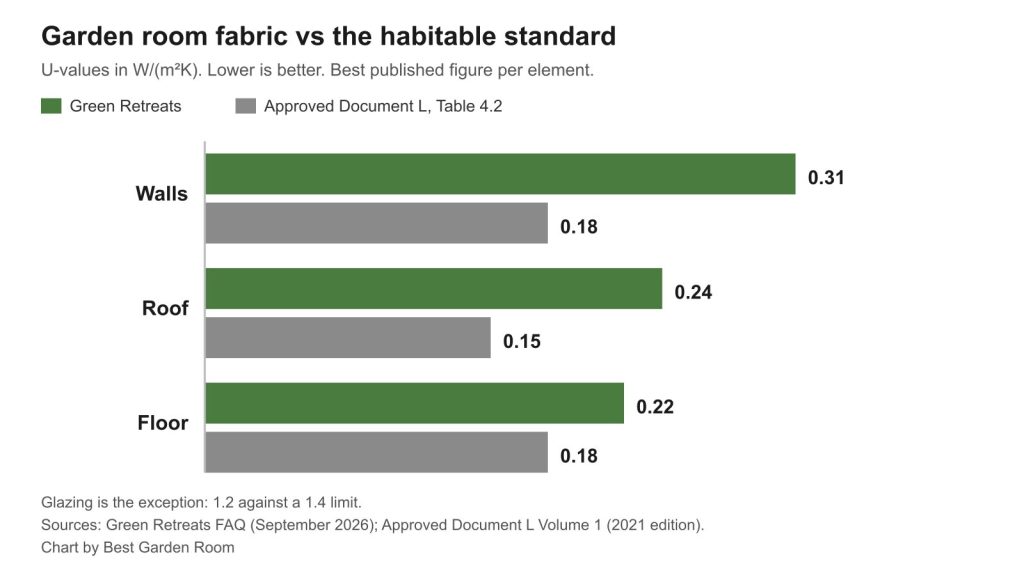
Green Retreats publishes U-values, which is more than many competitors do, and they are respectable numbers for a garden building: glazing 1.2, walls 0.31 to 0.35 depending on range, roof 0.24 to 0.35, and floor 0.22, all in watts per square metre kelvin, with high density polyurethane insulation.
Set those against the standards England applies to habitable space and the picture is clear. Table 4.2 of Approved Document L, which governs new elements in existing dwellings, requires a wall at 0.18, a roof at 0.15, a floor at 0.18 and a window at 1.4. The glazing beats the habitable standard comfortably. The opaque fabric does not come close to it.
That is a description of what a garden room is rather than a criticism. Outbuildings are not built to dwelling standards, which is why they go up under permitted development without building regulations approval. The practical effect is running cost: the walls and roof lose heat roughly twice as fast per square metre as a compliant extension, so budget for heating. The Annex is the range that carries building regulations approval, and the price step reflects it.
The guarantee: 12 years, structural
The company’s own FAQ is unambiguous: “All Green Retreats garden rooms come with a 12-year structural guarantee.” It also states the buildings are designed to last over 30 years with maintenance. You will see a 20 year figure quoted in places online for the X1; the company’s own guarantee page gives 12 years across the ranges, so get whatever applies to your building written into your order.
Read the word structural carefully. It is not the same as cover on doors, ironmongery, glazing units, heating or electrics, which carry separate and much shorter manufacturer warranties. The commonest complaint in public reviews of garden rooms generally, this company included, is doors needing adjustment after a few years, a moving parts issue rather than a structural one. Ask what the door and glazing warranty period is.
Foundations, lead time and site access
Standard buildings include professionally fitted ground screw foundations in a grid, with depth assessed on installation day. The B-Range treats this as an option rather than an inclusion, which is another reason the entry price is not a like for like comparison with the ranges above it.
The company asks for the ground to be cleared and level to within 200mm before installation. That tolerance is the single most common source of unexpected cost on garden room projects: a sloping or overgrown plot needs groundworks that are not in the quote. Walk your site with a spirit level and a tape before you sign anything.
Base work is quoted at half a day to a full day, the building at two to five days on site, and the overall build at one to 15 days depending on design. Electrical connection from the house is available at extra cost with a Part P certificate, or you can use your own electrician. Ground screws need machine access, so a narrow side return changes the job significantly.
Planning permission and the annexe question
Most garden rooms are built under permitted development as an outbuilding incidental to the house, which is why no planning application is normally needed. Flats and listed buildings are outside that, and Article 4 directions can remove the right in conservation areas. Green Retreats says it manages the application where one is needed and quotes a 92% success rate, a figure that is its own and not independently verifiable. CAD drawings are quoted at £200 each with roughly a week’s lead time.
The important line is what a garden room is not. The company states plainly that its garden rooms are “not designed to be lived in as they do not comply to building regulations”, and points anyone wanting living accommodation at The Annex range instead. That is the honest answer, and it is worth hearing before a salesperson elsewhere tells you otherwise. If you want somewhere a relative can sleep permanently, you are buying a different, more expensive and more regulated product. See our guides to garden room planning permission and garden room annexes for the detail.
The payment schedule is the thing to look at hardest
Per the company’s published terms, the sequence is a £300 holding deposit to secure an installation slot, 60% of the balance six weeks before installation to start production, 30% on the final day of construction, and the last 10% on project completion.
So roughly 90% of the money is with the supplier by the time the building is finished, and 60% of it before manufacturing even begins. This is standard practice across the bespoke garden building trade rather than anything unusual to this company, and it is the reason the Companies House check above is worth doing on any supplier you are considering. Two practical protections: pay the deposit and as much of the balance as possible by credit card, which brings Section 75 protection on transactions over £100, and ask in writing what happens to your money if the company cannot deliver.
What the reviews say, and what they do not
On Trustpilot the company holds a 4.9 out of 5 score from 1,257 reviews, with 91% at five stars. That is a genuinely strong record for a business selling a five figure product, and the recurring themes are the showroom experience, build quality and installation teams.
The number worth noticing is the 3% at one star, a larger share than the two and three star reviews combined. That polarised shape is normal for construction: most projects run smoothly and a small number go wrong badly. Read the one star reviews and the company’s replies rather than the average, and pay attention to whether complaints concern the product or the aftercare, because those tell you different things.
Verdict: who should buy
Green Retreats suits a buyer who wants a manufactured, installed, guaranteed building with a single point of responsibility, and who values walking through 21 buildings before committing. The published U-values, the 12 year structural guarantee, in-house installation and clean filed accounts add up to a lower risk purchase than much of this market offers.
It suits you less if you are price led. The B-Range entry point exists, but the specification that most buyers actually want sits in the G-Range and above, and at that level a good local builder or a smaller regional specialist may build something better insulated for similar money. It also suits you less if you want somewhere to sleep, since that is a different product with building regulations attached.
Either way, do the same three things: check the supplier at Companies House, walk the site for access and level, and get the payment schedule and warranty terms in writing before the deposit leaves your account. Our comparison of UK garden room companies covers the alternatives.
Frequently asked questions
Is Green Retreats a reputable company?
On the public evidence, yes. GREEN RETREATS LIMITED is active at Companies House, files medium company accounts on time, has no insolvency history, and holds a 4.9 out of 5 Trustpilot score from more than 1,200 reviews. That is not a guarantee of a smooth project, but it is a materially better starting position than an unfilable trading name with a handful of reviews.
How much does a Green Retreats garden room cost?
Its published starting prices in September 2026 ranged from roughly £9,500 for the entry B-Range to about £63,000 for The Annex, with the mainstream G-Range starting near £23,800. Starting prices are for the smallest size in each range with base specification, so the quoted figure for the building most people actually choose will be higher.
Do I need planning permission for one?
Usually not. Garden rooms normally fall under permitted development rights as outbuildings incidental to the house, subject to height, siting and coverage limits. Flats, listed buildings and areas with an Article 4 direction are the common exceptions. Check with your council before ordering.
Can you sleep in a Green Retreats garden room?
Not in the standard garden room ranges. The company states its garden rooms are not designed to be lived in because they do not comply with building regulations. Its Annex range is the product intended for full time living and includes building regulations approval.
What does the 12 year guarantee actually cover?
It is described as a structural guarantee, covering the structure of the building rather than the components fitted into it. Doors, glazing units, heating and electrical items generally carry their own shorter manufacturer warranties. Ask for those periods in writing alongside the headline figure.
Related guides
- Garden Room Planning Permission UK: The 30m² and 50% Rules Explained
- How Much Does a Garden Room Cost to Run in Winter? Real UK Figures
- Garden Room vs Extension: Honest Cost, Value and When Each Wins
- How Much Does It Cost to Run Electrics to a Garden Room in 2026?
- Ground Screws vs Concrete Base: Which Garden Room Foundation Is Right for You?
- Do Garden Rooms Need Building Regulations? The 15, 30 and 1m Rules Explained
- Prefab vs Bespoke Garden Rooms: Which Is Right for You?
- Garden Room Buying Mistakes: 12 Costly Errors to Avoid
- Garden Room News: June 2026
- How to Buy a Garden Room: The Complete UK Buyer’s Guide (2026)
- What to Look for in a Garden Room: 15 Things to Check Before You Buy
- Buying a Second-Hand Garden Room: Is It Worth It?
- Garden Room Kits vs Fully Installed: Should You Self-Build or Buy Turnkey?
- Garden Room Deposits, Contracts and Deliverables: Protecting Your Money
- How Long Does a Garden Room Last? Lifespan and Maintenance
- Garden Room Cost Per Square Metre: 2026 UK Rates Explained
- How Much Does a Garden Room Cost in the UK? (2026 Price Guide)
- Garden Room Prices by Size: From 3x3m to 8x4m and Beyond
- How Much Does a Garden Office Cost? (2026 UK Breakdown)
- Garden Room Planning News: Late June 2026
- How Much Does a Garden Room with a Bathroom Cost?
- Hidden Garden Room Costs: Foundations, VAT and the Extras Quotes Miss
- Garden Room Finance: Loans, Mortgages and Payment Options Explained
- Garden Room News: Early July 2026
- Do Garden Rooms Add Value to Your House? What the UK Resale Data Shows
- Permitted Development Rights for Garden Rooms: Size, Height and the 2m Boundary Rule
- Do Garden Rooms Affect Council Tax? Business Rates and Reassessment
- Garden Room News: Mid-July 2026
- How a Garden Room Is Built: Foundations to Finish (UK Guide)
- SIPs vs Timber Frame Garden Rooms: Which Construction Is Better?
- How Close to a Boundary Can a Garden Room Be? UK Rules Explained
- How to Apply for Garden Room Planning Permission: Step by Step
- Can You Build a Garden Room on Decking, Slabs or a Patio?
- Is a Garden Room Cheaper Than an Extension? 2026 Cost Comparison
- Garden Room News: Mid-July 2026
- Garden Room Cladding: Cedar vs Composite vs Larch vs Render
- Garden Room Roof Guide: Flat vs Pitched and the Best Materials
- Garden Room Windows and Doors: Bifold, Sliding and Glazing
- How to Build a Garden Room: A DIY Step-by-Step Guide (UK)
- How Long Does It Take to Build a Garden Room?
- How to Make a Garden Room Usable All Year Round
- Garden Room Insulation: Best Materials and U-Values for the UK
- How to Heat a Garden Room: 9 Options Compared by Cost and Warmth
- Best Heating for a Garden Office: Warm Without a Huge Bill
- Air Conditioning for Garden Rooms: Cooling and Heating in One
- Stopping Condensation and Damp in a Garden Room (UK Guide)
- How to Get Wi-Fi in a Garden Office: 6 Ways That Actually Work
- Garden Office Ideas: Designing the Perfect Work-From-Home Space
- Garden Room Ideas: 20 Popular Uses to Inspire Your Build
- Garden Room Annexe: Rules, Costs and How to Build One
- Garden Bar Ideas: The Height Rules, Power and Layout
- Garden Room Business: What Changes Once Clients Visit
- Garden Studio Ideas: Sizes, Light and the 2.5m Rule
- Garden Room Lighting: IP20 Inside, IP65 Out, Part P Rules
- Landscaping Around a Garden Room: the 30cm Decking Trap
- Garden Room Design: Why 2.5m Decides Everything
- Garden Room Planning Permission: the 2.5m Boundary Rule
- Garden Room News: New NPPF Lands, PD Rules Unchanged
- Garden Saunas UK: Planning, Building Regs and Electrics
- Best Garden Room Companies UK: Guarantees of 10 to 25 Years
- Garden Room Electrics: The Rules Change on 15 Oct 2026
- Golf Simulator Garden Room: The 2.5m Rule That Stops It
- Garden Screens: the 2m Rule, and Why Trellis Counts
- Cheap Garden Rooms: What 19mm Walls Really Get You
- Booths Garden Studios Review: Steel Build, 25 Years
- Eden Garden Rooms Review: £23,500 Start, 10-Year Cover
- Green Retreats vs Booths: 25-Year Steel or Timber?
- Garden Rooms London: 6 Companies and the 2.5m Limit
- Garden Room Bedroom: Why a Bed Changes the Rules
- Do I Need Planning Permission for a Garden Shed? Usually Not
- Garden Room News: Staged Payments Arrive, Timber Stays Dear
- Garden Gym Ideas: Sizes, Ceilings and the 2.5m Height Rule
- Garden Gazebo Rules: 2.5m Near a Boundary, 4m Max
- Garden Arch: Wood or Metal, and the 2.7m Height Rule
- Garden Arbour: Sizes That Seat Two, and Wood vs Metal
- Wooden Garden Gates: Sizes, UC4 Posts and the 1m Rule
- Garden Room News: Rates Held, Materials Up 5.9%
- Summer House Interior Ideas: 9 That Work in Winter
- Garden Trellis Panels: the 2m Rule Most Buyers Miss
- Garden Shelters: Six Types and When You Need Permission
- Garden Greenhouses: Glass Gives 90% Light, Plastic 80%
- Summer House Doors and Windows: 4mm Toughened or Styrene?
- Log Stores: Size, Siting and the 20% Moisture Rule
- Garden Shed Roof: Felt, EPDM or Onduline by Pitch
- Insulated Garden Shed: The 25mm Gap That Stops Damp
- Composite Garden Sheds: Rot-Proof, But Check These 6 Things
- How to Build a Garden Shed: Base, Frame and Roof in 5 Steps
- Garden Room News: Power 26.32p a kWh, VAT-Free to March
- Garden Workshop: Size, Base, Power and the Planning Rules
- Plastic Garden Sheds: Who They Suit and 6 Checks First
- Metal Garden Sheds: Stop Condensation Before You Buy
- Garden Shed Storage Ideas: 12 That Free Up Floor Space
- Wooden Garden Sheds: 7 Specs That Decide How Long They Last
- 8×6 Garden Shed: Real Floor Size, Door Width and Base
- 6×4 Garden Shed: 59cm Door, 118cm Deep and What Fits
- Small Garden Shed: 88.5cm Wide Inside and What Fits
- Garden Room News: Building Control Fees Change 6 Nov
- 6×10 Garden Shed: 295 x 182.6cm Inside, and What Fits