

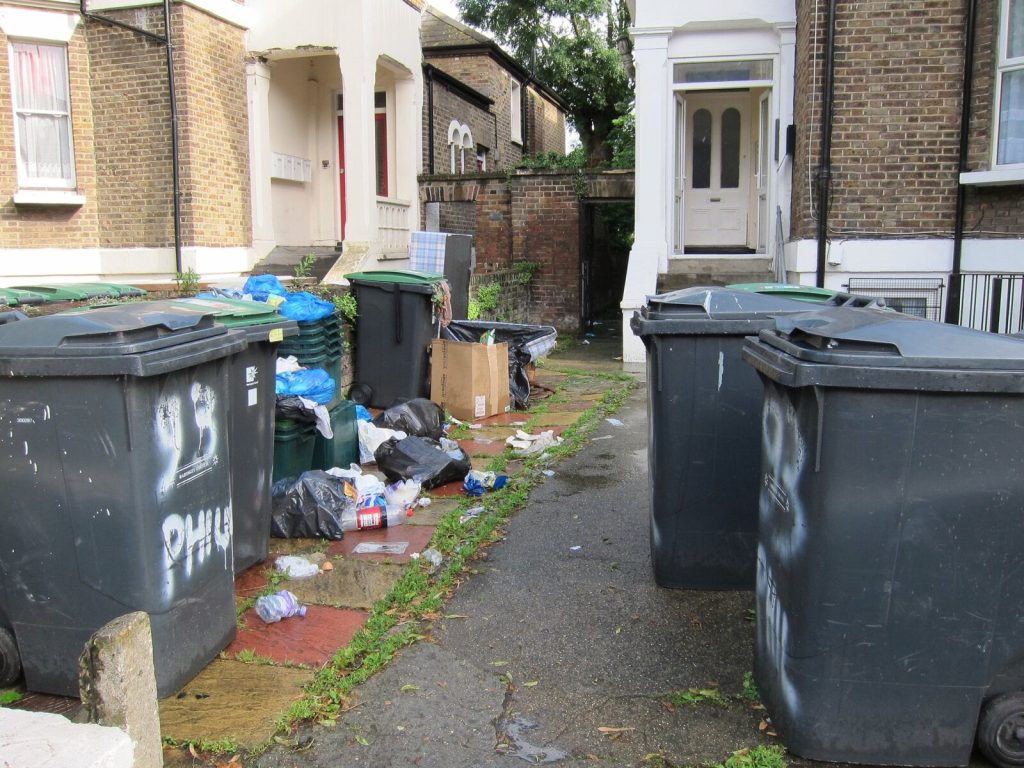
Garden bin storage looks like a five-minute purchase until you measure the bins. A council 240 litre wheelie bin is about 107cm tall, 58cm wide and 74cm deep, and most homes now have three or four containers to house once weekly food waste caddies are counted. Get the internal sizes, the lid clearance or the planning position wrong, and you end up with a store the bins do not fit, or one the council asks you to move.
This page covers the measurements to work from, the materials that last, where a bin store can go without a planning application, and the details that decide whether you will actually use it on collection day.
Measure your bins before you buy anything
Bin sizes vary a little by manufacturer and council, so measure your own. As a starting point, Croydon Council publishes these dimensions for its bins:
- 180 litre wheelie bin: 107cm high, 48cm wide, 72cm deep.
- 240 litre wheelie bin: 107cm high, 58cm wide, 74cm deep. This is the most common household size.
- 360 litre wheelie bin: 109.8cm high, 61cm wide, 88cm deep.
Then add clearance. Each bay needs a few centimetres either side so the bin rolls in without scraping, and the store needs to be deep enough for the handle, which sticks out at the back. A bay that matches the bin’s width to the centimetre will be a daily irritation.
Lid clearance is the measurement people forget
A wheelie bin lid hinges at the back and swings up past vertical. A store with a fixed roof only a few centimetres above the bin means pulling the bin out every time you throw a bag away. Three ways to solve it:
- A hinged roof that lifts with the bin lid, often linked by a chain or strap so opening the store lid opens the bin.
- A taller store with enough headroom for the lid to open fully inside it.
- An open-fronted screen with no roof at all, which hides the bins from the street but does nothing for rain.
Count every container, not just the wheelie bins
Under the Simpler Recycling reforms, councils in England have been moving every household onto weekly food waste collections, with 31 March 2026 the deadline set for household services. That usually means a kerbside food caddy alongside the general waste and recycling bins, plus a garden waste bin if you pay for one. Plan a bay or a shelf for each, or the overflow ends up beside the store.
Wood, metal or plastic: which bin store lasts
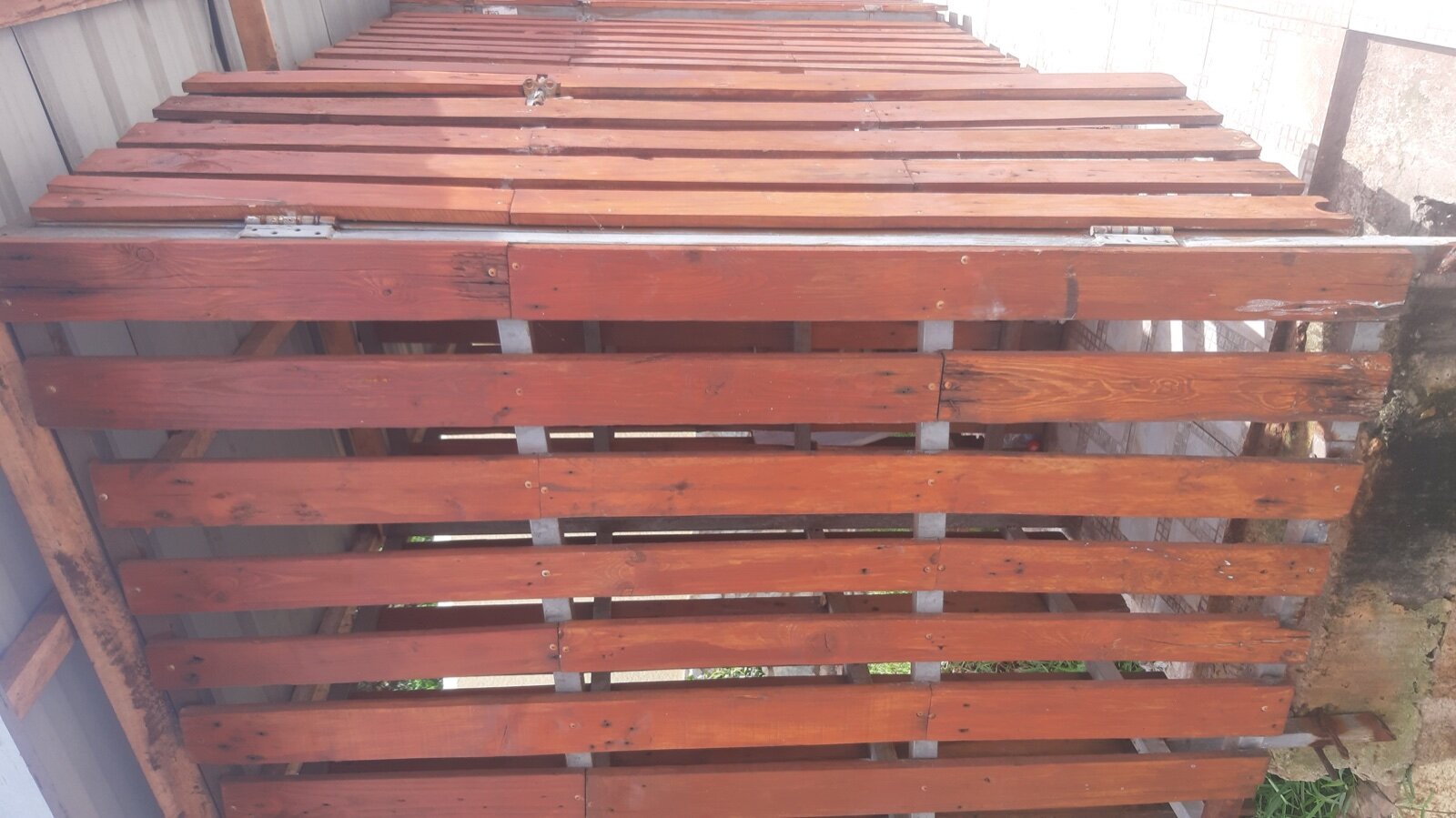
- Timber: the most common choice and the easiest to blend with fences and planting. Look for pressure-treated softwood, keep the base off the ground on bearers or slabs, and treat it every year or two. Slatted fronts let air through, which helps with smells in summer.
- Metal: galvanised or powder-coated steel stores are tough, do not rot and are harder to break into, but they get hot in sun and can dent. Check fixings are galvanised too, or rust stains will run down the panels.
- Plastic and resin: light, cheap and wipe-clean, with no maintenance. Thin panels flex and can blow over if not fixed down, and the colours fade in direct sun.
- Brick or block: the most permanent option and common on new builds. It needs a footing and counts as a structure for planning purposes, so it is the option most likely to need a conversation with the council.
Living roofs and planters
Many timber stores come with a planted roof tray or planter on top. They soften the look, but a wet planted roof is heavy, so the frame needs to be built for the load and the lid hinge needs to be strong enough to lift it. Sedum mats suit a shallow tray better than bedding plants.
Do you need planning permission for a bin store?
For most houses in England, a bin store in the back garden or down the side can go up under permitted development, the same rules that cover sheds and other outbuildings. The Planning Portal outbuildings guidance sets the limits that matter for a bin store:
- Not forward of the principal elevation: no outbuilding on land in front of the wall that forms the main front of the house.
- 2.5m within 2m of a boundary: anything within two metres of a boundary can be no more than 2.5 metres high. No domestic bin store comes close to that.
- Half the garden: outbuildings and extensions together can cover no more than half the land around the original house.
- Listed buildings: any outbuilding within the curtilage of a listed building needs planning permission.
- Designated land: in conservation areas, National Parks and similar areas, enclosures to the side of the house need planning permission.
The front garden problem
This is where most people are caught out. Plenty of terraced houses have nowhere to keep bins except the front garden, but a store in front of the principal elevation falls outside permitted development. Whether a small freestanding screen counts as development can depend on its size, how permanent it is and your council’s view; a fixed timber or brick structure is much more likely to be treated as development. If you are unsure, ask your council before building, especially in a conservation area.
The government consulted in 2024 on a new permitted development right for bin and bike stores in front gardens, up to 2m wide, 1m deep and 1.5m high. As of October 2026 the consultation page still says the government is analysing the feedback, and the planning order that came into force on 21 October 2026 does not include it. Until the rules actually change, do not rely on those dimensions.
Our page on planning permission for garden sheds covers the same outbuilding rules in more detail.
Details that make a bin store work every week
- A level, hard base. Paving slabs or a concrete pad stop the bins sinking and the store rocking. Lay it flush with the path so the wheels roll straight on.
- A clear route to the kerb. Steps, gravel and narrow side gates make collection day harder. Check the bins will still go through the gate when the store is in place.
- Doors that stay open. A simple hook or catch stops doors swinging shut on the bin while you pull it out.
- Somewhere for the numbers. If your council asks for house numbers on bins, make sure they are still visible or easy to check.
- Fix it down. Light stores and screens should be anchored to the base or a wall so a gust does not tip them onto a car.
- Keep foxes out. A closed store helps, but food caddies still need their own lids locked.
Combining bin storage with other garden storage
A long store can take bins in one section and garden tools, recycling boxes or logs in another. If you are weighing up a combined unit, our page on a shed with a log store covers how to split one structure between dry storage and open, ventilated bays. Keep bins in the end nearest the gate.
Frequently asked questions
What size bin store do I need for two wheelie bins?
For two 240 litre bins at about 58cm wide each, allow at least 130cm of internal width so each bin has room either side, and around 80cm or more of depth for the handle. Measure your own bins first, as sizes vary.
Do I need planning permission for a wheelie bin store in my front garden?
A fixed store in front of the main front wall of the house falls outside permitted development in England, so it may need permission. The 2024 proposal to allow front garden bin stores without an application has not been made law. Check with your council.
Can I put a bin store on gravel?
You can, but bins are hard to wheel across gravel and the store can settle unevenly. A strip of paving slabs under the store and along the route to the gate makes collection day far easier.
How do I stop my bin store smelling?
Choose a store with slatted or vented panels so air moves through, keep it out of full afternoon sun if you can, and rinse the bins and the base now and then. Food waste in sealed caddies helps most.
Is a wooden or plastic bin store better?
Timber looks better and lasts if it is treated and kept off the ground. Plastic needs no maintenance but can fade and needs fixing down. Metal is the most secure and does not rot.
Can a bin store go against my neighbour’s fence?
Yes, within permitted development the limit near a boundary is 2.5 metres high, which no ordinary bin store reaches. Keep it freestanding rather than fixing it to your neighbour’s fence.
See more storage and garden building advice on Best Garden Room.
Related guides
- Garden Room Planning Permission UK: The 30m² and 50% Rules Explained
- How Much Does a Garden Room Cost to Run in Winter? Real UK Figures
- Garden Room vs Extension: Honest Cost, Value and When Each Wins
- How Much Does It Cost to Run Electrics to a Garden Room in 2026?
- Ground Screws vs Concrete Base: Which Garden Room Foundation Is Right for You?
- Do Garden Rooms Need Building Regulations? The 15, 30 and 1m Rules Explained
- Prefab vs Bespoke Garden Rooms: Which Is Right for You?
- Garden Room Buying Mistakes: 12 Costly Errors to Avoid
- Garden Room News: June 2026
- How to Buy a Garden Room: The Complete UK Buyer’s Guide (2026)
- What to Look for in a Garden Room: 15 Things to Check Before You Buy
- Buying a Second-Hand Garden Room: Is It Worth It?
- Garden Room Kits vs Fully Installed: Should You Self-Build or Buy Turnkey?
- Garden Room Deposits, Contracts and Deliverables: Protecting Your Money
- How Long Does a Garden Room Last? Lifespan and Maintenance
- Garden Room Cost Per Square Metre: 2026 UK Rates Explained
- How Much Does a Garden Room Cost in the UK? (2026 Price Guide)
- Garden Room Prices by Size: From 3x3m to 8x4m and Beyond
- How Much Does a Garden Office Cost? (2026 UK Breakdown)
- Garden Room Planning News: Late June 2026
- How Much Does a Garden Room with a Bathroom Cost?
- Hidden Garden Room Costs: Foundations, VAT and the Extras Quotes Miss
- Garden Room Finance: Loans, Mortgages and Payment Options Explained
- Garden Room News: Early July 2026
- Do Garden Rooms Add Value to Your House? What the UK Resale Data Shows
- Permitted Development Rights for Garden Rooms: Size, Height and the 2m Boundary Rule
- Do Garden Rooms Affect Council Tax? Business Rates and Reassessment
- Garden Room News: Mid-July 2026
- How a Garden Room Is Built: Foundations to Finish (UK Guide)
- SIPs vs Timber Frame Garden Rooms: Which Construction Is Better?
- How Close to a Boundary Can a Garden Room Be? UK Rules Explained
- How to Apply for Garden Room Planning Permission: Step by Step
- Can You Build a Garden Room on Decking, Slabs or a Patio?
- Is a Garden Room Cheaper Than an Extension? 2026 Cost Comparison
- Garden Room News: Mid-July 2026
- Garden Room Cladding: Cedar vs Composite vs Larch vs Render
- Garden Room Roof Guide: Flat vs Pitched and the Best Materials
- Garden Room Windows and Doors: Bifold, Sliding and Glazing
- How to Build a Garden Room: A DIY Step-by-Step Guide (UK)
- How Long Does It Take to Build a Garden Room?
- How to Make a Garden Room Usable All Year Round
- Garden Room Insulation: Best Materials and U-Values for the UK
- How to Heat a Garden Room: 9 Options Compared by Cost and Warmth
- Best Heating for a Garden Office: Warm Without a Huge Bill
- Air Conditioning for Garden Rooms: Cooling and Heating in One
- Stopping Condensation and Damp in a Garden Room (UK Guide)
- How to Get Wi-Fi in a Garden Office: 6 Ways That Actually Work
- Garden Office Ideas: Designing the Perfect Work-From-Home Space
- Garden Room Ideas: 20 Popular Uses to Inspire Your Build
- Garden Room Annexe: Rules, Costs and How to Build One
- Garden Bar Ideas: The Height Rules, Power and Layout
- Garden Room Business: What Changes Once Clients Visit
- Garden Studio Ideas: Sizes, Light and the 2.5m Rule
- Garden Room Lighting: IP20 Inside, IP65 Out, Part P Rules
- Landscaping Around a Garden Room: the 30cm Decking Trap
- Garden Room Design: Why 2.5m Decides Everything
- Garden Room Planning Permission: the 2.5m Boundary Rule
- Garden Room News: New NPPF Lands, PD Rules Unchanged
- Garden Saunas UK: Planning, Building Regs and Electrics
- Best Garden Room Companies UK: Guarantees of 10 to 25 Years
- Garden Room Electrics: The Rules Change on 15 Oct 2026
- Golf Simulator Garden Room: The 2.5m Rule That Stops It
- Garden Screens: the 2m Rule, and Why Trellis Counts
- Cheap Garden Rooms: What 19mm Walls Really Get You
- Green Retreats Review: 12-Year Cover, 60% Upfront
- Booths Garden Studios Review: Steel Build, 25 Years
- Eden Garden Rooms Review: £23,500 Start, 10-Year Cover
- Green Retreats vs Booths: 25-Year Steel or Timber?
- Garden Rooms London: 6 Companies and the 2.5m Limit
- Garden Room Bedroom: Why a Bed Changes the Rules
- Do I Need Planning Permission for a Garden Shed? Usually Not
- Garden Room News: Staged Payments Arrive, Timber Stays Dear
- Garden Gym Ideas: Sizes, Ceilings and the 2.5m Height Rule
- Garden Gazebo Rules: 2.5m Near a Boundary, 4m Max
- Garden Arch: Wood or Metal, and the 2.7m Height Rule
- Garden Arbour: Sizes That Seat Two, and Wood vs Metal
- Wooden Garden Gates: Sizes, UC4 Posts and the 1m Rule
- Garden Room News: Rates Held, Materials Up 5.9%
- Summer House Interior Ideas: 9 That Work in Winter
- Garden Trellis Panels: the 2m Rule Most Buyers Miss
- Garden Shelters: Six Types and When You Need Permission
- Garden Greenhouses: Glass Gives 90% Light, Plastic 80%
- Summer House Doors and Windows: 4mm Toughened or Styrene?
- Log Stores: Size, Siting and the 20% Moisture Rule
- Garden Shed Roof: Felt, EPDM or Onduline by Pitch
- Insulated Garden Shed: The 25mm Gap That Stops Damp
- Composite Garden Sheds: Rot-Proof, But Check These 6 Things
- How to Build a Garden Shed: Base, Frame and Roof in 5 Steps
- Garden Room News: Power 26.32p a kWh, VAT-Free to March
- Garden Workshop: Size, Base, Power and the Planning Rules
- Plastic Garden Sheds: Who They Suit and 6 Checks First
- Metal Garden Sheds: Stop Condensation Before You Buy
- Garden Shed Storage Ideas: 12 That Free Up Floor Space
- Wooden Garden Sheds: 7 Specs That Decide How Long They Last
- 8×6 Garden Shed: Real Floor Size, Door Width and Base
- 6×4 Garden Shed: 59cm Door, 118cm Deep and What Fits
- Small Garden Shed: 88.5cm Wide Inside and What Fits
- Garden Room News: Building Control Fees Change 6 Nov
- 6×10 Garden Shed: 295 x 182.6cm Inside, and What Fits
- Bike Shed for Garden: Sizes, Ground Anchors and the Locks
- Shed With Log Store: Sizes, Layout and the 2.5m Rule