

A shed with a log store puts the firewood and the tools under one roof: a lockable shed on one side, an open, airy bay for logs on the other. It saves a second base, a second roof and a second patch of lawn, and it means the axe, the log basket and the wood live in the same place. The catch is that the two halves want opposite things. Tools want to be dry and shut in. Logs want air moving through them all year.
Get the layout right and a combined unit works well. Get it wrong and you end up with a damp shed and logs that never dry. Here is what to look for, how to size the log bay, and where the planning limits sit.
Combined unit or two separate buildings?
A combined shed and log store makes sense when space is tight and you want one neat building against a fence. Forest Garden, one of the biggest UK makers, sells several: its Medium Overlap Log Store and Tool Shed, for example, measures 182.2cm wide, 87cm deep and 190.8cm high, with overlap side panels, a felted boarded roof, a slatted floor and a 15-year anti-rot guarantee. Its Timberdale range adds a log store to a full-size apex shed.
Two separate buildings make more sense when:
- You burn a lot of wood and need more log space than any combined unit offers.
- The best spot for drying logs (sunny and breezy) is not the best spot for the shed (close to the house and the back door).
- You want a workshop or an insulated shed, which you would not want sharing a wall with damp, freshly split wood.
If you already have a shed, a lean-to log store against its side wall gives you most of the benefit for much less money. Fix it to its own posts rather than hanging the weight of wet logs off the shed wall.
What a good shed with log store looks like
The HETAS guide to seasoning firewood sets out what logs need: a store raised off the ground so air can circulate, shelter from rain and snow, and plenty of sun through the year. Air movement is the main way logs lose moisture. Translate that into a combined building and you get a short checklist.
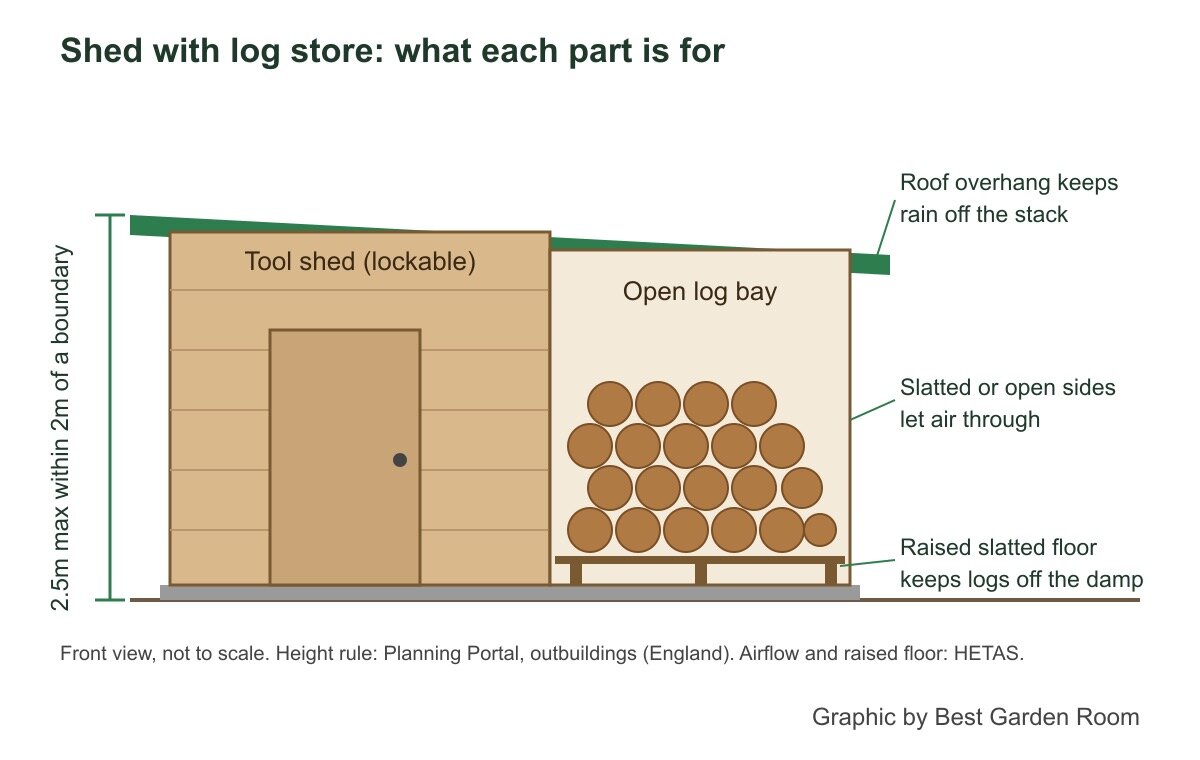
- A raised, slatted floor in the log bay. Logs left on the ground pick up damp, mould and insects. A slatted floor lets air in from underneath.
- Open or slatted sides on the log bay. A solid-clad log bay is a cupboard, not a log store. Look for gaps between the boards or a fully open front.
- A roof that oversteps the front of the bay. The roof is there to stop rain falling straight onto the stack, so a decent overhang matters more than a solid front.
- A solid partition between the two halves. Damp air from the logs should not drift through into the tool side.
- A lockable door on the shed side. Mowers and power tools need security; logs do not.
- Pressure-treated timber with a written guarantee. The log bay sits in damp conditions for much of the year, so check what the anti-rot guarantee covers.
How big should the log bay be?
Size the log bay from how you buy wood, not from the shed. Work out the volume of the bay by multiplying width, depth and height of the usable space. A bay 1m wide, 0.6m deep and 1.4m high holds 0.84 cubic metres of stacked space, before the gaps between logs.
Two points shape the answer:
- Seasoning your own wood needs more space. HETAS says hardwood generally takes eighteen months to two years to dry. If you split your own logs, you need room for this year’s dry wood and next year’s drying wood side by side. Many people use a combined unit for the ready-to-burn logs and a separate open rack for wood that is still drying.
- Buying dry logs needs less. In England, wood sold in quantities under 2 cubic metres must be certified as Ready to Burn, which means a moisture content of 20% or less. Bulk loads of 2 cubic metres or more do not need the certificate, but the seller must give you advice on drying and storing them. A large bulk load will not fit in a typical combined unit, so plan for overflow.
Our guide to log stores goes deeper on sizing and siting a stand-alone store.
Where to put it
Siting is a compromise between the two halves. For the logs, HETAS points to sun and shelter: a spot that gets plenty of sun through the year, with air able to move round the stack. For the shed, you want a firm, level base and an easy path to the house. Practical points:
- Face the open log bay away from the wettest prevailing wind where you can, so rain is not driven into the stack.
- Leave a gap behind the building so air can move and you can reach the back wall to re-treat it.
- Do not tuck the log bay under trees that drip all winter.
- Keep a clear, hard path to the back door. You will be carrying logs in the dark in January.
Do you need planning permission?
Usually not. A shed with a log store is an outbuilding, and in England most outbuildings fall under permitted development. The Planning Portal outbuildings page sets the main limits:
- Single storey, with eaves no higher than 2.5m.
- Overall height up to 4m with a dual-pitched roof, or 3m with any other roof.
- No more than 2.5m tall if it sits within 2m of a boundary, which is where most shed and log store combinations end up.
- Not on land in front of the principal elevation of the house.
- Together with other buildings and extensions, no more than half the land around the original house covered.
- On designated land (conservation areas, National Parks, National Landscapes and World Heritage Sites), anything at the side of the house needs permission, and in some of those areas buildings more than 20m from the house are limited to 10 square metres in total.
Listed buildings and properties with their permitted development rights removed need a check with the council first. Wales, Scotland and Northern Ireland have their own rules.
Looking after it
- Re-treat the timber as the maker advises, paying most attention to the log bay, which stays damp for longer.
- Check the roof covering each autumn. Felt is cheap but has the shortest life; our shed roof guide compares felt, EPDM and corrugated sheets.
- Stack logs loosely. HETAS warns that packing logs tightly or stacking logs behind other logs cuts the airflow and slows drying.
- Use the oldest logs first and refill from the back.
For more on choosing and planning garden buildings, start at the Best Garden Room homepage.
Frequently asked questions
Is a shed with a log store a good idea?
Yes, if your garden is small and you want one building for tools and firewood. It is less suited to heavy wood burners who season their own logs, because the log bay is usually too small to hold two years of drying wood.
Should a log store be open or closed?
Open or slatted at the front and sides, with a solid roof. Logs dry through air movement, so a closed box slows drying and can trap damp.
Can I store logs inside a normal shed?
Only logs that are already dry, and only for a short time. A closed shed has little airflow, so damp logs stay damp and can bring mould and insects in with them.
Does a shed with a log store need planning permission?
Usually not in England, if it meets permitted development limits: single storey, eaves no higher than 2.5m, no taller than 2.5m within 2m of a boundary, and not in front of the house. Designated land and listed buildings have tighter rules.
What moisture should logs be before burning?
20% or less, according to HETAS. In England, firewood sold in quantities under 2 cubic metres must be certified Ready to Burn, which confirms this.
How long do logs take to season in a log store?
HETAS says hardwood generally takes eighteen months to two years. Splitting logs small and stacking them loosely in a sunny, airy spot speeds it up.
Related guides
- Garden Room Planning Permission UK: The 30m² and 50% Rules Explained
- How Much Does a Garden Room Cost to Run in Winter? Real UK Figures
- Garden Room vs Extension: Honest Cost, Value and When Each Wins
- How Much Does It Cost to Run Electrics to a Garden Room in 2026?
- Ground Screws vs Concrete Base: Which Garden Room Foundation Is Right for You?
- Do Garden Rooms Need Building Regulations? The 15, 30 and 1m Rules Explained
- Prefab vs Bespoke Garden Rooms: Which Is Right for You?
- Garden Room Buying Mistakes: 12 Costly Errors to Avoid
- Garden Room News: June 2026
- How to Buy a Garden Room: The Complete UK Buyer’s Guide (2026)
- What to Look for in a Garden Room: 15 Things to Check Before You Buy
- Buying a Second-Hand Garden Room: Is It Worth It?
- Garden Room Kits vs Fully Installed: Should You Self-Build or Buy Turnkey?
- Garden Room Deposits, Contracts and Deliverables: Protecting Your Money
- How Long Does a Garden Room Last? Lifespan and Maintenance
- Garden Room Cost Per Square Metre: 2026 UK Rates Explained
- How Much Does a Garden Room Cost in the UK? (2026 Price Guide)
- Garden Room Prices by Size: From 3x3m to 8x4m and Beyond
- How Much Does a Garden Office Cost? (2026 UK Breakdown)
- Garden Room Planning News: Late June 2026
- How Much Does a Garden Room with a Bathroom Cost?
- Hidden Garden Room Costs: Foundations, VAT and the Extras Quotes Miss
- Garden Room Finance: Loans, Mortgages and Payment Options Explained
- Garden Room News: Early July 2026
- Do Garden Rooms Add Value to Your House? What the UK Resale Data Shows
- Permitted Development Rights for Garden Rooms: Size, Height and the 2m Boundary Rule
- Do Garden Rooms Affect Council Tax? Business Rates and Reassessment
- Garden Room News: Mid-July 2026
- How a Garden Room Is Built: Foundations to Finish (UK Guide)
- SIPs vs Timber Frame Garden Rooms: Which Construction Is Better?
- How Close to a Boundary Can a Garden Room Be? UK Rules Explained
- How to Apply for Garden Room Planning Permission: Step by Step
- Can You Build a Garden Room on Decking, Slabs or a Patio?
- Is a Garden Room Cheaper Than an Extension? 2026 Cost Comparison
- Garden Room News: Mid-July 2026
- Garden Room Cladding: Cedar vs Composite vs Larch vs Render
- Garden Room Roof Guide: Flat vs Pitched and the Best Materials
- Garden Room Windows and Doors: Bifold, Sliding and Glazing
- How to Build a Garden Room: A DIY Step-by-Step Guide (UK)
- How Long Does It Take to Build a Garden Room?
- How to Make a Garden Room Usable All Year Round
- Garden Room Insulation: Best Materials and U-Values for the UK
- How to Heat a Garden Room: 9 Options Compared by Cost and Warmth
- Best Heating for a Garden Office: Warm Without a Huge Bill
- Air Conditioning for Garden Rooms: Cooling and Heating in One
- Stopping Condensation and Damp in a Garden Room (UK Guide)
- How to Get Wi-Fi in a Garden Office: 6 Ways That Actually Work
- Garden Office Ideas: Designing the Perfect Work-From-Home Space
- Garden Room Ideas: 20 Popular Uses to Inspire Your Build
- Garden Room Annexe: Rules, Costs and How to Build One
- Garden Bar Ideas: The Height Rules, Power and Layout
- Garden Room Business: What Changes Once Clients Visit
- Garden Studio Ideas: Sizes, Light and the 2.5m Rule
- Garden Room Lighting: IP20 Inside, IP65 Out, Part P Rules
- Landscaping Around a Garden Room: the 30cm Decking Trap
- Garden Room Design: Why 2.5m Decides Everything
- Garden Room Planning Permission: the 2.5m Boundary Rule
- Garden Room News: New NPPF Lands, PD Rules Unchanged
- Garden Saunas UK: Planning, Building Regs and Electrics
- Best Garden Room Companies UK: Guarantees of 10 to 25 Years
- Garden Room Electrics: The Rules Change on 15 Oct 2026
- Golf Simulator Garden Room: The 2.5m Rule That Stops It
- Garden Screens: the 2m Rule, and Why Trellis Counts
- Cheap Garden Rooms: What 19mm Walls Really Get You
- Green Retreats Review: 12-Year Cover, 60% Upfront
- Booths Garden Studios Review: Steel Build, 25 Years
- Eden Garden Rooms Review: £23,500 Start, 10-Year Cover
- Green Retreats vs Booths: 25-Year Steel or Timber?
- Garden Rooms London: 6 Companies and the 2.5m Limit
- Garden Room Bedroom: Why a Bed Changes the Rules
- Do I Need Planning Permission for a Garden Shed? Usually Not
- Garden Room News: Staged Payments Arrive, Timber Stays Dear
- Garden Gym Ideas: Sizes, Ceilings and the 2.5m Height Rule
- Garden Gazebo Rules: 2.5m Near a Boundary, 4m Max
- Garden Arch: Wood or Metal, and the 2.7m Height Rule
- Garden Arbour: Sizes That Seat Two, and Wood vs Metal
- Wooden Garden Gates: Sizes, UC4 Posts and the 1m Rule
- Garden Room News: Rates Held, Materials Up 5.9%
- Summer House Interior Ideas: 9 That Work in Winter
- Garden Trellis Panels: the 2m Rule Most Buyers Miss
- Garden Shelters: Six Types and When You Need Permission
- Garden Greenhouses: Glass Gives 90% Light, Plastic 80%
- Summer House Doors and Windows: 4mm Toughened or Styrene?
- Log Stores: Size, Siting and the 20% Moisture Rule
- Garden Shed Roof: Felt, EPDM or Onduline by Pitch
- Insulated Garden Shed: The 25mm Gap That Stops Damp
- Composite Garden Sheds: Rot-Proof, But Check These 6 Things
- How to Build a Garden Shed: Base, Frame and Roof in 5 Steps
- Garden Room News: Power 26.32p a kWh, VAT-Free to March
- Garden Workshop: Size, Base, Power and the Planning Rules
- Plastic Garden Sheds: Who They Suit and 6 Checks First
- Metal Garden Sheds: Stop Condensation Before You Buy
- Garden Shed Storage Ideas: 12 That Free Up Floor Space
- Wooden Garden Sheds: 7 Specs That Decide How Long They Last
- 8×6 Garden Shed: Real Floor Size, Door Width and Base
- 6×4 Garden Shed: 59cm Door, 118cm Deep and What Fits
- Small Garden Shed: 88.5cm Wide Inside and What Fits
- Garden Room News: Building Control Fees Change 6 Nov
- 6×10 Garden Shed: 295 x 182.6cm Inside, and What Fits
- Bike Shed for Garden: Sizes, Ground Anchors and the Locks