

Garden cushion storage fails in one of two ways: the box is too small, so half the cushions end up in the shed or the hall, or the box is big enough but the cushions go in damp and come out in April smelling of mildew. Both are avoidable. This page works out how many litres your cushions actually take up, compares three real box sizes, and sets out how to pack them so they come out dry next spring.
Work out how many litres your cushions need
Storage boxes are sold by capacity in litres, but cushions are sold by size in centimetres, so most people guess. The sum is simple: multiply length by width by depth in centimetres and divide by 1,000 to get litres.
- A dining chair seat pad of 40 x 40 x 5cm is 8 litres. Four of them are 32 litres, which fits in almost any box.
- A deep lounge seat cushion of 60 x 60 x 15cm is 54 litres.
- A matching back cushion of 60 x 45 x 15cm is about 40.5 litres.
- A sun lounger pad of 190 x 55 x 5cm is about 52 litres, but its length is the real problem: it has to fold or roll to fit most boxes.
A typical rattan or timber lounge set with a three seat sofa and two armchairs has five seat cushions and five back cushions. Using the sizes above, that is 270 litres of seats plus about 202 litres of backs: roughly 473 litres in total. Measure your own cushions, because sizes vary a lot between sets, and add scatter cushions and throws on top.
Foam cushions compress a little when packed, but they spring back and push against the lid. Leave some headroom rather than filling a box to the brim; a lid forced shut on overfilled cushions will not seal against rain.
Three real box sizes compared
Keter’s resin boxes are among the most widely sold in the UK, and B&Q lists the specifications for several of them. As of October 2026:
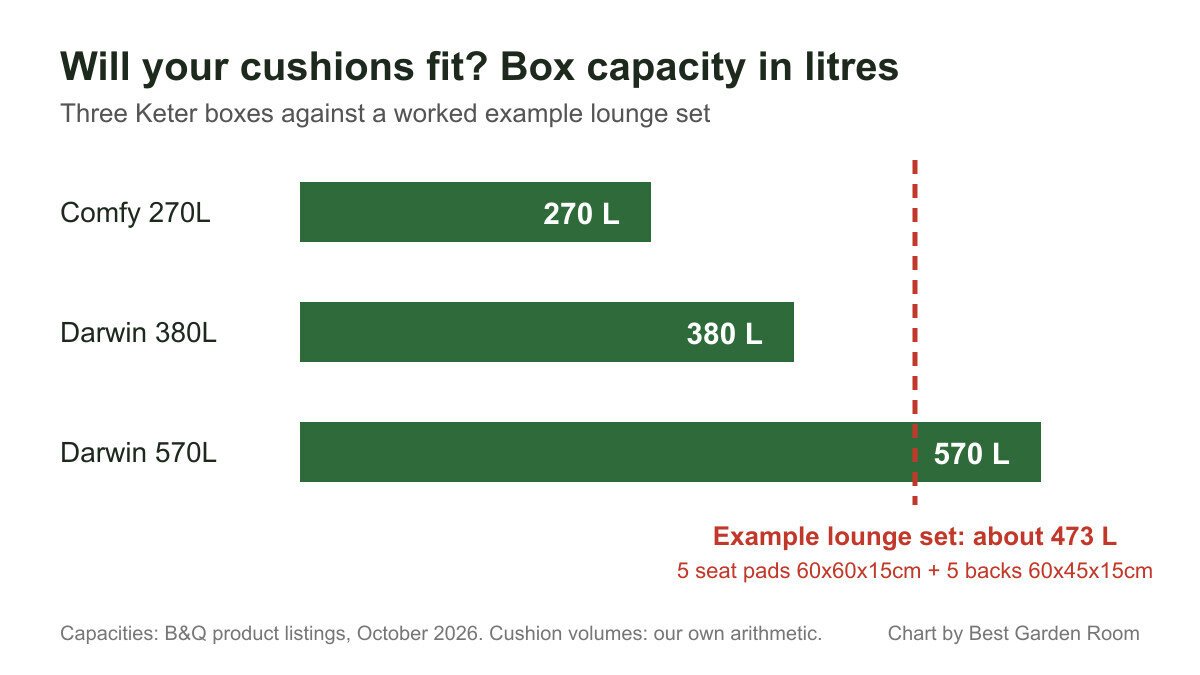
- Keter Comfy 270L: 116.7cm long, 44.7cm deep and 57cm high, weather resistant resin, with wheels and a two year guarantee. Big enough for a dining set’s seat pads and a few scatter cushions, not a lounge set.
- Keter Darwin 380L: 142.5cm wide and 65.3cm deep, about 55cm high, with a lockable lid on a hydraulic piston, a raised floor and ventilation. B&Q’s Darwin 380L listing says it seats two adults. Two year guarantee.
- Keter Darwin 570L: the same 142.5cm width but 78.2cm high, lockable, two year guarantee. Of the three, it is the only one that would take the 473 litre example set with room to spare.
Check the internal dimensions as well as the litres. A 60cm square seat cushion will not lie flat in a box that is less than 60cm deep inside, and a box with a gas strut lid loses a little space where the strut is fixed.
Waterproof or weather resistant: read the wording
Retail listings use the words loosely. The same Darwin boxes are described on one page as having a “waterproof lockable lid” and elsewhere as “weather resistant”. In practice, a resin box with a hinged lid keeps rain off the contents but is not sealed: wind-driven rain can get past the lid edge, and water can sit around the base if the box stands on a lawn or in a low corner of the patio.
Three things make far more difference than the word on the label:
- Where it stands. Put the box on paving or a level slab, ideally under the eaves of the house or a garden room overhang, never on grass.
- A raised floor. Boxes with an elevated floor, as the Darwin range has, keep cushions off any water that gets in at the base.
- Ventilation. A fully airtight box traps the moisture already in the cushions. Vents, or a lid that is not gasket sealed, let it out.
If you need something genuinely sealed, for example for electrical items, look for a product sold and tested for that job, and treat any cushion box as rain resistant, not watertight.
How to store garden cushions so they stay dry
Mildew in a cushion box almost always starts with cushions that went in damp. The steps that prevent it:
- Dry them completely first. After the last use of the season, bring cushions indoors or into a dry shed for a day or two. Squeeze the corners: if the foam feels cool or damp inside, it is not ready.
- Clean before storing. Brush off leaves, pollen and bird droppings. Follow the care label for washable covers and let them dry fully before refitting.
- Do not seal them in plastic. Plastic bags trap moisture against the fabric. A breathable cotton bag or an old sheet keeps dust off and lets air move.
- Stand them on edge. Cushions stood vertically, like books on a shelf, let air move between them and are easier to pull out than a flattened stack.
- Air the box on dry days. Open the lid for an hour on a dry, breezy winter day, especially after a run of wet weather.
- Check in midwinter. A quick look in January catches a leak or a damp corner before it spreads.
Cushions with a quick dry reticulated foam core and a solution dyed acrylic or olefin cover cope with damp far better than standard upholstery foam, but they still last longer stored dry.
Box, bench, shed or garden room?
A cushion box is not the only option, and the right one depends on how often you use the cushions.
- Storage box or deck box. Best if cushions come in and out through the summer: they live next to the furniture and go away in a minute.
- Storage bench. Smaller capacity, but it doubles as seating. Good for a dining set’s seat pads.
- Shed. Fine if it is dry. Cushions on the floor of a damp, unlined shed often fare worse than in a good box; keep them on a shelf, off the floor, and see our garden shed storage ideas for shelving that frees up space.
- Insulated garden room. The driest place in the garden if it is heated or ventilated. Worth it for expensive lounge sets.
For more on choosing, siting and building every kind of garden building, from sheds to garden rooms, see Best Garden Room.
Frequently asked questions
What size storage box do I need for garden cushions?
Multiply each cushion’s length, width and depth in centimetres, divide by 1,000 for litres, and add them up. A four chair dining set’s seat pads need about 32 litres; a five seat lounge set with back cushions can need around 470 litres or more.
Can I leave garden cushions in a storage box all winter?
Yes, if they go in completely dry, the box stands on paving rather than grass, and it has some ventilation. Air the box on dry days and check it in midwinter.
Are garden cushion boxes waterproof?
Most are rain resistant rather than sealed. Even boxes advertised with a waterproof lid can let in wind-driven rain at the edges, so siting and a raised floor matter more than the label.
Why do my garden cushions smell musty after storage?
They were stored damp, or moisture got in and could not escape. Dry them fully before storing, avoid plastic bags, and choose a box with ventilation.
Should I store garden cushions in plastic bags?
No. Plastic traps moisture against the fabric and encourages mildew. Use a breathable cotton bag or a sheet instead.
Where is the best place to store garden cushions in winter?
A dry indoor space, such as a heated garden room, spare room or loft, is best. A ventilated resin box on paving under cover is the next best option.
Related guides
- Garden Room Planning Permission UK: The 30m² and 50% Rules Explained
- How Much Does a Garden Room Cost to Run in Winter? Real UK Figures
- Garden Room vs Extension: Honest Cost, Value and When Each Wins
- How Much Does It Cost to Run Electrics to a Garden Room in 2026?
- Ground Screws vs Concrete Base: Which Garden Room Foundation Is Right for You?
- Do Garden Rooms Need Building Regulations? The 15, 30 and 1m Rules Explained
- Prefab vs Bespoke Garden Rooms: Which Is Right for You?
- Garden Room Buying Mistakes: 12 Costly Errors to Avoid
- Garden Room News: June 2026
- How to Buy a Garden Room: The Complete UK Buyer’s Guide (2026)
- What to Look for in a Garden Room: 15 Things to Check Before You Buy
- Buying a Second-Hand Garden Room: Is It Worth It?
- Garden Room Kits vs Fully Installed: Should You Self-Build or Buy Turnkey?
- Garden Room Deposits, Contracts and Deliverables: Protecting Your Money
- How Long Does a Garden Room Last? Lifespan and Maintenance
- Garden Room Cost Per Square Metre: 2026 UK Rates Explained
- How Much Does a Garden Room Cost in the UK? (2026 Price Guide)
- Garden Room Prices by Size: From 3x3m to 8x4m and Beyond
- How Much Does a Garden Office Cost? (2026 UK Breakdown)
- Garden Room Planning News: Late June 2026
- How Much Does a Garden Room with a Bathroom Cost?
- Hidden Garden Room Costs: Foundations, VAT and the Extras Quotes Miss
- Garden Room Finance: Loans, Mortgages and Payment Options Explained
- Garden Room News: Early July 2026
- Do Garden Rooms Add Value to Your House? What the UK Resale Data Shows
- Permitted Development Rights for Garden Rooms: Size, Height and the 2m Boundary Rule
- Do Garden Rooms Affect Council Tax? Business Rates and Reassessment
- Garden Room News: Mid-July 2026
- How a Garden Room Is Built: Foundations to Finish (UK Guide)
- SIPs vs Timber Frame Garden Rooms: Which Construction Is Better?
- How Close to a Boundary Can a Garden Room Be? UK Rules Explained
- How to Apply for Garden Room Planning Permission: Step by Step
- Can You Build a Garden Room on Decking, Slabs or a Patio?
- Is a Garden Room Cheaper Than an Extension? 2026 Cost Comparison
- Garden Room News: Mid-July 2026
- Garden Room Cladding: Cedar vs Composite vs Larch vs Render
- Garden Room Roof Guide: Flat vs Pitched and the Best Materials
- Garden Room Windows and Doors: Bifold, Sliding and Glazing
- How to Build a Garden Room: A DIY Step-by-Step Guide (UK)
- How Long Does It Take to Build a Garden Room?
- How to Make a Garden Room Usable All Year Round
- Garden Room Insulation: Best Materials and U-Values for the UK
- How to Heat a Garden Room: 9 Options Compared by Cost and Warmth
- Best Heating for a Garden Office: Warm Without a Huge Bill
- Air Conditioning for Garden Rooms: Cooling and Heating in One
- Stopping Condensation and Damp in a Garden Room (UK Guide)
- How to Get Wi-Fi in a Garden Office: 6 Ways That Actually Work
- Garden Office Ideas: Designing the Perfect Work-From-Home Space
- Garden Room Ideas: 20 Popular Uses to Inspire Your Build
- Garden Room Annexe: Rules, Costs and How to Build One
- Garden Bar Ideas: The Height Rules, Power and Layout
- Garden Room Business: What Changes Once Clients Visit
- Garden Studio Ideas: Sizes, Light and the 2.5m Rule
- Garden Room Lighting: IP20 Inside, IP65 Out, Part P Rules
- Landscaping Around a Garden Room: the 30cm Decking Trap
- Garden Room Design: Why 2.5m Decides Everything
- Garden Room Planning Permission: the 2.5m Boundary Rule
- Garden Room News: New NPPF Lands, PD Rules Unchanged
- Garden Saunas UK: Planning, Building Regs and Electrics
- Best Garden Room Companies UK: Guarantees of 10 to 25 Years
- Garden Room Electrics: The Rules Change on 15 Oct 2026
- Golf Simulator Garden Room: The 2.5m Rule That Stops It
- Garden Screens: the 2m Rule, and Why Trellis Counts
- Cheap Garden Rooms: What 19mm Walls Really Get You
- Green Retreats Review: 12-Year Cover, 60% Upfront
- Booths Garden Studios Review: Steel Build, 25 Years
- Eden Garden Rooms Review: £23,500 Start, 10-Year Cover
- Green Retreats vs Booths: 25-Year Steel or Timber?
- Garden Rooms London: 6 Companies and the 2.5m Limit
- Garden Room Bedroom: Why a Bed Changes the Rules
- Do I Need Planning Permission for a Garden Shed? Usually Not
- Garden Room News: Staged Payments Arrive, Timber Stays Dear
- Garden Gym Ideas: Sizes, Ceilings and the 2.5m Height Rule
- Garden Gazebo Rules: 2.5m Near a Boundary, 4m Max
- Garden Arch: Wood or Metal, and the 2.7m Height Rule
- Garden Arbour: Sizes That Seat Two, and Wood vs Metal
- Wooden Garden Gates: Sizes, UC4 Posts and the 1m Rule
- Garden Room News: Rates Held, Materials Up 5.9%
- Summer House Interior Ideas: 9 That Work in Winter
- Garden Trellis Panels: the 2m Rule Most Buyers Miss
- Garden Shelters: Six Types and When You Need Permission
- Garden Greenhouses: Glass Gives 90% Light, Plastic 80%
- Summer House Doors and Windows: 4mm Toughened or Styrene?
- Log Stores: Size, Siting and the 20% Moisture Rule
- Garden Shed Roof: Felt, EPDM or Onduline by Pitch
- Insulated Garden Shed: The 25mm Gap That Stops Damp
- Composite Garden Sheds: Rot-Proof, But Check These 6 Things
- How to Build a Garden Shed: Base, Frame and Roof in 5 Steps
- Garden Room News: Power 26.32p a kWh, VAT-Free to March
- Garden Workshop: Size, Base, Power and the Planning Rules
- Plastic Garden Sheds: Who They Suit and 6 Checks First
- Metal Garden Sheds: Stop Condensation Before You Buy
- Garden Shed Storage Ideas: 12 That Free Up Floor Space
- Wooden Garden Sheds: 7 Specs That Decide How Long They Last
- 8×6 Garden Shed: Real Floor Size, Door Width and Base
- 6×4 Garden Shed: 59cm Door, 118cm Deep and What Fits
- Small Garden Shed: 88.5cm Wide Inside and What Fits
- Garden Room News: Building Control Fees Change 6 Nov
- 6×10 Garden Shed: 295 x 182.6cm Inside, and What Fits
- Bike Shed for Garden: Sizes, Ground Anchors and the Locks
- Shed With Log Store: Sizes, Layout and the 2.5m Rule
- Garden Bin Storage: Sizes, Lids and the Front Garden Rule
- Pergola Planning Permission: the 2.5m Boundary Rule