

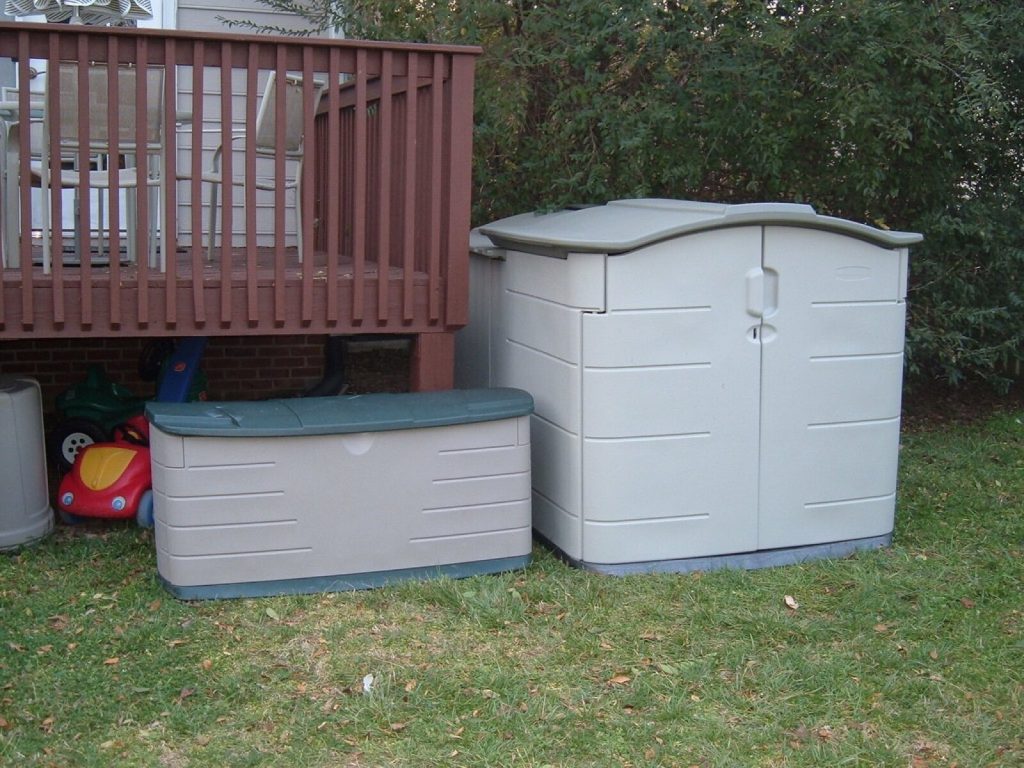
A garden bench with storage does two jobs in the space of one: somewhere to sit, and a dry box for the cushions, toys and tools that otherwise end up in the shed or the hallway. The catch is that the “dry box” part varies far more than the seat. Three two-seat benches on sale at Wickes this month hold 150, 200 and 265 litres under the seat, and they are built from three different materials with guarantees running from one year to fifteen. This page shows what those litres hold in practice, which material suits which garden, and the checks that stop a storage bench turning into a damp cupboard full of mildewed cushions.
How much a storage bench actually holds
Retailers quote storage in litres. A litre is 1,000 cubic centimetres, so the quickest way to make sense of a figure is to work out what your own things take up.
- A seat cushion 50cm square and 8cm thick takes up 20 litres. Six of them is 120 litres before you add any back cushions.
- A five-seat lounge set’s cushions come to roughly 473 litres, by our own arithmetic in our cushion storage guide. That is more than any two-seat bench below holds, so a bench is the answer for dining chair pads, not a full lounge set.
- Long-handled tools are the other common mistake. A bench box is low and wide, so a rake or a spade only fits if its full length is shorter than the inside width.
Always check the internal measurements as well as the litre figure. The outside of a bench includes the frame, the arms and the lid, and the corners of the box are often taken up by supports, so the usable space is a rectangle smaller than the outside suggests.
Three benches compared
These are the three two-seat storage benches we found on Wickes with a stated capacity in October 2026. We have not tested them; the figures are the retailer’s.
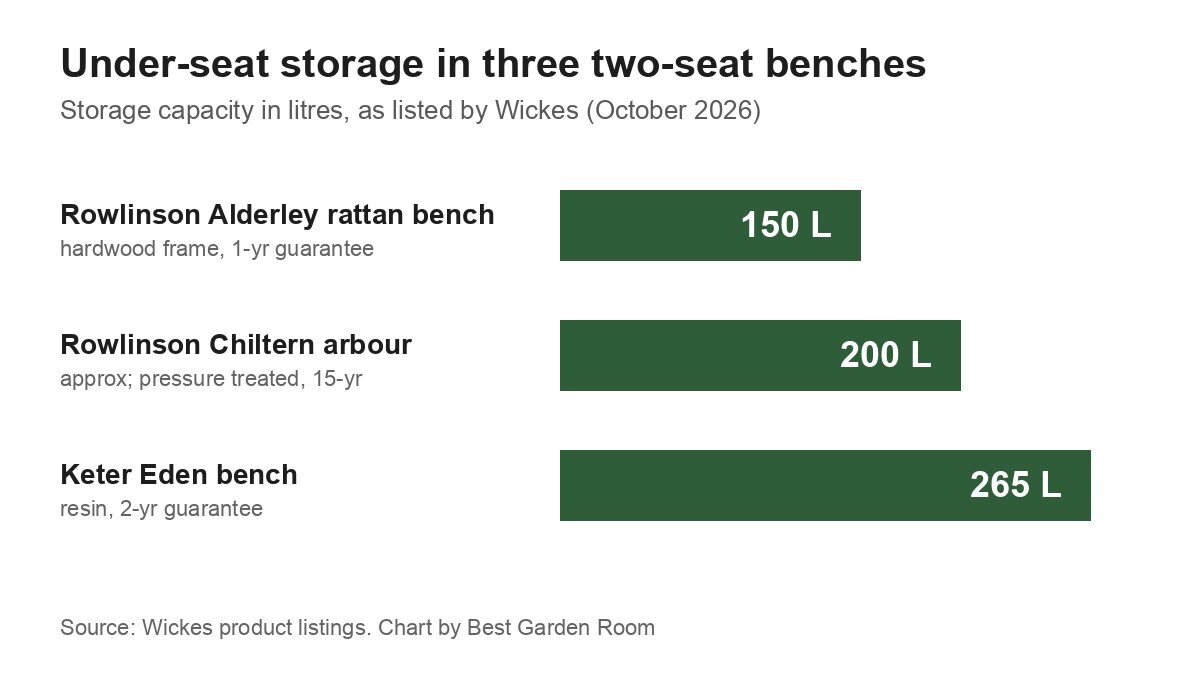
- Rowlinson Alderley Rattan Storage Bench: 150 litres. A rattan-effect weave on a hardwood frame, a lift-up seat, a grey seat pad included, and seating for two. It weighs 21.5kg and carries a one-year guarantee.
- Rowlinson Chiltern Arbour with Storage Box: about 200 litres. A pressure treated softwood arbour, 1980mm high, 1320mm wide and 800mm deep, with a lifting seat over the box. It seats two, carries a 15-year guarantee, and the timber is from PEFC certified forests. It can be painted.
- Keter Eden Storage Bench: 265 litres. A plastic bench with a wood-effect finish, described as ventilated, seating two adults and with a lockable option. It weighs 14.7kg and has a two-year guarantee.
The pattern is worth noticing: the resin bench holds the most and costs the least effort to keep, the timber arbour gives you the longest guarantee and a structure you can grow a climber over, and the rattan-effect bench is the smallest box but the most furniture-like to look at.
Wood, resin or rattan effect
Timber
Pressure treated softwood is the most common timber for storage benches and arbours. It lasts well if it is kept off wet ground and given a coat of preserver or stain every couple of years. Timber breathes, which helps against condensation, but the gaps between boards also let in wind-driven rain, so anything inside should be able to cope with being slightly damp. Hardwood benches are heavier and longer lived but usually need oiling to keep their colour.
Resin and plastic
Plastic benches do not rot, need no treatment and are light enough to move about. The lid and walls keep rain out well. The weakness is condensation: a sealed plastic box in full sun warms up by day and cools at night, and moisture forms on the inside of the lid. Look for a bench described as ventilated, as the Keter Eden is, and do not pack cushions in damp.
Rattan effect
Synthetic rattan weave over a frame looks like indoor furniture and suits a patio set. The storage box is usually the smallest of the three types because the weave and frame take up room. Check whether the frame is metal or wood and what the guarantee covers: the Alderley’s is one year.
Keeping the inside dry
Every storage bench lets in some moisture. What decides whether your cushions come out smelling of mildew is what you do with them.
- Stand it on something hard and level. Paving slabs or a patio, not bare soil or lawn. A bench on grass wicks water up through the base and sinks unevenly so the lid stops closing properly.
- Raise the box off the ground if it sits directly on the base. A couple of strips of treated batten underneath let air move.
- Only store dry things. A cushion put away damp after a shower will grow mould in a closed box within days.
- Add a moisture absorber through the winter, the kind sold for caravans and sheds, and empty it monthly.
- Use breathable cushion bags rather than plastic sacks, which trap condensation against the fabric.
- Bring cushions in for winter if you can. A bench box is a good place for them between uses in summer, less so for five months of British weather.
Lid, lock and safety
Lift-up seats are heavy, and a lid that drops on a child’s fingers is a real risk. Check whether the lid has a stay or a hinge that holds it open, and keep a bench with a free-falling lid away from where small children play. If you store petrol, fertiliser or chemicals, a bench is the wrong place: they belong in a locked shed, out of reach.
For security, a lockable bench deters casual theft but is not a safe. A plastic bench weighing under 15kg can be carried away full. If it sits in a front garden or by a side gate, fix it to the paving with brackets, or keep only low-value things in it. Our page on garden shed storage ideas covers storage for tools and anything worth stealing.
Where to put a storage bench
- Against a wall or fence, so the back is sheltered and the lid can rest back without straining the hinges. Leave a gap behind it for air.
- In part shade if it is plastic, to reduce the daily heating that drives condensation and fades the colour.
- Near where the things in it are used. By the patio table for cushions, by the back door for children’s toys, by the bin store for bags and gloves (see our bin storage page for sizes).
- Not under a dripping roof edge or a tree that drops sap and leaves onto the lid.
A storage bench is furniture, not a building, so it needs no planning permission wherever it goes in the garden.
Frequently asked questions
What is the best garden bench with storage?
It depends on what you need to store and how much upkeep you want. For the most space and least maintenance, a ventilated resin bench such as the 265 litre Keter Eden. For a long guarantee and a natural look, a pressure treated timber arbour or bench. For a patio set, a rattan-effect bench, accepting a smaller box.
Are garden storage benches waterproof?
Most are weather resistant rather than waterproof. Plastic benches keep rain out well but can collect condensation inside; timber benches let in some wind-driven rain. Store only dry items and use a moisture absorber in winter.
Can you leave cushions in a storage bench over winter?
You can, if they go in completely dry, in breathable bags, with a moisture absorber in the box. Cushions stored damp or in sealed plastic are likely to come out with mould in spring.
How many cushions fit in a storage bench?
A 50cm square seat cushion 8cm thick takes up about 20 litres, so a 150 litre bench holds around seven in theory and fewer in practice, because cushions do not pack perfectly. Measure your own cushions and check the bench’s internal size.
Do I need planning permission for a garden storage bench?
No. A bench is furniture rather than a building or structure, so planning rules do not apply to it.
For more on sheds, stores and garden buildings, see the rest of Best Garden Room.
Related guides
- Garden Room Planning Permission UK: The 30m² and 50% Rules Explained
- How Much Does a Garden Room Cost to Run in Winter? Real UK Figures
- Garden Room vs Extension: Honest Cost, Value and When Each Wins
- How Much Does It Cost to Run Electrics to a Garden Room in 2026?
- Ground Screws vs Concrete Base: Which Garden Room Foundation Is Right for You?
- Do Garden Rooms Need Building Regulations? The 15, 30 and 1m Rules Explained
- Prefab vs Bespoke Garden Rooms: Which Is Right for You?
- Garden Room Buying Mistakes: 12 Costly Errors to Avoid
- Garden Room News: June 2026
- How to Buy a Garden Room: The Complete UK Buyer’s Guide (2026)
- What to Look for in a Garden Room: 15 Things to Check Before You Buy
- Buying a Second-Hand Garden Room: Is It Worth It?
- Garden Room Kits vs Fully Installed: Should You Self-Build or Buy Turnkey?
- Garden Room Deposits, Contracts and Deliverables: Protecting Your Money
- How Long Does a Garden Room Last? Lifespan and Maintenance
- Garden Room Cost Per Square Metre: 2026 UK Rates Explained
- How Much Does a Garden Room Cost in the UK? (2026 Price Guide)
- Garden Room Prices by Size: From 3x3m to 8x4m and Beyond
- How Much Does a Garden Office Cost? (2026 UK Breakdown)
- Garden Room Planning News: Late June 2026
- How Much Does a Garden Room with a Bathroom Cost?
- Hidden Garden Room Costs: Foundations, VAT and the Extras Quotes Miss
- Garden Room Finance: Loans, Mortgages and Payment Options Explained
- Garden Room News: Early July 2026
- Do Garden Rooms Add Value to Your House? What the UK Resale Data Shows
- Permitted Development Rights for Garden Rooms: Size, Height and the 2m Boundary Rule
- Do Garden Rooms Affect Council Tax? Business Rates and Reassessment
- Garden Room News: Mid-July 2026
- How a Garden Room Is Built: Foundations to Finish (UK Guide)
- SIPs vs Timber Frame Garden Rooms: Which Construction Is Better?
- How Close to a Boundary Can a Garden Room Be? UK Rules Explained
- How to Apply for Garden Room Planning Permission: Step by Step
- Can You Build a Garden Room on Decking, Slabs or a Patio?
- Is a Garden Room Cheaper Than an Extension? 2026 Cost Comparison
- Garden Room News: Mid-July 2026
- Garden Room Cladding: Cedar vs Composite vs Larch vs Render
- Garden Room Roof Guide: Flat vs Pitched and the Best Materials
- Garden Room Windows and Doors: Bifold, Sliding and Glazing
- How to Build a Garden Room: A DIY Step-by-Step Guide (UK)
- How Long Does It Take to Build a Garden Room?
- How to Make a Garden Room Usable All Year Round
- Garden Room Insulation: Best Materials and U-Values for the UK
- How to Heat a Garden Room: 9 Options Compared by Cost and Warmth
- Best Heating for a Garden Office: Warm Without a Huge Bill
- Air Conditioning for Garden Rooms: Cooling and Heating in One
- Stopping Condensation and Damp in a Garden Room (UK Guide)
- How to Get Wi-Fi in a Garden Office: 6 Ways That Actually Work
- Garden Office Ideas: Designing the Perfect Work-From-Home Space
- Garden Room Ideas: 20 Popular Uses to Inspire Your Build
- Garden Room Annexe: Rules, Costs and How to Build One
- Garden Bar Ideas: The Height Rules, Power and Layout
- Garden Room Business: What Changes Once Clients Visit
- Garden Studio Ideas: Sizes, Light and the 2.5m Rule
- Garden Room Lighting: IP20 Inside, IP65 Out, Part P Rules
- Landscaping Around a Garden Room: the 30cm Decking Trap
- Garden Room Design: Why 2.5m Decides Everything
- Garden Room Planning Permission: the 2.5m Boundary Rule
- Garden Room News: New NPPF Lands, PD Rules Unchanged
- Garden Saunas UK: Planning, Building Regs and Electrics
- Best Garden Room Companies UK: Guarantees of 10 to 25 Years
- Garden Room Electrics: The Rules Change on 15 Oct 2026
- Golf Simulator Garden Room: The 2.5m Rule That Stops It
- Garden Screens: the 2m Rule, and Why Trellis Counts
- Cheap Garden Rooms: What 19mm Walls Really Get You
- Green Retreats Review: 12-Year Cover, 60% Upfront
- Booths Garden Studios Review: Steel Build, 25 Years
- Eden Garden Rooms Review: £23,500 Start, 10-Year Cover
- Green Retreats vs Booths: 25-Year Steel or Timber?
- Garden Rooms London: 6 Companies and the 2.5m Limit
- Garden Room Bedroom: Why a Bed Changes the Rules
- Do I Need Planning Permission for a Garden Shed? Usually Not
- Garden Room News: Staged Payments Arrive, Timber Stays Dear
- Garden Gym Ideas: Sizes, Ceilings and the 2.5m Height Rule
- Garden Gazebo Rules: 2.5m Near a Boundary, 4m Max
- Garden Arch: Wood or Metal, and the 2.7m Height Rule
- Garden Arbour: Sizes That Seat Two, and Wood vs Metal
- Wooden Garden Gates: Sizes, UC4 Posts and the 1m Rule
- Garden Room News: Rates Held, Materials Up 5.9%
- Summer House Interior Ideas: 9 That Work in Winter
- Garden Trellis Panels: the 2m Rule Most Buyers Miss
- Garden Shelters: Six Types and When You Need Permission
- Garden Greenhouses: Glass Gives 90% Light, Plastic 80%
- Summer House Doors and Windows: 4mm Toughened or Styrene?
- Log Stores: Size, Siting and the 20% Moisture Rule
- Garden Shed Roof: Felt, EPDM or Onduline by Pitch
- Insulated Garden Shed: The 25mm Gap That Stops Damp
- Composite Garden Sheds: Rot-Proof, But Check These 6 Things
- How to Build a Garden Shed: Base, Frame and Roof in 5 Steps
- Garden Room News: Power 26.32p a kWh, VAT-Free to March
- Garden Workshop: Size, Base, Power and the Planning Rules
- Plastic Garden Sheds: Who They Suit and 6 Checks First
- Metal Garden Sheds: Stop Condensation Before You Buy
- Garden Shed Storage Ideas: 12 That Free Up Floor Space
- Wooden Garden Sheds: 7 Specs That Decide How Long They Last
- 8×6 Garden Shed: Real Floor Size, Door Width and Base
- 6×4 Garden Shed: 59cm Door, 118cm Deep and What Fits
- Small Garden Shed: 88.5cm Wide Inside and What Fits
- Garden Room News: Building Control Fees Change 6 Nov
- 6×10 Garden Shed: 295 x 182.6cm Inside, and What Fits
- Bike Shed for Garden: Sizes, Ground Anchors and the Locks
- Shed With Log Store: Sizes, Layout and the 2.5m Rule
- Garden Bin Storage: Sizes, Lids and the Front Garden Rule
- Pergola Planning Permission: the 2.5m Boundary Rule
- Garden Cushion Storage: How Many Litres You Really Need