

A garden storage cabinet is the in-between option: bigger and more organised than a storage box, smaller and cheaper than a shed. It stands upright against a wall or fence, has shelves rather than one deep well, and usually opens with a pair of doors. That makes it the best fit for a small garden, a patio, a side passage or the space beside a garden room, where you need tools, pots, cleaning kit and chemicals tidied away and easy to reach.
This page covers the six checks that decide whether a cabinet will actually work for you, the differences between resin, metal and timber, and the things that should not go in one at all.
Tall cabinet, low cabinet or storage box?
Outdoor storage comes in three broad shapes, and the right one depends on what you are storing rather than how much space you have.
- Tall cabinets (roughly 1.7m to 1.9m high) suit long-handled tools such as rakes, spades, brooms and hoes, with shelves above for smaller items. They take the least ground space for their capacity.
- Low or base cabinets (around waist height) double as a potting bench or barbecue prep surface, with shelves underneath for pots, compost bags and charcoal.
- Storage boxes and benches lift from the top and suit bulky soft items such as cushions. They are poor for tools, because everything ends up in a heap at the bottom. If cushions are your main need, see our guide to waterproof garden storage boxes.
If you have more than a dozen long-handled tools, a mower and a bike to store, you have outgrown a cabinet. That is shed territory.
Six checks before you buy a garden storage cabinet
1. Measure the tallest thing you will store
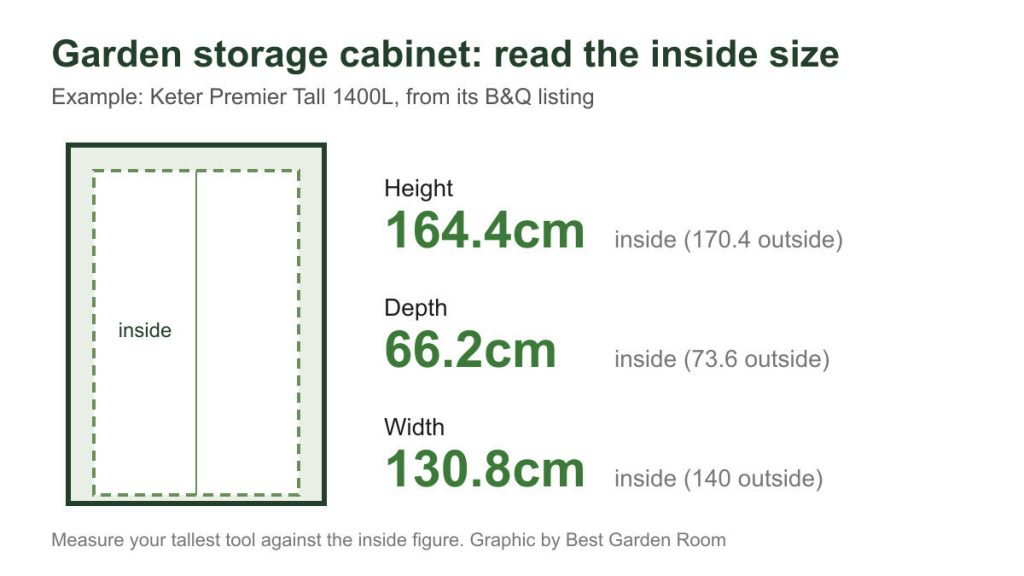
Internal height is what matters, and it is always lower than the advertised external figure. The Keter Premier Tall, a common UK resin model, is 170.4cm high outside but 164.4cm inside according to its B&Q listing. Measure your longest rake or spade before you buy, and allow for the handle to lean rather than stand vertically.
2. Check internal depth, not just width
That same Keter unit is 73.6cm deep outside and 66.2cm inside, and 140cm wide outside but 130.8cm inside. Depth is what lets a wheelbarrow-sized load of pots or a folded parasol fit. Very slim cabinets, under about 45cm deep, are ideal for a side passage but only take hand tools and small items.
3. Count the shelves and how they adjust
Some cabinets come with shelves fitted; others only provide brackets and leave you to add them. The Premier Tall, for example, has adjustable brackets that allow two extra shelves to be added. Adjustable shelves matter more than many shelves, because pots, sprayers and paint tins are all different heights.
4. Look at the floor
A cabinet with its own floor panel keeps contents off wet ground and stops mud splashing in. Without one, you need a paved or slabbed base. Either way, the ground has to be level: manufacturers routinely tell you to level the ground first, because doors on a twisted frame will not close or lock properly.
5. Plan for ventilation
Ventilation is what stops a closed cabinet from becoming a condensation box. Look for vents high on the sides or under the roof overhang. “Weatherproof” on a product page usually means the walls and roof shed rain, not that the doors are sealed against wind-driven water, so keep anything that rusts on shelves rather than on the floor.
6. Decide how you will lock it
Many resin cabinets come with a lock hasp but no padlock, so budget for a decent closed-shackle padlock. A hasp is only as strong as the plastic it is screwed into, so a cabinet in an exposed front garden or shared passage is better fixed to a wall and kept out of sight than relied on as a security store.
Resin, metal or timber?
All three work. The right choice depends on where the cabinet will stand and how much upkeep you will accept.
- Resin (plastic). The most common choice for small cabinets. It will not rot, rust or need painting, and it is light enough for two people to assemble without tools beyond a screwdriver. The downsides are that it can look utilitarian, and its lightness means a tall unit needs fixing down in an exposed spot. Keter’s Premier Tall, for instance, carries a 10-year guarantee and is listed as needing two people to assemble.
- Metal (galvanised or powder-coated steel). Stronger against forced entry and sturdy once anchored. Steel attracts condensation on its inner surfaces in cold weather, so ventilation and a floor panel matter more. Scratches in the coating need touching up before rust starts. For the same trade-offs at a larger scale, see our page on metal garden sheds.
- Timber. The best looking, especially against a fence or beside a timber garden room, and easy to paint to match. It needs a preservative or paint every few years, a roof covering such as felt that will need replacing, and a gap between the back panel and any wall so air can move.
Where to put it
A cabinet works best where you use what is in it. Next to the back door for cleaning kit and bird food; beside the vegetable beds for hand tools; near the barbecue for charcoal and utensils.
- Against a wall or fence, not in open ground. A wall gives shelter from wind and somewhere to fix the cabinet. Leave a small gap behind for air.
- Away from windows you want to open. Tall cabinets block light more than you expect.
- On level slabs or a small concrete pad rather than lawn or gravel, which settle unevenly.
- Not across a fire escape route or side passage you need to use. A tall cabinet in a narrow passage can block the only way to get bins out or a ladder in.
At under two metres tall, a freestanding cabinet sits well below the 2.5m height limit that applies to outbuildings within 2m of a boundary under permitted development. Listed buildings and flats have different rules, and our page on permitted development for garden rooms explains how those limits work.
What not to keep in a garden storage cabinet
Cabinets tidy things away so effectively that it is easy to forget what is in them. Three categories need more thought.
Petrol
The Health and Safety Executive’s guidance on storing petrol at home allows up to 30 litres without telling your local Petroleum Enforcement Authority, in suitable containers: plastic containers of up to 10 litres, metal containers of up to 20 litres, or a demountable fuel tank of up to 30 litres. Fuel in the tank of a mower does not count towards the total. The guidance also asks you to take all reasonable precautions against ignition sources and heat where petrol is stored. A sealed cabinet in full sun beside a barbecue is not that place; a ventilated spot away from heat is.
Lithium batteries and chargers
Cordless mowers, strimmers and hedge trimmers mean many gardens now store large lithium batteries outdoors. In January 2026 London Fire Brigade attended a fire in Orpington that destroyed a garden shed and a tree and damaged other outbuildings; the brigade said it was believed to have been caused by the failure of a lithium battery in a power tool. Its advice is to use the correct charger for the product, bought from a reputable seller, and to unplug chargers when charging is finished. In practice that means charging indoors or in a room with a smoke alarm, never inside a closed cabinet, and storing batteries away from fuel, oily rags and dry compost bags.
Garden chemicals
Weedkillers, slug pellets and pool or hot tub chemicals should stay in their original labelled containers, on a high shelf if children use the garden, with the cabinet locked. Keep oxidising pool chemicals well apart from fuel and fertiliser. Any product label’s storage instructions take priority over general advice.
Making a cabinet last
- Fix tall cabinets to a wall or to the base with the supplied fixings, or with brackets if none are included. A tall, empty resin unit can blow over in a gale.
- Keep vents clear of leaves and cobwebs, and open the doors on dry days in winter to let damp air out.
- Store tools clean and dry. A spade put away muddy will rust whatever the cabinet is made of.
- Check hinges and the lock hasp each spring and tighten any screws that have worked loose.
- For ideas on organising what goes inside, our garden shed storage ideas scale down well to a cabinet.
Frequently asked questions
Are garden storage cabinets waterproof?
Most are weather-resistant rather than fully waterproof. The roof and walls shed rain, but door joints and vents can let in driving rain and the air inside will be damp in winter. Keep anything that rusts or rots on shelves, not on the floor.
Do I need planning permission for a garden storage cabinet?
For a typical freestanding cabinet in the garden of a house, generally no, because it is well below the height limits for outbuildings. Flats, listed buildings and some conservation areas have different rules, so check with your council if any of those apply.
What size garden storage cabinet do I need?
Measure your tallest tool and add a few centimetres, then check the internal height on the listing, not the external figure. For depth, around 60cm inside takes pots and bulkier items; under 45cm suits hand tools only.
Can I store petrol in a garden storage cabinet?
Small amounts can be stored at home: HSE guidance allows up to 30 litres in approved containers without notifying the authorities. The storage place should be ventilated and kept away from heat and ignition sources, so a sealed cabinet in direct sun or next to a barbecue is a poor choice.
Is a metal or plastic garden storage cabinet better?
Plastic resin needs no maintenance and will not rust, but is lighter and less secure. Steel is stronger and harder to force, but suffers more from condensation and needs scratches touched up. For a patio or small garden, resin is usually enough; for a front garden or shared space, steel fixed to a wall is the more secure choice.
Planning a garden room with storage alongside it? Best Garden Room covers costs, planning and building from the ground up.
Related guides
- Garden Room Planning Permission UK: The 30m² and 50% Rules Explained
- How Much Does a Garden Room Cost to Run in Winter? Real UK Figures
- Garden Room vs Extension: Honest Cost, Value and When Each Wins
- How Much Does It Cost to Run Electrics to a Garden Room in 2026?
- Ground Screws vs Concrete Base: Which Garden Room Foundation Is Right for You?
- Do Garden Rooms Need Building Regulations? The 15, 30 and 1m Rules Explained
- Prefab vs Bespoke Garden Rooms: Which Is Right for You?
- Garden Room Buying Mistakes: 12 Costly Errors to Avoid
- Garden Room News: June 2026
- How to Buy a Garden Room: The Complete UK Buyer’s Guide (2026)
- What to Look for in a Garden Room: 15 Things to Check Before You Buy
- Buying a Second-Hand Garden Room: Is It Worth It?
- Garden Room Kits vs Fully Installed: Should You Self-Build or Buy Turnkey?
- Garden Room Deposits, Contracts and Deliverables: Protecting Your Money
- How Long Does a Garden Room Last? Lifespan and Maintenance
- Garden Room Cost Per Square Metre: 2026 UK Rates Explained
- How Much Does a Garden Room Cost in the UK? (2026 Price Guide)
- Garden Room Prices by Size: From 3x3m to 8x4m and Beyond
- How Much Does a Garden Office Cost? (2026 UK Breakdown)
- Garden Room Planning News: Late June 2026
- How Much Does a Garden Room with a Bathroom Cost?
- Hidden Garden Room Costs: Foundations, VAT and the Extras Quotes Miss
- Garden Room Finance: Loans, Mortgages and Payment Options Explained
- Garden Room News: Early July 2026
- Do Garden Rooms Add Value to Your House? What the UK Resale Data Shows
- Permitted Development Rights for Garden Rooms: Size, Height and the 2m Boundary Rule
- Do Garden Rooms Affect Council Tax? Business Rates and Reassessment
- Garden Room News: Mid-July 2026
- How a Garden Room Is Built: Foundations to Finish (UK Guide)
- SIPs vs Timber Frame Garden Rooms: Which Construction Is Better?
- How Close to a Boundary Can a Garden Room Be? UK Rules Explained
- How to Apply for Garden Room Planning Permission: Step by Step
- Can You Build a Garden Room on Decking, Slabs or a Patio?
- Is a Garden Room Cheaper Than an Extension? 2026 Cost Comparison
- Garden Room News: Mid-July 2026
- Garden Room Cladding: Cedar vs Composite vs Larch vs Render
- Garden Room Roof Guide: Flat vs Pitched and the Best Materials
- Garden Room Windows and Doors: Bifold, Sliding and Glazing
- How to Build a Garden Room: A DIY Step-by-Step Guide (UK)
- How Long Does It Take to Build a Garden Room?
- How to Make a Garden Room Usable All Year Round
- Garden Room Insulation: Best Materials and U-Values for the UK
- How to Heat a Garden Room: 9 Options Compared by Cost and Warmth
- Best Heating for a Garden Office: Warm Without a Huge Bill
- Air Conditioning for Garden Rooms: Cooling and Heating in One
- Stopping Condensation and Damp in a Garden Room (UK Guide)
- How to Get Wi-Fi in a Garden Office: 6 Ways That Actually Work
- Garden Office Ideas: Designing the Perfect Work-From-Home Space
- Garden Room Ideas: 20 Popular Uses to Inspire Your Build
- Garden Room Annexe: Rules, Costs and How to Build One
- Garden Bar Ideas: The Height Rules, Power and Layout
- Garden Room Business: What Changes Once Clients Visit
- Garden Studio Ideas: Sizes, Light and the 2.5m Rule
- Garden Room Lighting: IP20 Inside, IP65 Out, Part P Rules
- Landscaping Around a Garden Room: the 30cm Decking Trap
- Garden Room Design: Why 2.5m Decides Everything
- Garden Room Planning Permission: the 2.5m Boundary Rule
- Garden Room News: New NPPF Lands, PD Rules Unchanged
- Garden Saunas UK: Planning, Building Regs and Electrics
- Best Garden Room Companies UK: Guarantees of 10 to 25 Years
- Garden Room Electrics: The Rules Change on 15 Oct 2026
- Golf Simulator Garden Room: The 2.5m Rule That Stops It
- Garden Screens: the 2m Rule, and Why Trellis Counts
- Cheap Garden Rooms: What 19mm Walls Really Get You
- Green Retreats Review: 12-Year Cover, 60% Upfront
- Booths Garden Studios Review: Steel Build, 25 Years
- Eden Garden Rooms Review: £23,500 Start, 10-Year Cover
- Green Retreats vs Booths: 25-Year Steel or Timber?
- Garden Rooms London: 6 Companies and the 2.5m Limit
- Garden Room Bedroom: Why a Bed Changes the Rules
- Do I Need Planning Permission for a Garden Shed? Usually Not
- Garden Room News: Staged Payments Arrive, Timber Stays Dear
- Garden Gym Ideas: Sizes, Ceilings and the 2.5m Height Rule
- Garden Gazebo Rules: 2.5m Near a Boundary, 4m Max
- Garden Arch: Wood or Metal, and the 2.7m Height Rule
- Garden Arbour: Sizes That Seat Two, and Wood vs Metal
- Wooden Garden Gates: Sizes, UC4 Posts and the 1m Rule
- Garden Room News: Rates Held, Materials Up 5.9%
- Summer House Interior Ideas: 9 That Work in Winter
- Garden Trellis Panels: the 2m Rule Most Buyers Miss
- Garden Shelters: Six Types and When You Need Permission
- Garden Greenhouses: Glass Gives 90% Light, Plastic 80%
- Summer House Doors and Windows: 4mm Toughened or Styrene?
- Log Stores: Size, Siting and the 20% Moisture Rule
- Garden Shed Roof: Felt, EPDM or Onduline by Pitch
- Insulated Garden Shed: The 25mm Gap That Stops Damp
- Composite Garden Sheds: Rot-Proof, But Check These 6 Things
- How to Build a Garden Shed: Base, Frame and Roof in 5 Steps
- Garden Room News: Power 26.32p a kWh, VAT-Free to March
- Garden Workshop: Size, Base, Power and the Planning Rules
- Plastic Garden Sheds: Who They Suit and 6 Checks First
- Metal Garden Sheds: Stop Condensation Before You Buy
- Garden Shed Storage Ideas: 12 That Free Up Floor Space
- Wooden Garden Sheds: 7 Specs That Decide How Long They Last
- 8×6 Garden Shed: Real Floor Size, Door Width and Base
- 6×4 Garden Shed: 59cm Door, 118cm Deep and What Fits
- Small Garden Shed: 88.5cm Wide Inside and What Fits
- Garden Room News: Building Control Fees Change 6 Nov
- 6×10 Garden Shed: 295 x 182.6cm Inside, and What Fits
- Bike Shed for Garden: Sizes, Ground Anchors and the Locks
- Shed With Log Store: Sizes, Layout and the 2.5m Rule
- Garden Bin Storage: Sizes, Lids and the Front Garden Rule
- Pergola Planning Permission: the 2.5m Boundary Rule
- Garden Cushion Storage: How Many Litres You Really Need
- Garden Bench With Storage: 150 to 265 Litres, What Fits
- Garden Playhouse: Sizing, Base and the 2.5m Planning Rule
- Garden Pod: Sizes, Planning Limits and the 15m² Rule
- Log Cabin UK: 19mm to 70mm Walls and the 2.5m Height Rule
- Waterproof Garden Storage Box: Why Most Aren’t, What to Buy