

A waterproof garden storage box is what most people think they are buying, and very few boxes on sale actually are one. Keter, the biggest name in plastic garden storage, is candid about it in its own FAQ: its products are “weather-resistant and designed to keep contents dry and ventilated”, and while they “protect against rain and snow, they are not intended for full submersion”. Retail listings are looser with the word. B&Q’s listing for the Keter Ontario 870 litre box calls it “waterproof” in one sentence and says the contents “always remain dry and ventilated” in the next. A ventilated box is, by design, not sealed. This page explains what waterproof really means, where water gets into a garden box, and how to keep cushions, tools and kit dry through a British winter.
For more on choosing and siting outdoor storage, see the rest of our guides at Best Garden Room.
Waterproof vs weather-resistant: what the words mean
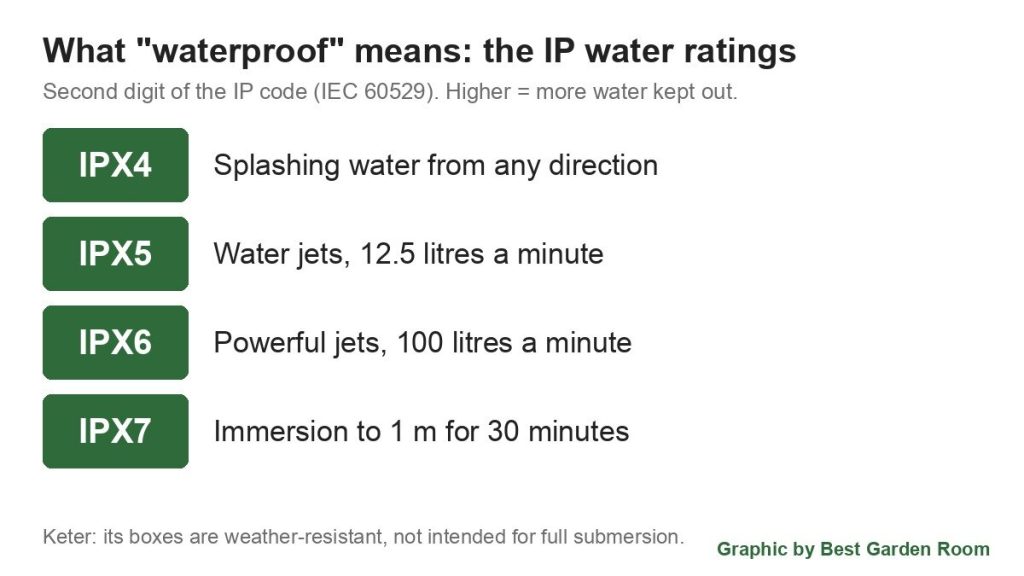
“Waterproof” has no legal definition on a garden product listing. Where water protection is tested properly, it is graded by the IP code in the international standard IEC 60529, which electrical enclosures, outdoor sockets and phones are rated against. The second digit of the code tells you how much water the enclosure keeps out:
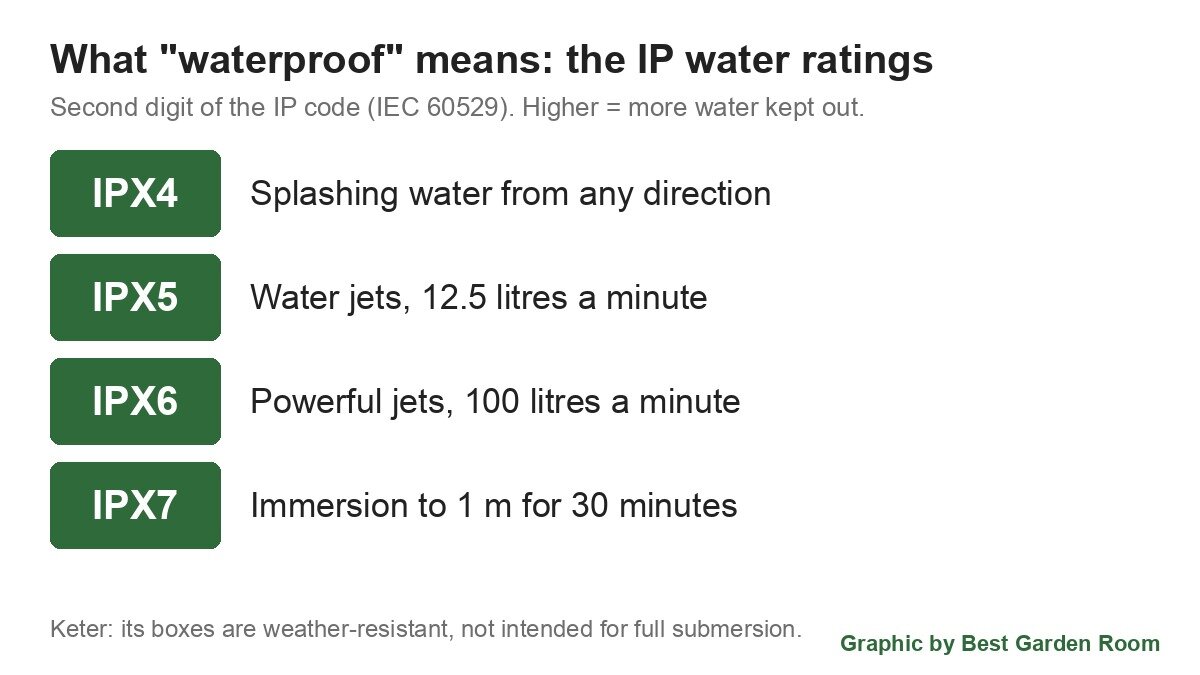
- IPX4: splashing water from any direction does no harm.
- IPX5: water jets, tested at 12.5 litres a minute from a 6.3mm nozzle.
- IPX6: powerful jets, tested at 100 litres a minute from a 12.5mm nozzle.
- IPX7: temporary immersion, tested at up to 1 metre deep for 30 minutes.
The point of the standard, as the summary of the IP code puts it, is to give buyers more detail than vague marketing terms such as waterproof. A garden storage box sold with no IP rating has not been tested to any of these levels. “Weather-resistant” is the honest description: it keeps off rain falling on the lid, and it is not built to sit in a puddle or take a hose at the seams.
Where water gets into a garden storage box
When a box lets in water, it is almost always through one of five routes. Knowing them tells you what to look for in the shop and what to fix at home.
- The lid seam. Wind-driven rain gets under a lid that sits flush on the walls. A lid with a deep overhanging lip sheds water much better than a flat one.
- The hinge line. At the back, where the lid pivots, there is often a gap. Rain running off a wall or fence behind the box goes straight in.
- The floor. A box standing on soil, lawn or a dip in the patio sits in water after heavy rain. Joints in the floor and lower walls are not sealed against standing water.
- The vents. Ventilation slots let damp air out, which is good, but they also let driven rain in if they face the weather.
- Condensation. The one people miss. On cold nights the inside of the lid chills, moisture in the air inside condenses on it and drips onto whatever is stored. A box can be completely rain-tight and still wet inside in January.
How to keep the contents of a garden box dry
You can make an ordinary weather-resistant box behave very nearly like a waterproof one with a few simple steps.
Site it properly
- Stand it on a level, hard base: paving slabs or a small patch of patio, raised slightly above the surrounding ground so water drains away rather than towards it.
- Keep it out from under a downpipe, a dripping gutter or the drip line of a shed roof.
- Leave a small gap between the back of the box and any wall or fence so rain running down the wall does not pour onto the hinge line.
- Turn any vents away from the prevailing wind, which in most of the UK means away from the south west.
Pack it properly
- Lift items off the floor. Some boxes have a raised floor built in: B&Q’s listing for the Keter Darwin 380 litre box notes a raised floor and ventilation. If yours does not, a couple of timber battens or a slatted pallet section inside does the same job.
- Cover cushions with breathable storage bags, not sealed plastic sacks. Sealed bags trap any moisture already in the foam and are the commonest cause of mildew.
- Put a moisture absorber or a few large silica gel packs inside over the winter and change them when full.
- Close and latch the lid every time. A lid left resting on a cushion corner lets in a surprising amount of water.
Check it after the first storm
The first heavy, windy downpour after you set the box up will show you exactly where it leaks. Open it the next morning, see which corner is damp, and deal with that route: raise the base, move it away from the wall, or add a strip of self-adhesive draught seal under the lid edge if the lid lip is shallow.
What genuinely needs a sealed box
For cushions, garden toys, hoses and hand tools, a well-sited weather-resistant box is enough. Some things need more protection than any garden box can give:
- Power tool batteries and chargers. Keep these indoors or in a dry shed, not in a garden box that sees condensation. Never store an extension lead or charger that is plugged in inside a plastic box.
- Paperwork, seed packets and anything that rusts or swells. Put these in a small gasketed case with a proper seal, ideally one carrying an IP rating, and keep that case inside the bigger box or in a shed.
- Anything you would be upset to lose. If an item would be ruined by a cupful of water, it should not rely on a garden storage box at all.
Choosing a box that stays dry
When you compare boxes, look past the word “waterproof” in the title and check these instead:
- The lid: a deep overlapping lip, ideally sloped or domed so water runs off rather than pooling. Gas struts that hold it open are a convenience, not a seal.
- The floor: raised or ribbed rather than flat, so anything that does get in drains away from your stored items.
- Ventilation: some is good for cushions, but it should be shielded under the lid edge, not open slots facing outwards.
- The material: polypropylene resin will not rot and needs no treatment; timber boxes need regular treatment and are only as dry as their lid; metal boxes suffer most from condensation.
- The manufacturer’s own wording: if the brand’s FAQ says weather-resistant, trust that over the retailer’s headline.
If cushions are the main job, our guide to garden cushion storage works out how many litres a set of outdoor furniture needs. If you want a seat as well, see garden benches with storage. For wheelie bins, there is a separate guide to garden bin storage.
Frequently asked questions
Are plastic garden storage boxes waterproof?
Mostly no. They are weather-resistant: they keep off rain falling on the lid but are not sealed. Keter’s own FAQ says its products protect against rain and snow but are not intended for full submersion, even where a retailer’s listing uses the word waterproof.
Why is my garden storage box wet inside?
Usually one of three causes: rain driven under the lid or hinge, the box standing in water on soft or uneven ground, or condensation forming under the lid on cold nights. Check after a storm to see which corner is wet; condensation shows as drips across the whole underside of the lid.
How do I stop condensation in a garden storage box?
Keep some ventilation, lift stored items off the floor, use breathable bags rather than sealed plastic for cushions, and put a moisture absorber inside over winter. Opening the lid to air the box on a dry, breezy day also helps.
What does IPX7 mean?
It is a water rating from the IP code in IEC 60529. IPX7 means the enclosure has been tested to keep out water in harmful quantity when immersed up to 1 metre deep for 30 minutes. Garden storage boxes are rarely rated at all.
Can I leave cushions in a garden storage box all winter?
Yes, if the box is sited on a raised, level base, the cushions are dry when they go in, and they are in breathable covers with a moisture absorber in the box. Check them once a month or so, and bring them indoors if you find any damp or mildew.
Related guides
- Garden Room Planning Permission UK: The 30m² and 50% Rules Explained
- How Much Does a Garden Room Cost to Run in Winter? Real UK Figures
- Garden Room vs Extension: Honest Cost, Value and When Each Wins
- How Much Does It Cost to Run Electrics to a Garden Room in 2026?
- Ground Screws vs Concrete Base: Which Garden Room Foundation Is Right for You?
- Do Garden Rooms Need Building Regulations? The 15, 30 and 1m Rules Explained
- Prefab vs Bespoke Garden Rooms: Which Is Right for You?
- Garden Room Buying Mistakes: 12 Costly Errors to Avoid
- Garden Room News: June 2026
- How to Buy a Garden Room: The Complete UK Buyer’s Guide (2026)
- What to Look for in a Garden Room: 15 Things to Check Before You Buy
- Buying a Second-Hand Garden Room: Is It Worth It?
- Garden Room Kits vs Fully Installed: Should You Self-Build or Buy Turnkey?
- Garden Room Deposits, Contracts and Deliverables: Protecting Your Money
- How Long Does a Garden Room Last? Lifespan and Maintenance
- Garden Room Cost Per Square Metre: 2026 UK Rates Explained
- How Much Does a Garden Room Cost in the UK? (2026 Price Guide)
- Garden Room Prices by Size: From 3x3m to 8x4m and Beyond
- How Much Does a Garden Office Cost? (2026 UK Breakdown)
- Garden Room Planning News: Late June 2026
- How Much Does a Garden Room with a Bathroom Cost?
- Hidden Garden Room Costs: Foundations, VAT and the Extras Quotes Miss
- Garden Room Finance: Loans, Mortgages and Payment Options Explained
- Garden Room News: Early July 2026
- Do Garden Rooms Add Value to Your House? What the UK Resale Data Shows
- Permitted Development Rights for Garden Rooms: Size, Height and the 2m Boundary Rule
- Do Garden Rooms Affect Council Tax? Business Rates and Reassessment
- Garden Room News: Mid-July 2026
- How a Garden Room Is Built: Foundations to Finish (UK Guide)
- SIPs vs Timber Frame Garden Rooms: Which Construction Is Better?
- How Close to a Boundary Can a Garden Room Be? UK Rules Explained
- How to Apply for Garden Room Planning Permission: Step by Step
- Can You Build a Garden Room on Decking, Slabs or a Patio?
- Is a Garden Room Cheaper Than an Extension? 2026 Cost Comparison
- Garden Room News: Mid-July 2026
- Garden Room Cladding: Cedar vs Composite vs Larch vs Render
- Garden Room Roof Guide: Flat vs Pitched and the Best Materials
- Garden Room Windows and Doors: Bifold, Sliding and Glazing
- How to Build a Garden Room: A DIY Step-by-Step Guide (UK)
- How Long Does It Take to Build a Garden Room?
- How to Make a Garden Room Usable All Year Round
- Garden Room Insulation: Best Materials and U-Values for the UK
- How to Heat a Garden Room: 9 Options Compared by Cost and Warmth
- Best Heating for a Garden Office: Warm Without a Huge Bill
- Air Conditioning for Garden Rooms: Cooling and Heating in One
- Stopping Condensation and Damp in a Garden Room (UK Guide)
- How to Get Wi-Fi in a Garden Office: 6 Ways That Actually Work
- Garden Office Ideas: Designing the Perfect Work-From-Home Space
- Garden Room Ideas: 20 Popular Uses to Inspire Your Build
- Garden Room Annexe: Rules, Costs and How to Build One
- Garden Bar Ideas: The Height Rules, Power and Layout
- Garden Room Business: What Changes Once Clients Visit
- Garden Studio Ideas: Sizes, Light and the 2.5m Rule
- Garden Room Lighting: IP20 Inside, IP65 Out, Part P Rules
- Landscaping Around a Garden Room: the 30cm Decking Trap
- Garden Room Design: Why 2.5m Decides Everything
- Garden Room Planning Permission: the 2.5m Boundary Rule
- Garden Room News: New NPPF Lands, PD Rules Unchanged
- Garden Saunas UK: Planning, Building Regs and Electrics
- Best Garden Room Companies UK: Guarantees of 10 to 25 Years
- Garden Room Electrics: The Rules Change on 15 Oct 2026
- Golf Simulator Garden Room: The 2.5m Rule That Stops It
- Garden Screens: the 2m Rule, and Why Trellis Counts
- Cheap Garden Rooms: What 19mm Walls Really Get You
- Green Retreats Review: 12-Year Cover, 60% Upfront
- Booths Garden Studios Review: Steel Build, 25 Years
- Eden Garden Rooms Review: £23,500 Start, 10-Year Cover
- Green Retreats vs Booths: 25-Year Steel or Timber?
- Garden Rooms London: 6 Companies and the 2.5m Limit
- Garden Room Bedroom: Why a Bed Changes the Rules
- Do I Need Planning Permission for a Garden Shed? Usually Not
- Garden Room News: Staged Payments Arrive, Timber Stays Dear
- Garden Gym Ideas: Sizes, Ceilings and the 2.5m Height Rule
- Garden Gazebo Rules: 2.5m Near a Boundary, 4m Max
- Garden Arch: Wood or Metal, and the 2.7m Height Rule
- Garden Arbour: Sizes That Seat Two, and Wood vs Metal
- Wooden Garden Gates: Sizes, UC4 Posts and the 1m Rule
- Garden Room News: Rates Held, Materials Up 5.9%
- Summer House Interior Ideas: 9 That Work in Winter
- Garden Trellis Panels: the 2m Rule Most Buyers Miss
- Garden Shelters: Six Types and When You Need Permission
- Garden Greenhouses: Glass Gives 90% Light, Plastic 80%
- Summer House Doors and Windows: 4mm Toughened or Styrene?
- Log Stores: Size, Siting and the 20% Moisture Rule
- Garden Shed Roof: Felt, EPDM or Onduline by Pitch
- Insulated Garden Shed: The 25mm Gap That Stops Damp
- Composite Garden Sheds: Rot-Proof, But Check These 6 Things
- How to Build a Garden Shed: Base, Frame and Roof in 5 Steps
- Garden Room News: Power 26.32p a kWh, VAT-Free to March
- Garden Workshop: Size, Base, Power and the Planning Rules
- Plastic Garden Sheds: Who They Suit and 6 Checks First
- Metal Garden Sheds: Stop Condensation Before You Buy
- Garden Shed Storage Ideas: 12 That Free Up Floor Space
- Wooden Garden Sheds: 7 Specs That Decide How Long They Last
- 8×6 Garden Shed: Real Floor Size, Door Width and Base
- 6×4 Garden Shed: 59cm Door, 118cm Deep and What Fits
- Small Garden Shed: 88.5cm Wide Inside and What Fits
- Garden Room News: Building Control Fees Change 6 Nov
- 6×10 Garden Shed: 295 x 182.6cm Inside, and What Fits
- Bike Shed for Garden: Sizes, Ground Anchors and the Locks
- Shed With Log Store: Sizes, Layout and the 2.5m Rule
- Garden Bin Storage: Sizes, Lids and the Front Garden Rule
- Pergola Planning Permission: the 2.5m Boundary Rule
- Garden Cushion Storage: How Many Litres You Really Need
- Garden Bench With Storage: 150 to 265 Litres, What Fits
- Garden Playhouse: Sizing, Base and the 2.5m Planning Rule
- Garden Pod: Sizes, Planning Limits and the 15m² Rule
- Log Cabin UK: 19mm to 70mm Walls and the 2.5m Height Rule