

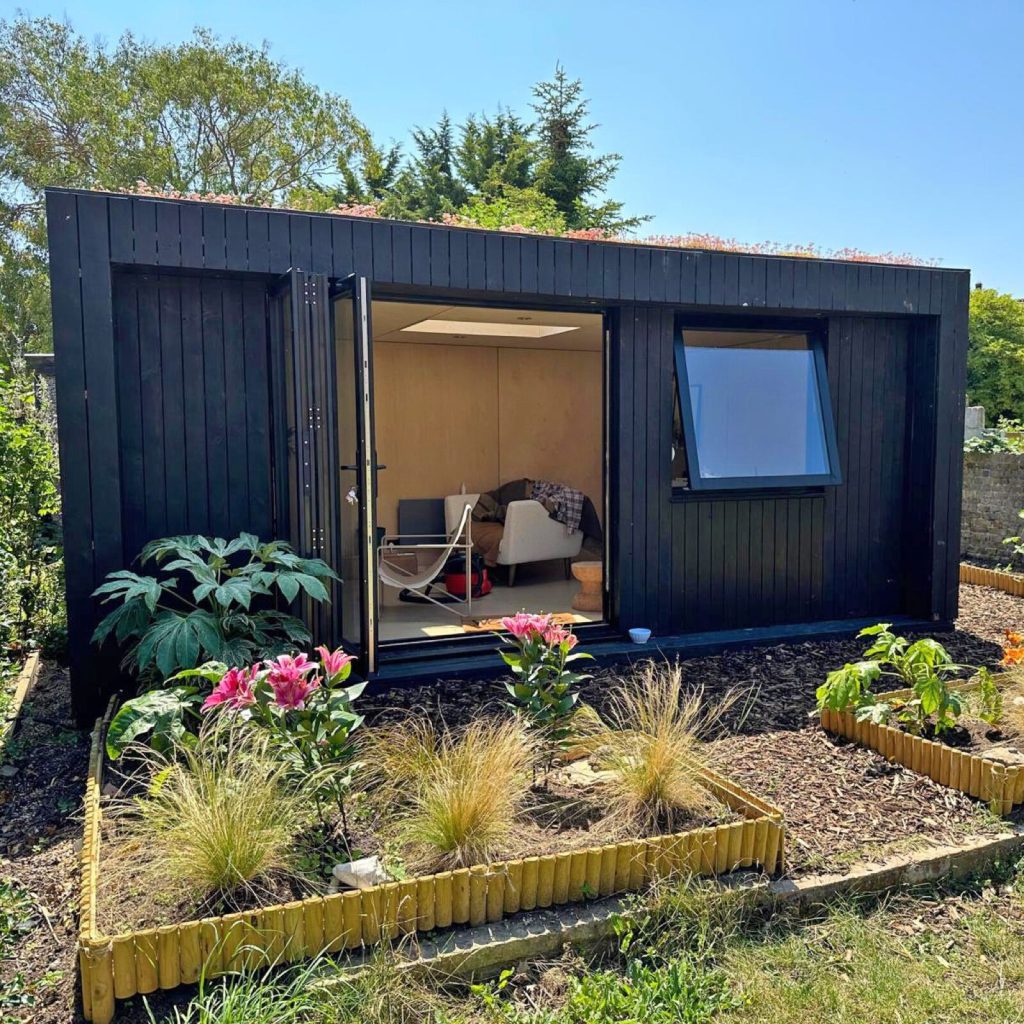
A garden pod is a small, self-contained building for one job, usually working from home, and it is the cheapest way to get a warm, dry room at the end of the garden. Most pods have floor areas of about 4 to 15 square metres. That size range matters more than the shape or the brand, because it decides whether you need planning permission, whether building regulations apply, and how much of your garden you lose. This page sets out the size thresholds, what a usable pod needs inside, and the checks to make before you order one.
What counts as a garden pod
There is no legal definition. Suppliers use “pod” for three broad types of building:
- Box pods. Rectangular, insulated, usually with a single-pitch or flat roof and a glazed front. Common footprints are 2.4m by 2.4m (8ft by 8ft) and 3.6m by 2.4m (12ft by 8ft). This is the type most people mean by a garden office pod.
- Round or curved pods. Domes and spheres such as the Archipod, which is made in 3m and 4m versions. The curved walls give more usable space at desk height than the floor area suggests, but shelving and furniture are harder to fit.
- Lightweight pods. Domes and igloo-style shelters, often 3m to 4m across, sold for seating or entertaining. Many are not insulated and are not a year-round workspace.
Planning and building regulations do not care which word the supplier uses. They treat a pod as an outbuilding, so the rules below apply to all three.
Garden pod sizes: what actually fits
Work out what has to go inside before you choose a footprint.
- About 4 to 6 square metres (roughly 2m by 2m to 2.4m by 2.4m) fits one desk, a chair, a small storage unit and room to turn round. It works for one person working at a laptop or a single screen.
- About 7 to 10 square metres (around 3.6m by 2.4m) adds a second desk, a sofa or reading chair, or space for a video-call backdrop that is not a wall a metre behind you.
- Above 10 square metres you are into garden room territory. Read our small garden rooms page before deciding which you need.
Measure internal size, not external. Insulated walls take up space: a pod with thick walls can lose a noticeable strip all round compared with its quoted footprint. Ask the supplier for internal dimensions and ceiling height.
Do you need planning permission for a garden pod?
Usually not, if it sits within permitted development for outbuildings. On the Planning Portal, the main limits for a house in England are:
- Maximum height of 2.5m if the pod is within 2m of a boundary.
- Otherwise, 4m with a dual-pitched roof or 3m with any other roof, and eaves no higher than 2.5m.
- Not on land forward of the principal elevation (normally the front of the house).
- No raised platform above 0.3m, and no veranda or balcony.
- Outbuildings and extensions together cover no more than half the land around the original house.
Planning permission is needed if the house is listed, for any outbuilding on designated land at the side of the house (conservation areas, National Parks, National Landscapes, the Broads and World Heritage Sites), and for any outbuilding at a flat or maisonette, because the allowances apply to houses only. The pod also has to stay incidental to the house. Using it as separate self-contained living accommodation falls outside permitted development. Our page on garden room distance from boundary goes through the 2m and 2.5m rule with examples.
In practice, most pods are designed under 2.5m tall so they can go anywhere in the garden, including tight against a fence.
Building regulations: the 15 and 30 square metre lines
Building regulations are separate from planning, and floor area is what triggers them for a detached outbuilding:
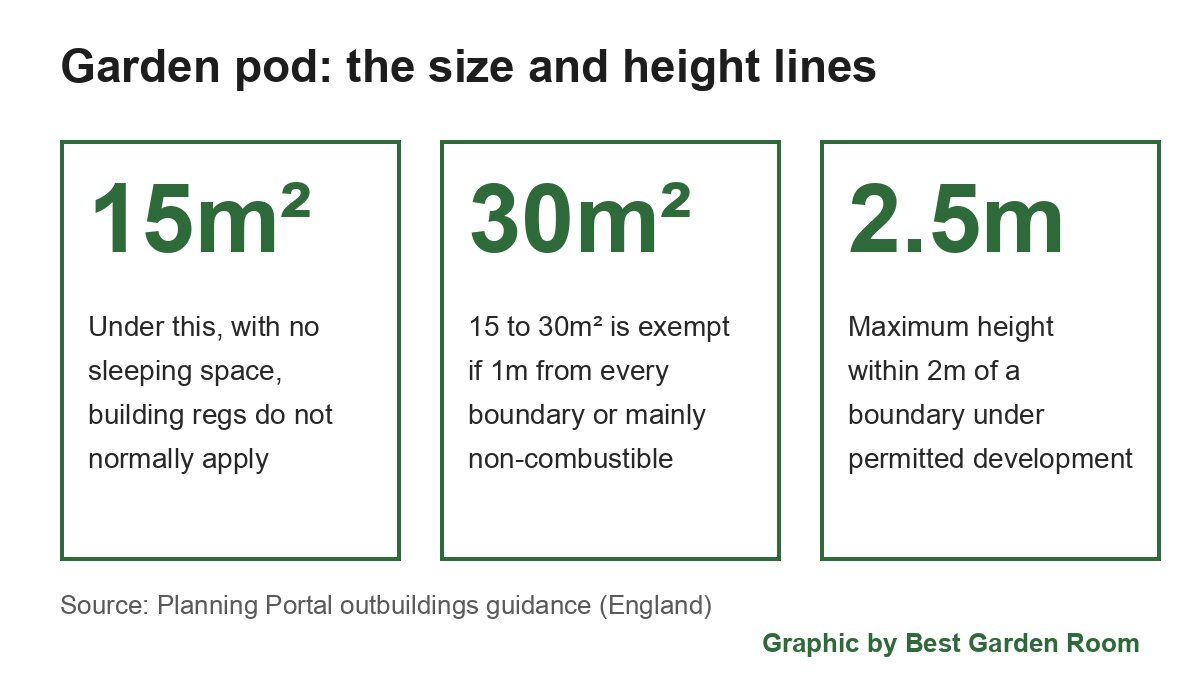
- Under 15 square metres with no sleeping accommodation: building regulations do not normally apply.
- 15 to 30 square metres with no sleeping accommodation: normally exempt if the building is at least 1m from every boundary, or is built substantially of non-combustible materials.
- Sleeping accommodation brings it into building regulations whatever the size.
This is why so many pods are sold at just under 15 square metres. A pod of 16 square metres with timber walls placed against your fence is no longer automatically exempt. Check the floor area the supplier quotes and whether it is internal or external.
The electrics are the exception to the exemption. Running a new circuit from the house to an outbuilding is notifiable work under Part P, so use a registered electrician who can self-certify it and give you the certificate. Our guide to garden room electrics covers armoured cable, the consumer unit and costs.
What a year-round garden pod needs
A pod you work in every day is a small building, not a shed. Before you buy, ask the supplier about each of these:
Insulation in the floor, walls and roof
All three, not just the walls. A cold floor is the most common complaint in a lightly built pod. Ask what the insulation is and how thick it is in each part.
Heating and ventilation
A small, well insulated pod needs very little heat; a panel heater or a small air conditioning unit is usual. Ventilation matters as much as heat. One person breathing in a sealed 6 square metre room for eight hours produces condensation, so you need a trickle vent or an opening window you will actually use in winter. Our page on condensation and damp in garden rooms explains why.
A base that will not move
Pods sit on a concrete pad, a timber frame on ground screws, or a prepared slab. Several suppliers require a professionally prepared base before delivery. See ground screws vs concrete for the trade-offs.
Internet that reaches the end of the garden
Wi-Fi from the house often drops off through two external walls and 15 metres of garden. A mesh point, a powerline adaptor or an outdoor Ethernet cable run in the same trench as the power fixes it. Garden office Wi-Fi has the options.
Access for delivery
Factory-built pods arrive in one piece or in large panels. Measure the side passage, gates and any steps before ordering, and ask how the pod will reach the base. Some round pods are built in sections small enough to carry through, others need a clear route or lifting.
Garden pod or garden room?
A pod makes sense when one person needs one quiet room, the garden is small, and you want to stay well clear of the building regulations line. A garden room makes sense when you want space for two people, a sofa bed for occasional guests (which then brings in building regulations) or a home gym. If you are weighing the two, our garden office cost page covers what drives the price, and the Best Garden Room home page links every guide on the site.
Before you order: a short checklist
- Internal floor area, and whether it is under 15 square metres.
- Height, if the pod will be within 2m of a boundary.
- Your house type and location: flat, listed building or designated land.
- Insulation in floor, walls and roof.
- Who prepares the base, and to what specification.
- Electrical certificate from a registered electrician.
- Delivery route and access.
- Guarantee length and what it covers.
Frequently asked questions
Do garden pods need planning permission?
Most do not, if they stay within the permitted development limits for outbuildings: 2.5m maximum height within 2m of a boundary, not in front of the house, and no more than half the garden covered. Listed houses, flats and side gardens on designated land need permission.
What size garden pod do I need for an office?
For one person at a desk, about 4 to 6 square metres (2.4m by 2.4m is common). For two desks or a desk and a chair, look at around 3.6m by 2.4m. Check the internal dimensions, not the external footprint.
Can you sleep in a garden pod?
Adding sleeping accommodation brings the pod into building regulations whatever its size, and using it as separate self-contained living accommodation is outside permitted development. Our page on sleeping in a garden room covers the detail.
Does a garden pod need building regulations approval?
Not normally if it is under 15 square metres with no sleeping accommodation. Between 15 and 30 square metres it is normally exempt if it is at least 1m from every boundary or built substantially of non-combustible materials. The electrical work is still notifiable under Part P.
Can a garden pod go right next to the fence?
Yes, if it is no taller than 2.5m and stays under 15 square metres, or is built substantially of non-combustible materials if it is between 15 and 30 square metres. Leave enough of a gap to treat or maintain the back wall.
Related guides
- Garden Room Planning Permission UK: The 30m² and 50% Rules Explained
- How Much Does a Garden Room Cost to Run in Winter? Real UK Figures
- Garden Room vs Extension: Honest Cost, Value and When Each Wins
- How Much Does It Cost to Run Electrics to a Garden Room in 2026?
- Ground Screws vs Concrete Base: Which Garden Room Foundation Is Right for You?
- Do Garden Rooms Need Building Regulations? The 15, 30 and 1m Rules Explained
- Prefab vs Bespoke Garden Rooms: Which Is Right for You?
- Garden Room Buying Mistakes: 12 Costly Errors to Avoid
- Garden Room News: June 2026
- How to Buy a Garden Room: The Complete UK Buyer’s Guide (2026)
- What to Look for in a Garden Room: 15 Things to Check Before You Buy
- Buying a Second-Hand Garden Room: Is It Worth It?
- Garden Room Kits vs Fully Installed: Should You Self-Build or Buy Turnkey?
- Garden Room Deposits, Contracts and Deliverables: Protecting Your Money
- How Long Does a Garden Room Last? Lifespan and Maintenance
- Garden Room Cost Per Square Metre: 2026 UK Rates Explained
- How Much Does a Garden Room Cost in the UK? (2026 Price Guide)
- Garden Room Prices by Size: From 3x3m to 8x4m and Beyond
- How Much Does a Garden Office Cost? (2026 UK Breakdown)
- Garden Room Planning News: Late June 2026
- How Much Does a Garden Room with a Bathroom Cost?
- Hidden Garden Room Costs: Foundations, VAT and the Extras Quotes Miss
- Garden Room Finance: Loans, Mortgages and Payment Options Explained
- Garden Room News: Early July 2026
- Do Garden Rooms Add Value to Your House? What the UK Resale Data Shows
- Permitted Development Rights for Garden Rooms: Size, Height and the 2m Boundary Rule
- Do Garden Rooms Affect Council Tax? Business Rates and Reassessment
- Garden Room News: Mid-July 2026
- How a Garden Room Is Built: Foundations to Finish (UK Guide)
- SIPs vs Timber Frame Garden Rooms: Which Construction Is Better?
- How Close to a Boundary Can a Garden Room Be? UK Rules Explained
- How to Apply for Garden Room Planning Permission: Step by Step
- Can You Build a Garden Room on Decking, Slabs or a Patio?
- Is a Garden Room Cheaper Than an Extension? 2026 Cost Comparison
- Garden Room News: Mid-July 2026
- Garden Room Cladding: Cedar vs Composite vs Larch vs Render
- Garden Room Roof Guide: Flat vs Pitched and the Best Materials
- Garden Room Windows and Doors: Bifold, Sliding and Glazing
- How to Build a Garden Room: A DIY Step-by-Step Guide (UK)
- How Long Does It Take to Build a Garden Room?
- How to Make a Garden Room Usable All Year Round
- Garden Room Insulation: Best Materials and U-Values for the UK
- How to Heat a Garden Room: 9 Options Compared by Cost and Warmth
- Best Heating for a Garden Office: Warm Without a Huge Bill
- Air Conditioning for Garden Rooms: Cooling and Heating in One
- Stopping Condensation and Damp in a Garden Room (UK Guide)
- How to Get Wi-Fi in a Garden Office: 6 Ways That Actually Work
- Garden Office Ideas: Designing the Perfect Work-From-Home Space
- Garden Room Ideas: 20 Popular Uses to Inspire Your Build
- Garden Room Annexe: Rules, Costs and How to Build One
- Garden Bar Ideas: The Height Rules, Power and Layout
- Garden Room Business: What Changes Once Clients Visit
- Garden Studio Ideas: Sizes, Light and the 2.5m Rule
- Garden Room Lighting: IP20 Inside, IP65 Out, Part P Rules
- Landscaping Around a Garden Room: the 30cm Decking Trap
- Garden Room Design: Why 2.5m Decides Everything
- Garden Room Planning Permission: the 2.5m Boundary Rule
- Garden Room News: New NPPF Lands, PD Rules Unchanged
- Garden Saunas UK: Planning, Building Regs and Electrics
- Best Garden Room Companies UK: Guarantees of 10 to 25 Years
- Garden Room Electrics: The Rules Change on 15 Oct 2026
- Golf Simulator Garden Room: The 2.5m Rule That Stops It
- Garden Screens: the 2m Rule, and Why Trellis Counts
- Cheap Garden Rooms: What 19mm Walls Really Get You
- Green Retreats Review: 12-Year Cover, 60% Upfront
- Booths Garden Studios Review: Steel Build, 25 Years
- Eden Garden Rooms Review: £23,500 Start, 10-Year Cover
- Green Retreats vs Booths: 25-Year Steel or Timber?
- Garden Rooms London: 6 Companies and the 2.5m Limit
- Garden Room Bedroom: Why a Bed Changes the Rules
- Do I Need Planning Permission for a Garden Shed? Usually Not
- Garden Room News: Staged Payments Arrive, Timber Stays Dear
- Garden Gym Ideas: Sizes, Ceilings and the 2.5m Height Rule
- Garden Gazebo Rules: 2.5m Near a Boundary, 4m Max
- Garden Arch: Wood or Metal, and the 2.7m Height Rule
- Garden Arbour: Sizes That Seat Two, and Wood vs Metal
- Wooden Garden Gates: Sizes, UC4 Posts and the 1m Rule
- Garden Room News: Rates Held, Materials Up 5.9%
- Summer House Interior Ideas: 9 That Work in Winter
- Garden Trellis Panels: the 2m Rule Most Buyers Miss
- Garden Shelters: Six Types and When You Need Permission
- Garden Greenhouses: Glass Gives 90% Light, Plastic 80%
- Summer House Doors and Windows: 4mm Toughened or Styrene?
- Log Stores: Size, Siting and the 20% Moisture Rule
- Garden Shed Roof: Felt, EPDM or Onduline by Pitch
- Insulated Garden Shed: The 25mm Gap That Stops Damp
- Composite Garden Sheds: Rot-Proof, But Check These 6 Things
- How to Build a Garden Shed: Base, Frame and Roof in 5 Steps
- Garden Room News: Power 26.32p a kWh, VAT-Free to March
- Garden Workshop: Size, Base, Power and the Planning Rules
- Plastic Garden Sheds: Who They Suit and 6 Checks First
- Metal Garden Sheds: Stop Condensation Before You Buy
- Garden Shed Storage Ideas: 12 That Free Up Floor Space
- Wooden Garden Sheds: 7 Specs That Decide How Long They Last
- 8×6 Garden Shed: Real Floor Size, Door Width and Base
- 6×4 Garden Shed: 59cm Door, 118cm Deep and What Fits
- Small Garden Shed: 88.5cm Wide Inside and What Fits
- Garden Room News: Building Control Fees Change 6 Nov
- 6×10 Garden Shed: 295 x 182.6cm Inside, and What Fits
- Bike Shed for Garden: Sizes, Ground Anchors and the Locks
- Shed With Log Store: Sizes, Layout and the 2.5m Rule
- Garden Bin Storage: Sizes, Lids and the Front Garden Rule
- Pergola Planning Permission: the 2.5m Boundary Rule
- Garden Cushion Storage: How Many Litres You Really Need
- Garden Bench With Storage: 150 to 265 Litres, What Fits
- Garden Playhouse: Sizing, Base and the 2.5m Planning Rule