

Searching for garden room installers near me throws up dozens of firms with near-identical websites, the same glossy photos and the same “free quote” button. The differences that matter only show up when you ask the right questions: who checks the planning position, what happens to your deposit if the company folds, who signs off the electrics, and what the guarantee is actually worth. This page gives you eight checks to run on any installer before you hand over money, with the consumer law that backs you up.
If you are still weighing up whether to buy a kit or pay for a full install, start with our comparison of garden room kits vs fully installed. Everything below assumes you have chosen installed. More buying advice is on the Best Garden Room homepage.
1. Look at buildings they have actually finished
A gallery of photos proves very little: some are renders, some come from the manufacturer of the cladding, and some are other firms’ work. Ask for the addresses or postcodes of two or three rooms finished in the last year near you, and ask whether you can speak to the owners or visit one. A good local installer will have customers happy to show off their room. Ask the owners how the room has coped with its first winter, whether anything leaked or moved, and how quickly the firm responded when they rang.
2. Check the company on Companies House
If the installer trades as a limited company, look it up free on the government’s Companies House register. Check that the company name on the quote matches the register, how long it has existed, whether its accounts are filed on time, and whether the directors have a string of dissolved companies in the same trade behind them. A business that has traded under three names in five years is telling you something about how its guarantees might work out.
3. Ask who checks the planning and building regulations
Most garden rooms are built under permitted development, but the limits are strict. A room within 2m of a boundary must be no more than 2.5m high overall, it cannot go forward of the front of the house, and outbuildings together cannot cover more than half the land around the house. Listed buildings, flats and many conservation areas have tighter rules again. A good installer will measure the site, explain which limits apply to you, and say in writing who is responsible if the room turns out to need planning permission.
Building regulations are a separate question. The Planning Portal says regulations will not normally apply to a detached outbuilding under 15 square metres with no sleeping accommodation. Between 15 and 30 square metres you will not normally need approval provided there is no sleeping accommodation and the building is either at least one metre from any boundary or built substantially of non-combustible materials (Planning Portal guidance on outbuildings and building regulations). Many garden room firms design rooms just under these thresholds for that reason. If yours is over 30 square metres, or will ever be slept in, ask how they will handle building control.
4. Ask who does the electrics and what certificate you get
Power to a garden room normally means a new circuit from your consumer unit, often with an armoured cable buried across the garden. In England that is notifiable electrical work under Part P of the Building Regulations. Ask whether the electrician is the installer’s own employee or a subcontractor, which competent person scheme they are registered with, and confirm in writing that you will receive an Electrical Installation Certificate and a building regulations compliance certificate at the end. Without them, you may struggle when you sell the house.
5. Get the quote broken down, line by line
A one-line price for “garden room, installed” makes it impossible to compare firms or to argue about extras later. Ask for the quote to separate:
- the base or foundation type (concrete slab, ground screws or pads) and site clearance
- the structure, insulation and roof covering
- doors and windows, including glazing type
- electrics, including the cable run from the house and the number of sockets and lights
- interior finish, flooring and any decking or steps
- waste removal and access, if materials have to be carried through the house
- VAT, so you know the figure is the full price
Anything not on the list is likely to be an extra. Our guide to hidden garden room costs covers the items quotes most often leave out. If you would rather start from a shortlist of national firms, see our round-up of the best garden room companies in the UK.
6. Protect your deposit
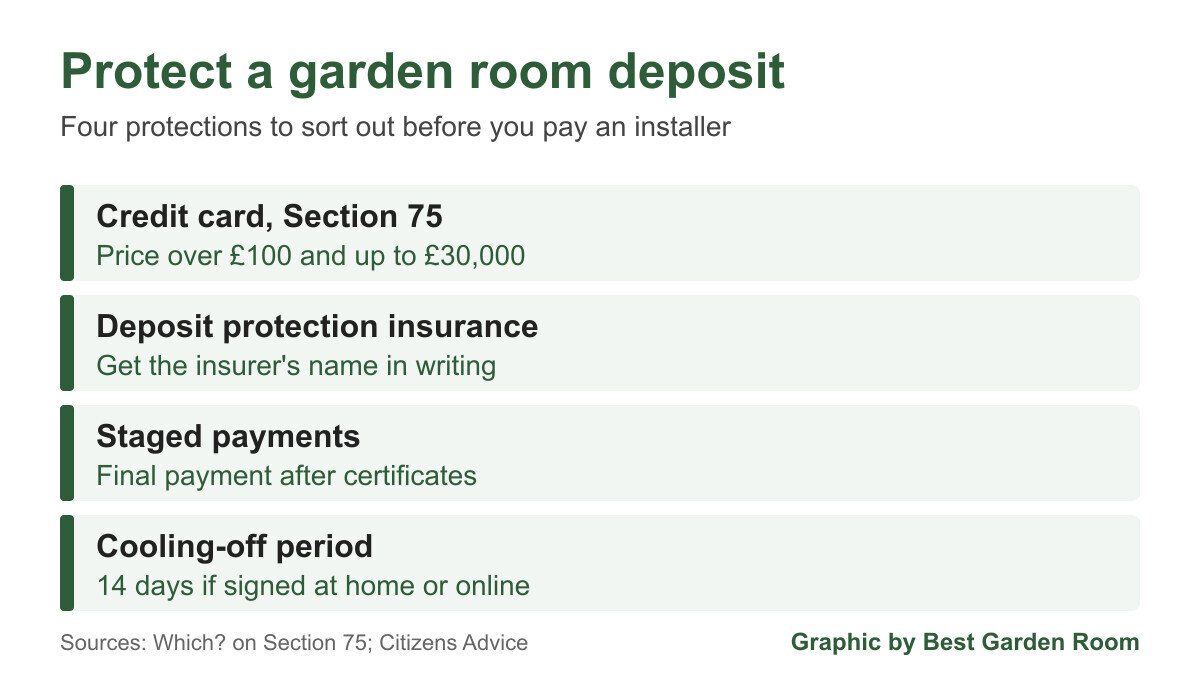
Most installers ask for a deposit to order materials, and a garden room firm going bust between deposit and delivery is the most common way buyers lose money. Three protections are worth knowing. What the contract itself should say is covered in our guide to garden room deposits and contracts.
Pay part on a credit card
Under Section 75 of the Consumer Credit Act, your card provider is jointly liable with the trader if something goes wrong, provided the goods or service cost over £100 and not more than £30,000. Which? explains that you do not need to have paid the full amount on the card: paying only a deposit on a credit card can cover the whole price (Which? on Section 75). Note the upper limit. If your room costs more than £30,000, Section 75 does not apply to it, so the other protections matter more.
Ask about deposit protection insurance
Some installers insure customer deposits so they are repaid if the business stops trading. Ask for the insurer’s name, how much of the deposit is covered and for how long, and whether you receive your own policy document. A verbal “your deposit is protected” is not enough.
Keep the deposit proportionate
The deposit should match what the installer genuinely has to spend before arriving on site. Stage further payments against visible progress, such as the base complete or the shell watertight, and hold back the final payment until the room is finished and the certificates are in your hand.
7. Read the guarantee, not the headline
Garden room firms advertise guarantees of 10 years or more. Check what the guarantee covers (the structure, the roof membrane, the glazing, the workmanship) and what it excludes. Above all, ask what happens if the company is no longer trading. A guarantee from a firm that has closed is worth nothing unless it is insurance backed. Citizens Advice describes an insurance-backed guarantee as cover designed to keep the installer’s workmanship guarantee valid if the installer stops trading. If one is offered, ask for the insurer’s name and confirm you will be registered with them.
8. Know your cancellation rights
If you agree the contract at home, over the phone or online, you normally have a 14 day cooling-off period to cancel. Citizens Advice explains that the business must give you details of how to cancel, and if it does not, the cooling-off period is extended by 14 days from when you receive them, up to a maximum of one year (Citizens Advice on cancelling building work). If you ask the installer to start work inside the 14 days and then cancel, you may have to pay for work done and materials supplied. Beware of any salesperson who pushes for a signature and a start date on the same visit.
Once the work starts, the Consumer Rights Act 2015 requires the installer to carry out the service with reasonable care and skill, within a reasonable time if no date is agreed, and for a reasonable price if no price was fixed. Put the start date, the completion date and the full specification in the contract so there is no argument about what was agreed.
Red flags when choosing a garden room installer
- A large deposit demanded before any site survey
- A discount that expires today if you sign now
- No company number, no landline and no trading address
- Vague answers about planning: “you never need permission for these”
- No mention of who does the electrics, or no certificate offered
- A guarantee with no named insurer
Frequently asked questions
How do I find good garden room installers near me?
Ask for addresses of recent rooms near you, speak to those owners, check the company on Companies House and compare at least three itemised quotes. Local recommendations from neighbours who have had a room for a winter or two are worth more than online star ratings.
How much deposit should a garden room company ask for?
There is no legal maximum. Keep it in line with what the installer must spend before arriving, pay part of it by credit card if the room costs £30,000 or less, and ask whether the deposit is insured.
Do garden room installers handle planning permission?
Many will advise on permitted development and some will submit an application for you, but the legal responsibility stays with you as the owner. Get their advice in writing and check your own position on the Planning Portal.
Is a garden room covered by Section 75?
Yes, if the total price is over £100 and not more than £30,000 and you paid at least part of it on a credit card. Rooms costing more than £30,000 fall outside Section 75.
Can I cancel a garden room order?
If you signed at home, by phone or online, you normally have 14 days to cancel. After that, cancelling usually means breaking the contract, and you may lose some or all of the deposit.
Related guides
- Garden Room Planning Permission UK: The 30m² and 50% Rules Explained
- How Much Does a Garden Room Cost to Run in Winter? Real UK Figures
- Garden Room vs Extension: Honest Cost, Value and When Each Wins
- How Much Does It Cost to Run Electrics to a Garden Room in 2026?
- Ground Screws vs Concrete Base: Which Garden Room Foundation Is Right for You?
- Do Garden Rooms Need Building Regulations? The 15, 30 and 1m Rules Explained
- Prefab vs Bespoke Garden Rooms: Which Is Right for You?
- Garden Room Buying Mistakes: 12 Costly Errors to Avoid
- Garden Room News: June 2026
- How to Buy a Garden Room: The Complete UK Buyer’s Guide (2026)
- What to Look for in a Garden Room: 15 Things to Check Before You Buy
- Buying a Second-Hand Garden Room: Is It Worth It?
- Garden Room Kits vs Fully Installed: Should You Self-Build or Buy Turnkey?
- Garden Room Deposits, Contracts and Deliverables: Protecting Your Money
- How Long Does a Garden Room Last? Lifespan and Maintenance
- Garden Room Cost Per Square Metre: 2026 UK Rates Explained
- How Much Does a Garden Room Cost in the UK? (2026 Price Guide)
- Garden Room Prices by Size: From 3x3m to 8x4m and Beyond
- How Much Does a Garden Office Cost? (2026 UK Breakdown)
- Garden Room Planning News: Late June 2026
- How Much Does a Garden Room with a Bathroom Cost?
- Hidden Garden Room Costs: Foundations, VAT and the Extras Quotes Miss
- Garden Room Finance: Loans, Mortgages and Payment Options Explained
- Garden Room News: Early July 2026
- Do Garden Rooms Add Value to Your House? What the UK Resale Data Shows
- Permitted Development Rights for Garden Rooms: Size, Height and the 2m Boundary Rule
- Do Garden Rooms Affect Council Tax? Business Rates and Reassessment
- Garden Room News: Mid-July 2026
- How a Garden Room Is Built: Foundations to Finish (UK Guide)
- SIPs vs Timber Frame Garden Rooms: Which Construction Is Better?
- How Close to a Boundary Can a Garden Room Be? UK Rules Explained
- How to Apply for Garden Room Planning Permission: Step by Step
- Can You Build a Garden Room on Decking, Slabs or a Patio?
- Is a Garden Room Cheaper Than an Extension? 2026 Cost Comparison
- Garden Room News: Mid-July 2026
- Garden Room Cladding: Cedar vs Composite vs Larch vs Render
- Garden Room Roof Guide: Flat vs Pitched and the Best Materials
- Garden Room Windows and Doors: Bifold, Sliding and Glazing
- How to Build a Garden Room: A DIY Step-by-Step Guide (UK)
- How Long Does It Take to Build a Garden Room?
- How to Make a Garden Room Usable All Year Round
- Garden Room Insulation: Best Materials and U-Values for the UK
- How to Heat a Garden Room: 9 Options Compared by Cost and Warmth
- Best Heating for a Garden Office: Warm Without a Huge Bill
- Air Conditioning for Garden Rooms: Cooling and Heating in One
- Stopping Condensation and Damp in a Garden Room (UK Guide)
- How to Get Wi-Fi in a Garden Office: 6 Ways That Actually Work
- Garden Office Ideas: Designing the Perfect Work-From-Home Space
- Garden Room Ideas: 20 Popular Uses to Inspire Your Build
- Garden Room Annexe: Rules, Costs and How to Build One
- Garden Bar Ideas: The Height Rules, Power and Layout
- Garden Room Business: What Changes Once Clients Visit
- Garden Studio Ideas: Sizes, Light and the 2.5m Rule
- Garden Room Lighting: IP20 Inside, IP65 Out, Part P Rules
- Landscaping Around a Garden Room: the 30cm Decking Trap
- Garden Room Design: Why 2.5m Decides Everything
- Garden Room Planning Permission: the 2.5m Boundary Rule
- Garden Room News: New NPPF Lands, PD Rules Unchanged
- Garden Saunas UK: Planning, Building Regs and Electrics
- Best Garden Room Companies UK: Guarantees of 10 to 25 Years
- Garden Room Electrics: The Rules Change on 15 Oct 2026
- Golf Simulator Garden Room: The 2.5m Rule That Stops It
- Garden Screens: the 2m Rule, and Why Trellis Counts
- Cheap Garden Rooms: What 19mm Walls Really Get You
- Green Retreats Review: 12-Year Cover, 60% Upfront
- Booths Garden Studios Review: Steel Build, 25 Years
- Eden Garden Rooms Review: £23,500 Start, 10-Year Cover
- Green Retreats vs Booths: 25-Year Steel or Timber?
- Garden Rooms London: 6 Companies and the 2.5m Limit
- Garden Room Bedroom: Why a Bed Changes the Rules
- Do I Need Planning Permission for a Garden Shed? Usually Not
- Garden Room News: Staged Payments Arrive, Timber Stays Dear
- Garden Gym Ideas: Sizes, Ceilings and the 2.5m Height Rule
- Garden Gazebo Rules: 2.5m Near a Boundary, 4m Max
- Garden Arch: Wood or Metal, and the 2.7m Height Rule
- Garden Arbour: Sizes That Seat Two, and Wood vs Metal
- Wooden Garden Gates: Sizes, UC4 Posts and the 1m Rule
- Garden Room News: Rates Held, Materials Up 5.9%
- Summer House Interior Ideas: 9 That Work in Winter
- Garden Trellis Panels: the 2m Rule Most Buyers Miss
- Garden Shelters: Six Types and When You Need Permission
- Garden Greenhouses: Glass Gives 90% Light, Plastic 80%
- Summer House Doors and Windows: 4mm Toughened or Styrene?
- Log Stores: Size, Siting and the 20% Moisture Rule
- Garden Shed Roof: Felt, EPDM or Onduline by Pitch
- Insulated Garden Shed: The 25mm Gap That Stops Damp
- Composite Garden Sheds: Rot-Proof, But Check These 6 Things
- How to Build a Garden Shed: Base, Frame and Roof in 5 Steps
- Garden Room News: Power 26.32p a kWh, VAT-Free to March
- Garden Workshop: Size, Base, Power and the Planning Rules
- Plastic Garden Sheds: Who They Suit and 6 Checks First
- Metal Garden Sheds: Stop Condensation Before You Buy
- Garden Shed Storage Ideas: 12 That Free Up Floor Space
- Wooden Garden Sheds: 7 Specs That Decide How Long They Last
- 8×6 Garden Shed: Real Floor Size, Door Width and Base
- 6×4 Garden Shed: 59cm Door, 118cm Deep and What Fits
- Small Garden Shed: 88.5cm Wide Inside and What Fits
- Garden Room News: Building Control Fees Change 6 Nov
- 6×10 Garden Shed: 295 x 182.6cm Inside, and What Fits
- Bike Shed for Garden: Sizes, Ground Anchors and the Locks
- Shed With Log Store: Sizes, Layout and the 2.5m Rule
- Garden Bin Storage: Sizes, Lids and the Front Garden Rule
- Pergola Planning Permission: the 2.5m Boundary Rule
- Garden Cushion Storage: How Many Litres You Really Need
- Garden Bench With Storage: 150 to 265 Litres, What Fits
- Garden Playhouse: Sizing, Base and the 2.5m Planning Rule
- Garden Pod: Sizes, Planning Limits and the 15m² Rule
- Log Cabin UK: 19mm to 70mm Walls and the 2.5m Height Rule
- Waterproof Garden Storage Box: Why Most Aren’t, What to Buy
- Garden Storage Cabinet: 6 Checks and What Not to Keep Inside
- Garden Room News: Judge Rules a Pergola Is a Garden Room