

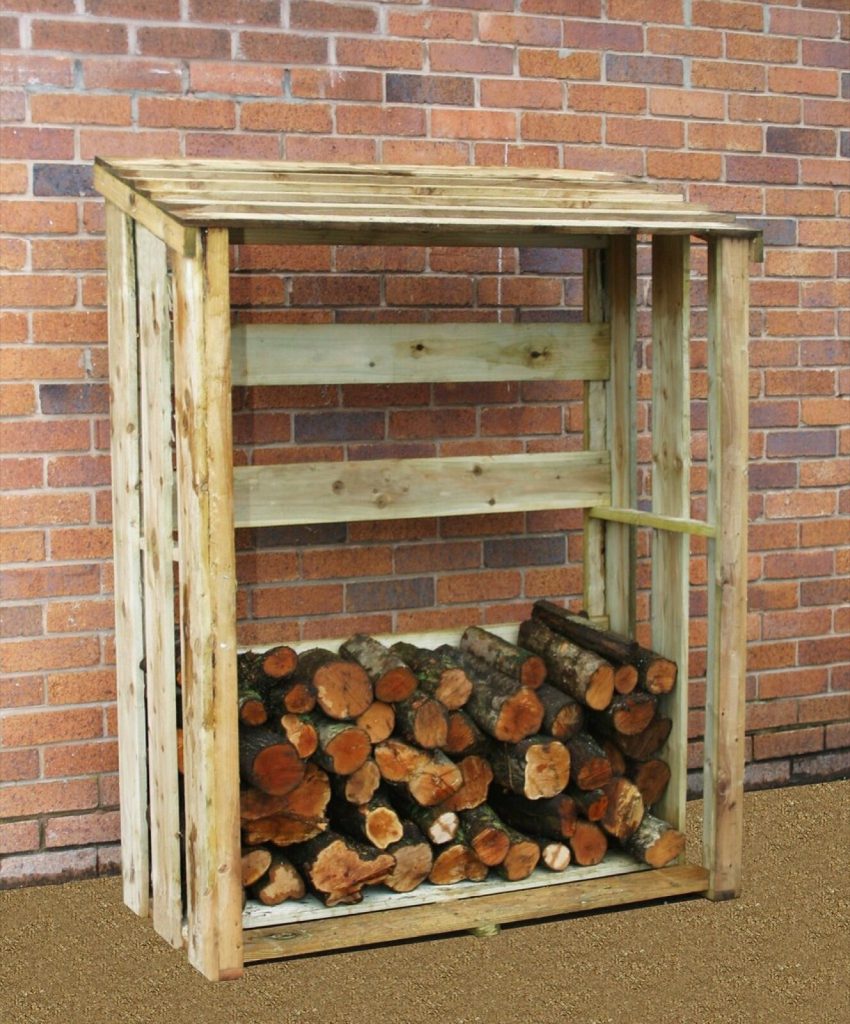
A log store has one job: to take wood that is wet or half dry and hand it back, months later, at a moisture content low enough to burn cleanly. Most of the log stores sold in the UK look the part and do that job badly, because they are built like small sheds when what firewood needs is a roof and a lot of moving air. This covers what separates a good outdoor log store from a pretty box, how big yours needs to be, where to put it in the garden, how to stack it, and when a log store needs planning permission.
Why a log store matters: the 20% line
Dry firewood is defined by a number. Defra’s practical guide to open fires and wood-burning stoves says dry wood should have a moisture content of 20% or less, and it suggests freshly chopped wood is left to dry for up to two years before burning. Wet wood burns cooler, makes more smoke and particulates, and coats the stove glass and the flue with tar.
The rules on buying wood follow the same line. Since May 2021, wood sold in England in volumes of up to two cubic metres has to be certified Ready to Burn under the Woodsure scheme, meaning a moisture content of 20% or less. Larger loads can still be sold wet, but they must come with advice on drying them. So if you buy in bulk to save money, or you cut your own, the log store is what gets the wood from wet to legal-to-sell dry. Even kiln-dried logs need a dry store, or they will take moisture back from the air and rain over the winter.
What makes a good log store
Four features do almost all of the work, and you can check any log store for sale against them in a minute.
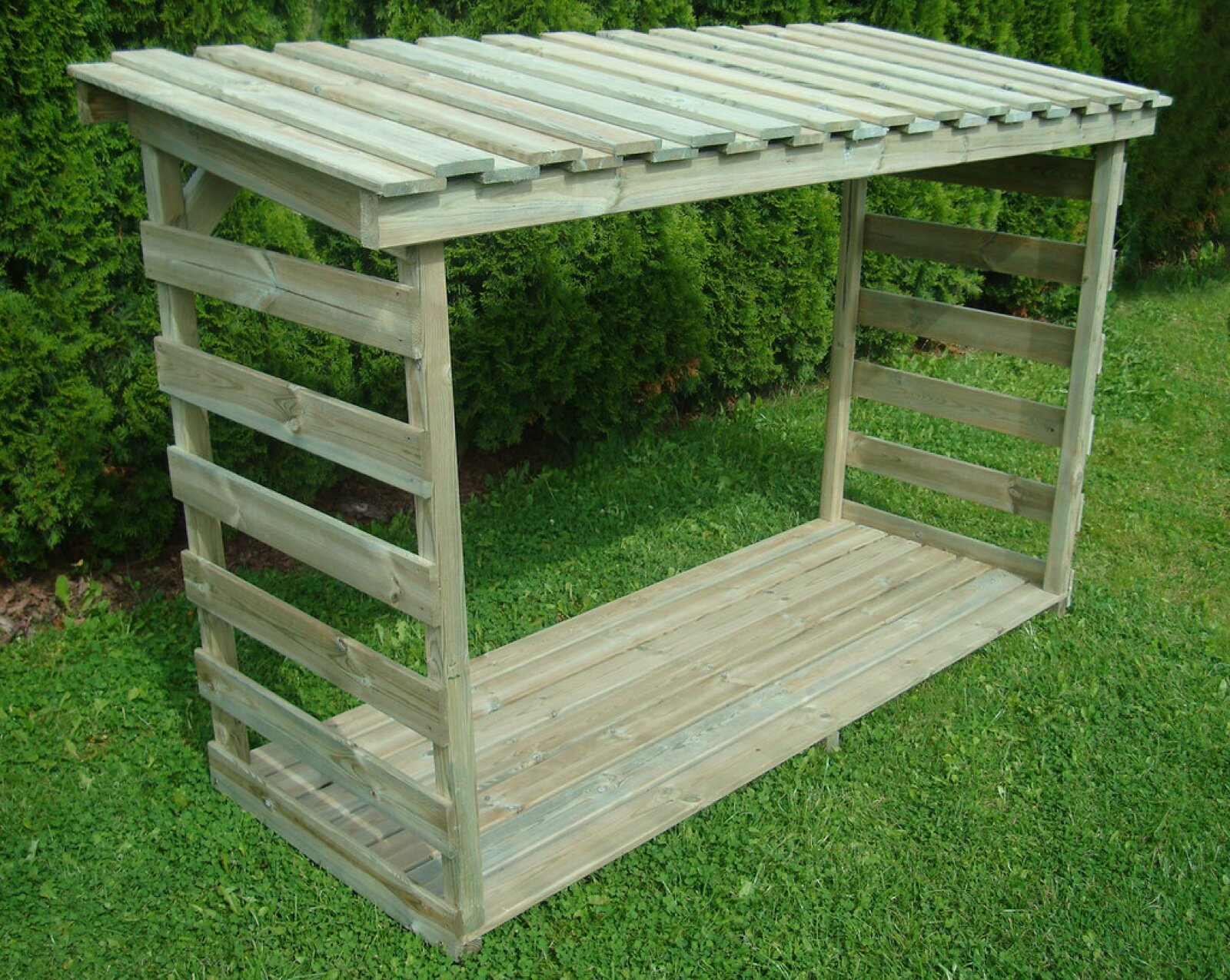
- A roof that overhangs. Rain is the main enemy, and it rarely falls straight down. A roof that stops flush with the front lets driven rain run onto the top of the stack. Look for an overhang at the front of at least 20cm, and a fall to the back so water sheds away from the logs.
- Open or slatted sides. Wood dries by losing moisture to moving air. Solid-sided stores with doors trap damp air around the stack, which is how you get mould and logs that never drop below the mid twenties. Slats with gaps, or fully open sides, let the wind through.
- A raised, slatted floor. Logs sitting on soil or paving wick up ground moisture and rot from the bottom row. A floor lifted clear of the ground, with gaps between the boards, keeps the base dry and lets air rise through the stack.
- An open or part-open front. Doors look tidy but slow drying. If you want a front, a slatted one or a hinged panel you leave open through spring and summer is the compromise.
After that, it is about build quality. Pressure-treated softwood is the usual material and is fine; check the frame is thick enough not to rack under a full load, as a cubic metre of seasoned hardwood logs weighs several hundred kilograms. Metal stores work well if they keep the open sides and raised floor. Avoid anything that is essentially a plastic storage box: it will keep the rain off and keep the moisture in.
Log store sizes: how big should yours be?
Size a log store by volume, and be careful which volume you mean. Firewood is sold loose, tipped into a bag or a trailer, but it is stored stacked. Stacked logs sit much tighter than loose ones: the firewood trade’s usual conversion is that one cubic metre of stacked logs equals about 1.67 cubic metres loose. Turned the other way, a one cubic metre bulk bag of loose logs stacks down to roughly 0.6 of a cubic metre.
To work out what a store holds, multiply its internal width, depth and stacking height. A store 1.2m wide, 0.6m deep with 1.5m of stacking height holds about 1.08 cubic metres of stacked logs, or a little under two bulk bags of loose logs delivered. Depth matters more than it looks: a single row of logs around 25cm long dries faster than a stack three logs deep, so a long, shallow store beats a deep cube for the same volume.
If you are drying your own wood over two summers, the easiest system is two stores, or one store split into two bays: this year’s wood seasoning in one, last year’s dry wood being burned from the other. For small gardens, a slim store under 40cm deep along a fence holds a surprising amount without dominating the space.
Where to put a log store in the garden
Put it where the weather will help rather than hinder. That usually means:
- Sun and wind. An open, sunny spot with a breeze dries logs far faster than a damp shaded corner behind a shed. In most UK gardens a south or west facing position gets both.
- Front facing away from the prevailing weather. Much of the UK gets its rain on westerly and south westerly winds, so if the store is exposed, turn the open front away from them or give it more roof overhang.
- A small gap from the house wall. A store tight against a wall cuts off airflow at the back and can hold damp against the brickwork. Leave a gap, and never let a log stack bridge a damp proof course or cover an air brick.
- Close enough to fetch from in the dark. Keep a small indoor basket or a second small store by the back door stocked from the main store, so the main one can sit where it dries best.
A log store can also go inside a larger outbuilding, a lean-to on the side of a garden room or a bay of a combined shed and log store. That works as long as the log bay itself keeps its open front and slatted sides.
How to stack logs so they dry
A few habits make a real difference to how fast a stack dries:
- Split logs before stacking. Wood dries mainly through the cut ends and split faces; bark slows it down. Rounds over about 10cm across dry far quicker once split.
- Stack in single rows with the cut ends facing the open front, leaving small gaps rather than packing tight.
- Put the newest, wettest wood at the back or in the seasoning bay, and burn from the driest.
- Keep the top of the stack a few centimetres below the roof so air can move across it.
- Check before you burn. A moisture meter is cheap. Split a log and test the fresh inside face, not the outside, and burn it only once it reads 20% or less.
Softwoods such as pine and spruce usually season faster than dense hardwoods like oak, which can need the full two years. A store with good airflow shortens that; a closed box lengthens it.
Do you need planning permission for a log store?
Most garden log stores do not need planning permission. A freestanding log store counts as an outbuilding, and in most houses outbuildings are allowed under permitted development within limits on height and position. The two that catch people out are height near a boundary (within two metres of a boundary the whole structure must be no taller than 2.5 metres) and position, since an outbuilding cannot sit forward of the principal elevation of the house without permission. Stores in the front garden, at listed buildings or in conservation areas and other designated land deserve a check first. The Planning Portal’s outbuildings guidance sets out the full rules, and we cover the same limits in more detail in planning permission for a garden shed, which apply in the same way.
Leases and new-build estate covenants are a separate question. A covenant can restrict structures in front gardens regardless of planning law, so read your deeds if you are on a newer estate.
For more on sheds, garden rooms and other outbuildings, see the rest of Best Garden Room.
Frequently asked questions
Should a log store have sides?
It should have sides that let air through. Slatted or gapped sides keep most rain off while the wind dries the logs. Solid sides and closed doors trap damp air around the stack and slow drying.
Should a log store face north or south?
Where you have the choice, put it in a sunny, breezy spot, which in most UK gardens means south or west facing. If that exposes the open front to driving rain, angle it away from the prevailing wind or choose a deeper roof overhang.
How long do logs take to dry in a log store?
Defra’s guidance is that freshly cut wood may need up to two years to dry. Split softwood in a well ventilated store can be ready sooner; dense hardwood such as oak often needs the full time. Test with a moisture meter and burn at 20% or less.
Can you store logs against a house wall?
You can, but leave a gap behind the store for airflow, keep it clear of air bricks, and never let the stack sit above the damp proof course against the wall. A store standing slightly off the wall dries logs better and keeps the brickwork drier.
Should you cover logs with a tarpaulin instead of a log store?
A tarp over the top only, with the sides left open, is a reasonable stopgap. Wrapping a stack fully in plastic traps moisture and causes mould, so it does more harm than good.
What size log store do I need for a cubic metre of logs?
A delivered cubic metre of loose logs stacks down to around 0.6 of a cubic metre, so a store with about 0.6 to 0.7 cubic metres of stacking space will take it. For example, 1.2m wide by 0.4m deep by 1.3m high gives about 0.62 cubic metres.
Related guides
- Garden Room Planning Permission UK: The 30m² and 50% Rules Explained
- How Much Does a Garden Room Cost to Run in Winter? Real UK Figures
- Garden Room vs Extension: Honest Cost, Value and When Each Wins
- How Much Does It Cost to Run Electrics to a Garden Room in 2026?
- Ground Screws vs Concrete Base: Which Garden Room Foundation Is Right for You?
- Do Garden Rooms Need Building Regulations? The 15, 30 and 1m Rules Explained
- Prefab vs Bespoke Garden Rooms: Which Is Right for You?
- Garden Room Buying Mistakes: 12 Costly Errors to Avoid
- Garden Room News: June 2026
- How to Buy a Garden Room: The Complete UK Buyer’s Guide (2026)
- What to Look for in a Garden Room: 15 Things to Check Before You Buy
- Buying a Second-Hand Garden Room: Is It Worth It?
- Garden Room Kits vs Fully Installed: Should You Self-Build or Buy Turnkey?
- Garden Room Deposits, Contracts and Deliverables: Protecting Your Money
- How Long Does a Garden Room Last? Lifespan and Maintenance
- Garden Room Cost Per Square Metre: 2026 UK Rates Explained
- How Much Does a Garden Room Cost in the UK? (2026 Price Guide)
- Garden Room Prices by Size: From 3x3m to 8x4m and Beyond
- How Much Does a Garden Office Cost? (2026 UK Breakdown)
- Garden Room Planning News: Late June 2026
- How Much Does a Garden Room with a Bathroom Cost?
- Hidden Garden Room Costs: Foundations, VAT and the Extras Quotes Miss
- Garden Room Finance: Loans, Mortgages and Payment Options Explained
- Garden Room News: Early July 2026
- Do Garden Rooms Add Value to Your House? What the UK Resale Data Shows
- Permitted Development Rights for Garden Rooms: Size, Height and the 2m Boundary Rule
- Do Garden Rooms Affect Council Tax? Business Rates and Reassessment
- Garden Room News: Mid-July 2026
- How a Garden Room Is Built: Foundations to Finish (UK Guide)
- SIPs vs Timber Frame Garden Rooms: Which Construction Is Better?
- How Close to a Boundary Can a Garden Room Be? UK Rules Explained
- How to Apply for Garden Room Planning Permission: Step by Step
- Can You Build a Garden Room on Decking, Slabs or a Patio?
- Is a Garden Room Cheaper Than an Extension? 2026 Cost Comparison
- Garden Room News: Mid-July 2026
- Garden Room Cladding: Cedar vs Composite vs Larch vs Render
- Garden Room Roof Guide: Flat vs Pitched and the Best Materials
- Garden Room Windows and Doors: Bifold, Sliding and Glazing
- How to Build a Garden Room: A DIY Step-by-Step Guide (UK)
- How Long Does It Take to Build a Garden Room?
- How to Make a Garden Room Usable All Year Round
- Garden Room Insulation: Best Materials and U-Values for the UK
- How to Heat a Garden Room: 9 Options Compared by Cost and Warmth
- Best Heating for a Garden Office: Warm Without a Huge Bill
- Air Conditioning for Garden Rooms: Cooling and Heating in One
- Stopping Condensation and Damp in a Garden Room (UK Guide)
- How to Get Wi-Fi in a Garden Office: 6 Ways That Actually Work
- Garden Office Ideas: Designing the Perfect Work-From-Home Space
- Garden Room Ideas: 20 Popular Uses to Inspire Your Build
- Garden Room Annexe: Rules, Costs and How to Build One
- Garden Bar Ideas: The Height Rules, Power and Layout
- Garden Room Business: What Changes Once Clients Visit
- Garden Studio Ideas: Sizes, Light and the 2.5m Rule
- Garden Room Lighting: IP20 Inside, IP65 Out, Part P Rules
- Landscaping Around a Garden Room: the 30cm Decking Trap
- Garden Room Design: Why 2.5m Decides Everything
- Garden Room Planning Permission: the 2.5m Boundary Rule
- Garden Room News: New NPPF Lands, PD Rules Unchanged
- Garden Saunas UK: Planning, Building Regs and Electrics
- Best Garden Room Companies UK: Guarantees of 10 to 25 Years
- Garden Room Electrics: The Rules Change on 15 Oct 2026
- Golf Simulator Garden Room: The 2.5m Rule That Stops It
- Garden Screens: the 2m Rule, and Why Trellis Counts
- Cheap Garden Rooms: What 19mm Walls Really Get You
- Green Retreats Review: 12-Year Cover, 60% Upfront
- Booths Garden Studios Review: Steel Build, 25 Years
- Eden Garden Rooms Review: £23,500 Start, 10-Year Cover
- Green Retreats vs Booths: 25-Year Steel or Timber?
- Garden Rooms London: 6 Companies and the 2.5m Limit
- Garden Room Bedroom: Why a Bed Changes the Rules
- Do I Need Planning Permission for a Garden Shed? Usually Not
- Garden Room News: Staged Payments Arrive, Timber Stays Dear
- Garden Gym Ideas: Sizes, Ceilings and the 2.5m Height Rule
- Garden Gazebo Rules: 2.5m Near a Boundary, 4m Max
- Garden Arch: Wood or Metal, and the 2.7m Height Rule
- Garden Arbour: Sizes That Seat Two, and Wood vs Metal
- Wooden Garden Gates: Sizes, UC4 Posts and the 1m Rule
- Garden Room News: Rates Held, Materials Up 5.9%
- Summer House Interior Ideas: 9 That Work in Winter
- Garden Trellis Panels: the 2m Rule Most Buyers Miss
- Garden Shelters: Six Types and When You Need Permission
- Garden Greenhouses: Glass Gives 90% Light, Plastic 80%
- Summer House Doors and Windows: 4mm Toughened or Styrene?