

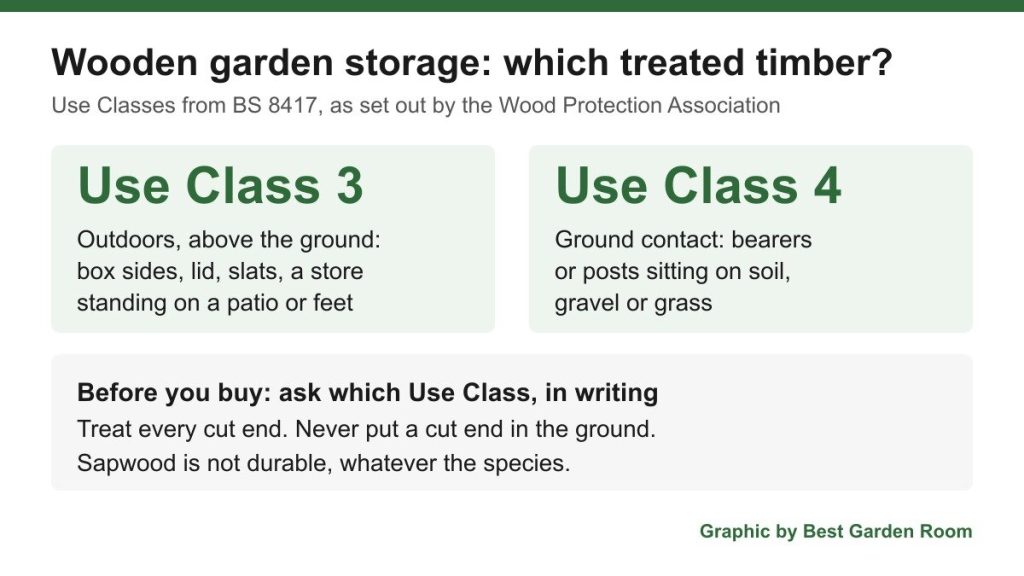
Wooden garden storage looks better than plastic and lasts longer than most people expect, but only if the timber was treated for the job and the box is kept off wet ground. The difference between a wooden storage box that rots at the base in three winters and one that lasts for many years is rarely the brand. It is the timber treatment, the base and a few construction details you can check before you buy.
This page covers the treated timber Use Classes in BS 8417, how naturally durable woods compare, the details that keep water out, and the upkeep that matters.
What counts as wooden garden storage
The term covers a wide range: low storage boxes and chests for cushions and toys, storage benches you can sit on, tall garden storage cabinets for tools, bin stores, and log stores. Anything bigger that you walk into is a shed, which we cover separately under wooden garden sheds.
All of these share the same weak points: the base sits close to wet ground, the lid catches rain, and the end grain at every cut soaks up water. Get those right and the rest is mostly taste.
Treated softwood: Use Class 3 or Use Class 4
Most wooden garden storage sold in the UK is pressure treated softwood, usually pine or spruce. The Wood Protection Association, the UK trade body for wood preservation, makes a point buyers often miss: treated wood that looks identical can carry very different levels of protection, because the standard requires the loading and penetration of preservative to be matched to the end use.
Those end uses are grouped into Use Classes under BS 8417. The WPA’s buyer’s guide gives three main ones:
- Use Class 2: inside a building, above the ground and covered. Not for garden storage.
- Use Class 3: outdoors, above the ground. The WPA’s examples are deck boards, fence rails and boards, cladding and fascias.
- Use Class 4: in contact with the ground or fresh water, or giving exterior structural support. Its examples are fence posts, playground equipment, and decking posts, joists and beams.
For a storage box, the panels, lid and slats are Use Class 3 work. Any bearers, runners or feet that sit directly on soil, gravel or grass are in ground contact and need Use Class 4. A box built entirely of Use Class 3 timber and set straight onto a lawn will rot from the bottom up, however good the rest of it is.
The WPA’s buying checklist
- Decide which Use Class you need before you order.
- Tell the supplier in writing that the wood must be treated to that Use Class to comply with BS 8417.
- Ask for confirmation on the delivery note, invoice or a treatment certificate. When buying from stock, check which Use Class it was treated to.
- Whenever you cut, notch or drill treated timber, brush an end grain preservative onto the fresh surface.
- Never put cut ends in the ground, even if they have been end grain coated.
The last two matter most for self-assembly kits and anything you modify. The preservative may not penetrate right to the heart of a thick piece, so a fresh saw cut can expose wood with little or no protection.
Naturally durable woods: cedar, larch and oak
The alternative to treated softwood is a timber that resists decay on its own. Durability is graded under the European standard EN 350, on a scale from class 1 (very durable) to class 5 (not durable). Two caveats apply to every species:
- The class applies to heartwood only. Sapwood, the paler outer layer of the log, is not durable in any species.
- The figures vary with where the tree grew. Published tables generally put imported North American western red cedar and European oak heartwood around class 2, and larch around class 3 to 4, with home grown timber of the same species often rated a class lower.
So a cedar or oak storage chest can outlast treated pine, but only if it is mostly heartwood. A cheap “cedar” box with plenty of pale sapwood on show is not the durable product the name suggests. For any wood, look for FSC or PEFC certification if you want to know it came from a responsibly managed forest.
Details that keep water out
Construction matters as much as the timber. Before buying, check these:
- Feet or bearers. The box should sit on its own feet or bearers, not on its floor boards. Air moving underneath dries it after rain.
- A firm, free-draining base. Paving slabs or a gravel pad beat bare soil. On a lawn, the grass underneath stays wet and the timber with it.
- A sloped or overhanging lid. A flat lid that sits flush with the sides lets rain run straight into the joint. An overhang throws water clear of the box.
- Tongue and groove or slatted walls. Tongue and groove keeps more rain out, which suits cushions and tools. Slatted sides let air through, which suits logs and anything that needs to dry.
- A gap from the house wall. Pushing a box hard against brickwork traps damp behind it.
- Rust resistant hinges and screws. Galvanised or stainless steel fittings will not stain the wood or seize.
No wooden box is fully waterproof. If you need contents to stay bone dry, such as electrical items or seat cushions, use a liner or read our page on waterproof garden storage boxes, which explains what the weather resistance claims on plastic boxes actually mean.
Finishes and upkeep
Pressure treatment protects against rot and insects, not against sun and rain weathering the surface. Untreated or unfinished timber turns silver-grey over time. That is cosmetic, not decay, and some people prefer it.
If you want to keep the colour, apply an exterior stain or oil once the timber is dry, and recoat when water stops beading on the surface. Each spring, lift the lid and check three places: the bottom edge of each panel, the feet, and the underside of the lid. Soft, dark or crumbly wood there is the first sign of rot, and a single bad board is easier to replace early than late.
Keep soil, leaves and grass clippings from building up against the base. They hold moisture against the wood far longer than rain does.
Wooden, metal or plastic?
Wood is the best looking option and the easiest to repair or adapt, but it needs the most care. Plastic resin boxes need almost none and are lighter, but tend to look cheaper and can fade and become brittle in strong sun. Metal is secure and fireproof but can condense inside and rust where the coating is damaged; see our page on metal garden sheds for the same trade-offs at a larger size.
For a storage box near the house that you will look at every day, wood usually wins. For a utility store down the side return, plastic or metal may be the more practical choice. More on garden buildings and storage across the site at Best Garden Room.
Frequently asked questions
How long does wooden garden storage last?
It depends far more on treatment and base than on brand. Timber treated to the right Use Class, kept off wet ground and checked each spring can last many years; the same box sat on a lawn can fail within a few winters. Few makers publish a lifespan, so look for a treatment guarantee and the Use Class instead.
Is pressure treated wood safe for a toy box?
Treated timber is routinely used where children play: the WPA lists playground equipment among its Use Class 4 applications. Let new treated timber dry fully before use, and add a liner if you want a barrier between toys and the wood.
Do I need to treat a new wooden storage box?
Not if it was pressure treated to the right Use Class, though a stain or oil will slow weathering. Any cut you make yourself needs an end grain preservative straight away.
What is the best wood for garden storage?
Treated softwood to the right Use Class gives the best value. For a longer life without chemical treatment, choose a naturally durable heartwood such as western red cedar or oak, checking that sapwood has been left out.
Should a wooden storage box sit on grass?
No. Set it on paving slabs, a gravel pad or bearers treated to Use Class 4. Grass keeps the base permanently damp, which is the most common cause of rot in garden storage.
Sources: Wood Protection Association, The Buyer’s Guide to Preservative Treated Wood (Issue 6, April 2022), thewpa.org.uk; EN 350 durability classes as published in timber durability tables; FSC.
Related guides
- Garden Room Planning Permission UK: The 30m² and 50% Rules Explained
- How Much Does a Garden Room Cost to Run in Winter? Real UK Figures
- Garden Room vs Extension: Honest Cost, Value and When Each Wins
- How Much Does It Cost to Run Electrics to a Garden Room in 2026?
- Ground Screws vs Concrete Base: Which Garden Room Foundation Is Right for You?
- Do Garden Rooms Need Building Regulations? The 15, 30 and 1m Rules Explained
- Prefab vs Bespoke Garden Rooms: Which Is Right for You?
- Garden Room Buying Mistakes: 12 Costly Errors to Avoid
- Garden Room News: June 2026
- How to Buy a Garden Room: The Complete UK Buyer’s Guide (2026)
- What to Look for in a Garden Room: 15 Things to Check Before You Buy
- Buying a Second-Hand Garden Room: Is It Worth It?
- Garden Room Kits vs Fully Installed: Should You Self-Build or Buy Turnkey?
- Garden Room Deposits, Contracts and Deliverables: Protecting Your Money
- How Long Does a Garden Room Last? Lifespan and Maintenance
- Garden Room Cost Per Square Metre: 2026 UK Rates Explained
- How Much Does a Garden Room Cost in the UK? (2026 Price Guide)
- Garden Room Prices by Size: From 3x3m to 8x4m and Beyond
- How Much Does a Garden Office Cost? (2026 UK Breakdown)
- Garden Room Planning News: Late June 2026
- How Much Does a Garden Room with a Bathroom Cost?
- Hidden Garden Room Costs: Foundations, VAT and the Extras Quotes Miss
- Garden Room Finance: Loans, Mortgages and Payment Options Explained
- Garden Room News: Early July 2026
- Do Garden Rooms Add Value to Your House? What the UK Resale Data Shows
- Permitted Development Rights for Garden Rooms: Size, Height and the 2m Boundary Rule
- Do Garden Rooms Affect Council Tax? Business Rates and Reassessment
- Garden Room News: Mid-July 2026
- How a Garden Room Is Built: Foundations to Finish (UK Guide)
- SIPs vs Timber Frame Garden Rooms: Which Construction Is Better?
- How Close to a Boundary Can a Garden Room Be? UK Rules Explained
- How to Apply for Garden Room Planning Permission: Step by Step
- Can You Build a Garden Room on Decking, Slabs or a Patio?
- Is a Garden Room Cheaper Than an Extension? 2026 Cost Comparison
- Garden Room News: Mid-July 2026
- Garden Room Cladding: Cedar vs Composite vs Larch vs Render
- Garden Room Roof Guide: Flat vs Pitched and the Best Materials
- Garden Room Windows and Doors: Bifold, Sliding and Glazing
- How to Build a Garden Room: A DIY Step-by-Step Guide (UK)
- How Long Does It Take to Build a Garden Room?
- How to Make a Garden Room Usable All Year Round
- Garden Room Insulation: Best Materials and U-Values for the UK
- How to Heat a Garden Room: 9 Options Compared by Cost and Warmth
- Best Heating for a Garden Office: Warm Without a Huge Bill
- Air Conditioning for Garden Rooms: Cooling and Heating in One
- Stopping Condensation and Damp in a Garden Room (UK Guide)
- How to Get Wi-Fi in a Garden Office: 6 Ways That Actually Work
- Garden Office Ideas: Designing the Perfect Work-From-Home Space
- Garden Room Ideas: 20 Popular Uses to Inspire Your Build
- Garden Room Annexe: Rules, Costs and How to Build One
- Garden Bar Ideas: The Height Rules, Power and Layout
- Garden Room Business: What Changes Once Clients Visit
- Garden Studio Ideas: Sizes, Light and the 2.5m Rule
- Garden Room Lighting: IP20 Inside, IP65 Out, Part P Rules
- Landscaping Around a Garden Room: the 30cm Decking Trap
- Garden Room Design: Why 2.5m Decides Everything
- Garden Room Planning Permission: the 2.5m Boundary Rule
- Garden Room News: New NPPF Lands, PD Rules Unchanged
- Garden Saunas UK: Planning, Building Regs and Electrics
- Best Garden Room Companies UK: Guarantees of 10 to 25 Years
- Garden Room Electrics: The Rules Change on 15 Oct 2026
- Golf Simulator Garden Room: The 2.5m Rule That Stops It
- Garden Screens: the 2m Rule, and Why Trellis Counts
- Cheap Garden Rooms: What 19mm Walls Really Get You
- Green Retreats Review: 12-Year Cover, 60% Upfront
- Booths Garden Studios Review: Steel Build, 25 Years
- Eden Garden Rooms Review: £23,500 Start, 10-Year Cover
- Green Retreats vs Booths: 25-Year Steel or Timber?
- Garden Rooms London: 6 Companies and the 2.5m Limit
- Garden Room Bedroom: Why a Bed Changes the Rules
- Do I Need Planning Permission for a Garden Shed? Usually Not
- Garden Room News: Staged Payments Arrive, Timber Stays Dear
- Garden Gym Ideas: Sizes, Ceilings and the 2.5m Height Rule
- Garden Gazebo Rules: 2.5m Near a Boundary, 4m Max
- Garden Arch: Wood or Metal, and the 2.7m Height Rule
- Garden Arbour: Sizes That Seat Two, and Wood vs Metal
- Wooden Garden Gates: Sizes, UC4 Posts and the 1m Rule
- Garden Room News: Rates Held, Materials Up 5.9%
- Summer House Interior Ideas: 9 That Work in Winter
- Garden Trellis Panels: the 2m Rule Most Buyers Miss
- Garden Shelters: Six Types and When You Need Permission
- Garden Greenhouses: Glass Gives 90% Light, Plastic 80%
- Summer House Doors and Windows: 4mm Toughened or Styrene?
- Log Stores: Size, Siting and the 20% Moisture Rule
- Garden Shed Roof: Felt, EPDM or Onduline by Pitch
- Insulated Garden Shed: The 25mm Gap That Stops Damp
- Composite Garden Sheds: Rot-Proof, But Check These 6 Things
- How to Build a Garden Shed: Base, Frame and Roof in 5 Steps
- Garden Room News: Power 26.32p a kWh, VAT-Free to March
- Garden Workshop: Size, Base, Power and the Planning Rules
- Plastic Garden Sheds: Who They Suit and 6 Checks First
- Metal Garden Sheds: Stop Condensation Before You Buy
- Garden Shed Storage Ideas: 12 That Free Up Floor Space
- Wooden Garden Sheds: 7 Specs That Decide How Long They Last
- 8×6 Garden Shed: Real Floor Size, Door Width and Base
- 6×4 Garden Shed: 59cm Door, 118cm Deep and What Fits
- Small Garden Shed: 88.5cm Wide Inside and What Fits
- Garden Room News: Building Control Fees Change 6 Nov
- 6×10 Garden Shed: 295 x 182.6cm Inside, and What Fits
- Bike Shed for Garden: Sizes, Ground Anchors and the Locks
- Shed With Log Store: Sizes, Layout and the 2.5m Rule
- Garden Bin Storage: Sizes, Lids and the Front Garden Rule
- Pergola Planning Permission: the 2.5m Boundary Rule
- Garden Cushion Storage: How Many Litres You Really Need
- Garden Bench With Storage: 150 to 265 Litres, What Fits
- Garden Playhouse: Sizing, Base and the 2.5m Planning Rule
- Garden Pod: Sizes, Planning Limits and the 15m² Rule
- Log Cabin UK: 19mm to 70mm Walls and the 2.5m Height Rule
- Waterproof Garden Storage Box: Why Most Aren’t, What to Buy
- Garden Storage Cabinet: 6 Checks and What Not to Keep Inside
- Garden Room News: Judge Rules a Pergola Is a Garden Room
- Garden Room Installers Near Me: 8 Checks Before a Deposit
- Summer Houses: The 2.5m Height Rule, Sizes and Bases