

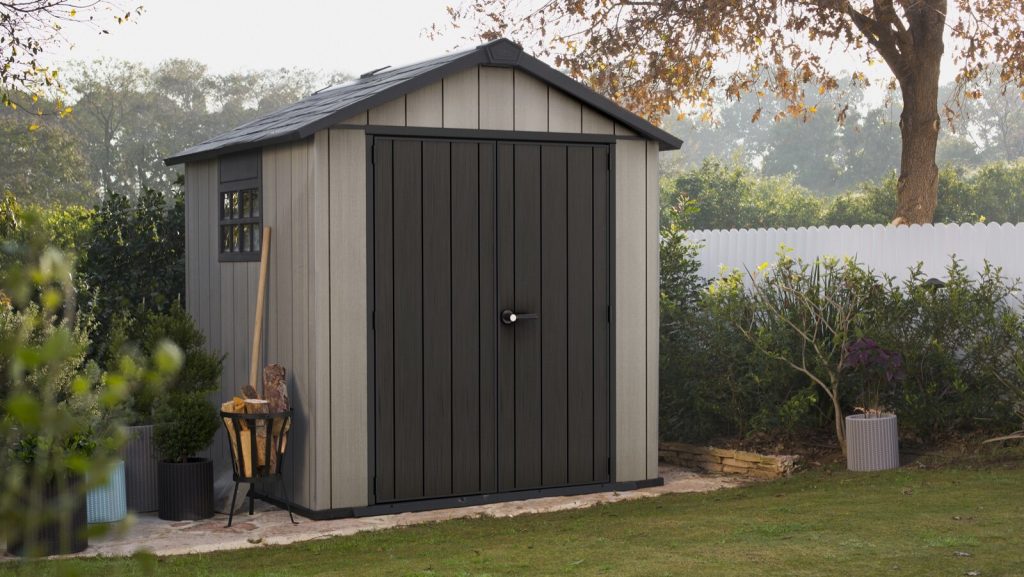
Plastic garden sheds are the low-maintenance option: no annual preserver, no rot, no felt to replace. Whether one is worth buying comes down to what you will keep in it, how exposed your garden is, and how much care you put into the base, because a plastic shed is only as straight, dry and secure as the surface it is fixed to.
This page covers what plastic sheds are actually made of, who they suit, the six things to check before you buy, and how they compare with timber, metal and composite. For the rest of our outdoor buildings advice, start at the Best Garden Room homepage.
What a plastic shed is made of
“Plastic” covers a few different materials, and the brochures use “resin” for most of them. The two you will meet most often in the UK:
- Polypropylene resin panels. Keter’s Factor range, for example, is described as made from “specially formulated polypropylene resin”. Panels are typically moulded with a wood-grain or shiplap texture and slot together, sometimes with a steel-reinforced roof on the larger models.
- Double-walled HDPE with a steel frame. Lifetime sheds are injection-moulded high-density polyethylene, double walled, reinforced with powder-coated steel, and built with steeply pitched roofs to shed water. UK stockists list a 10-year manufacturer warranty on them.
Most models are UV stabilised so the colour does not fade badly or the panels turn brittle in sun. Warranties vary by range: the Keter manuals we checked quote a limited five-year warranty that has to be activated online, so register it when you build the shed rather than when something goes wrong.
Who plastic garden sheds suit, and who they do not
A plastic shed is a good fit if you want to store garden tools, a mower, bikes, cushions and outdoor toys, and you do not want to spend a weekend each year treating timber. They are also popular with renters, because they come apart again and go with you.
They are a poor fit in a few cases:
- Workshops. You cannot easily screw heavy shelving, a pegboard or a vice into thin plastic walls. Many models have accessory rails, but they are designed for light loads. If you want a bench and power tools, read our garden workshop page first.
- Anything that needs to stay warm or dry all winter. Thin plastic walls are not insulation and condensation forms on the roof on cold nights. Paint, seeds, paper and electronics fare badly.
- Very exposed, windy plots unless the base and fixings are done properly. A light structure catches wind like a sail.
- Valuable kit. Plastic walls are easier to cut through than solid timber or steel, so high-value bikes and tools need more than a padlock on the door.
Six checks before you buy
1. The base it needs, and whether a floor is included
Manufacturers are blunt about this. Keter’s assembly manuals say the ground must be level and strongly recommend a wooden or concrete base; Lifetime’s stockists say the shed must go on a flat surface such as a patio, decking, slabs or concrete. Some models include a moulded floor, others are sold as a frame and walls only, and some offer the floor as an extra. Check before you order, because the answer changes what base you need to build.
2. Anchoring
Every plastic shed should be fixed down. Lifetime notes that anchoring hardware is not included because it depends on your foundation; its floors have small marked indentations in each corner for drilling through into the base. Keter models are designed to be anchored to the base, with the exact kit varying by model. Budget for the right fixings for your surface: concrete anchor bolts for a slab, coach screws for a timber frame.
3. Height and doors
Measure what you will store, then check the internal height at the door and at the eaves, not just the ridge. A pent roof loses headroom at the low side. Double doors make wheeling a mower or bikes in far easier, and a threshold or ramp helps on raised bases.
4. Ventilation and light
Look for built-in vents and a skylight or windows. Condensation forms when warm, moist air inside the shed meets the colder roof as the outside temperature drops at night, which happens a lot in a British autumn. Screened vents near the roof let that moisture escape. Skylights save you running power just to see inside.
5. Roof shape and strength
Steeply pitched apex roofs shed rain and leaves better than shallow ones. On larger sheds, look for steel roof trusses or reinforcement rather than plastic alone, especially if you get snow or overhanging trees drop branches.
6. Lockability and fixings for shelving
Check for a padlock hasp on the door, whether the doors lock to each other, and what shelving and hook accessories the maker sells. Retrofitting heavy shelves to a plastic wall is harder than on timber.
Building the base for a plastic shed
A level, solid base is what keeps the doors closing and the panels aligned. If the base is out by even a small amount, a plastic shed racks, the doors bind and gaps open at the corners where rain gets in.
- Concrete slab: the most rigid and the best for anchoring. Make it slightly larger than the footprint and level it properly.
- Paving slabs on a compacted sub-base: a good DIY option for small and mid-size sheds. Use a long spirit level across the whole area, not just slab to slab.
- Timber base or decking: works well on sloping ground, provided it is pressure treated, level and has airflow underneath.
- Plastic grid bases filled with gravel: sold for sheds and quick to lay. They need firm, level ground underneath and give fewer anchoring options, so check the shed maker accepts them.
We go through bases in more depth, including ground screws, in ground screws vs a concrete base, and the frame, bearers and floor steps for a timber shed in how to build a garden shed.
Plastic vs timber, metal and composite sheds
Each material trades something off:
- Plastic: no rot or treatment, light, quick to build, can be dismantled and moved. Less rigid, harder to fix things to, and walls offer little insulation or security.
- Timber: easy to modify, insulate, line and fix shelving to. Needs regular treatment and roof maintenance; see our garden shed roof page for felt and EPDM options.
- Metal: strong and hard to break into when properly anchored, but prone to condensation dripping from the roof and needs care where panels are cut or scratched.
- Composite: wood-plastic boards that look more like timber with less upkeep; usually a step up in weight and rigidity. We set out what to check in composite garden sheds.
Planning permission for a plastic shed
The material makes no difference to planning. A shed is an outbuilding, and in England most can go up under permitted development without an application, as long as it meets the limits set out on the Planning Portal’s outbuildings guidance: single storey, not forward of the front of the house, a maximum height of 2.5 metres if it sits within 2 metres of a boundary, and outbuildings together covering no more than half the garden. Listed buildings, conservation areas and flats have tighter rules. Our planning permission for a garden shed page has the full list.
Looking after a plastic shed
Maintenance is light, but not zero:
- Wash it down once or twice a year with mild soapy water; algae and leaf stains build up on north-facing walls.
- Clear leaves and snow off the roof, particularly on flat or shallow pitched models.
- Check the anchor fixings each autumn before the winter storms.
- Keep vents clear and open the doors on dry days to air it.
- Stand stored items on pallets or shelving rather than straight on the floor if condensation is a problem.
Frequently asked questions
Are plastic garden sheds any good?
For storing garden tools, bikes and outdoor furniture, yes, provided they go on a level base and are anchored. They are less suited to workshops, heavy shelving or storing anything that must stay completely dry through winter.
How long do plastic sheds last?
It depends on the material, UV stabilisation and how well the base was built. Warranties give a guide to the maker’s confidence: Lifetime sheds are listed with a 10-year warranty by UK stockists, and the Keter manuals we checked quote a limited five-year warranty.
Do plastic sheds need a base?
Yes. Keter and Lifetime both require a flat, level surface, and recommend a concrete, slab or timber base. Putting one straight onto grass or soil leads to racked panels, sticking doors and an unanchored shed.
Do plastic sheds get condensation?
They can, especially in spring and autumn when nights turn cold. Warm, damp air condenses on the cooler roof. Built-in vents, airing the shed on dry days and not storing wet tools inside all help.
Can a plastic shed blow away?
An unanchored one can, because it is light. Fix it to the base through the floor or frame with fixings suited to concrete, slabs or timber, and check them every autumn.
Do I need planning permission for a plastic shed?
Usually not in England, if it meets the permitted development limits for outbuildings, including a 2.5 metre height limit within 2 metres of a boundary. Conservation areas, listed buildings and flats are exceptions.
Related guides
- Garden Room Planning Permission UK: The 30m² and 50% Rules Explained
- How Much Does a Garden Room Cost to Run in Winter? Real UK Figures
- Garden Room vs Extension: Honest Cost, Value and When Each Wins
- How Much Does It Cost to Run Electrics to a Garden Room in 2026?
- Ground Screws vs Concrete Base: Which Garden Room Foundation Is Right for You?
- Do Garden Rooms Need Building Regulations? The 15, 30 and 1m Rules Explained
- Prefab vs Bespoke Garden Rooms: Which Is Right for You?
- Garden Room Buying Mistakes: 12 Costly Errors to Avoid
- Garden Room News: June 2026
- How to Buy a Garden Room: The Complete UK Buyer’s Guide (2026)
- What to Look for in a Garden Room: 15 Things to Check Before You Buy
- Buying a Second-Hand Garden Room: Is It Worth It?
- Garden Room Kits vs Fully Installed: Should You Self-Build or Buy Turnkey?
- Garden Room Deposits, Contracts and Deliverables: Protecting Your Money
- How Long Does a Garden Room Last? Lifespan and Maintenance
- Garden Room Cost Per Square Metre: 2026 UK Rates Explained
- How Much Does a Garden Room Cost in the UK? (2026 Price Guide)
- Garden Room Prices by Size: From 3x3m to 8x4m and Beyond
- How Much Does a Garden Office Cost? (2026 UK Breakdown)
- Garden Room Planning News: Late June 2026
- How Much Does a Garden Room with a Bathroom Cost?
- Hidden Garden Room Costs: Foundations, VAT and the Extras Quotes Miss
- Garden Room Finance: Loans, Mortgages and Payment Options Explained
- Garden Room News: Early July 2026
- Do Garden Rooms Add Value to Your House? What the UK Resale Data Shows
- Permitted Development Rights for Garden Rooms: Size, Height and the 2m Boundary Rule
- Do Garden Rooms Affect Council Tax? Business Rates and Reassessment
- Garden Room News: Mid-July 2026
- How a Garden Room Is Built: Foundations to Finish (UK Guide)
- SIPs vs Timber Frame Garden Rooms: Which Construction Is Better?
- How Close to a Boundary Can a Garden Room Be? UK Rules Explained
- How to Apply for Garden Room Planning Permission: Step by Step
- Can You Build a Garden Room on Decking, Slabs or a Patio?
- Is a Garden Room Cheaper Than an Extension? 2026 Cost Comparison
- Garden Room News: Mid-July 2026
- Garden Room Cladding: Cedar vs Composite vs Larch vs Render
- Garden Room Roof Guide: Flat vs Pitched and the Best Materials
- Garden Room Windows and Doors: Bifold, Sliding and Glazing
- How to Build a Garden Room: A DIY Step-by-Step Guide (UK)
- How Long Does It Take to Build a Garden Room?
- How to Make a Garden Room Usable All Year Round
- Garden Room Insulation: Best Materials and U-Values for the UK
- How to Heat a Garden Room: 9 Options Compared by Cost and Warmth
- Best Heating for a Garden Office: Warm Without a Huge Bill
- Air Conditioning for Garden Rooms: Cooling and Heating in One
- Stopping Condensation and Damp in a Garden Room (UK Guide)
- How to Get Wi-Fi in a Garden Office: 6 Ways That Actually Work
- Garden Office Ideas: Designing the Perfect Work-From-Home Space
- Garden Room Ideas: 20 Popular Uses to Inspire Your Build
- Garden Room Annexe: Rules, Costs and How to Build One
- Garden Bar Ideas: The Height Rules, Power and Layout
- Garden Room Business: What Changes Once Clients Visit
- Garden Studio Ideas: Sizes, Light and the 2.5m Rule
- Garden Room Lighting: IP20 Inside, IP65 Out, Part P Rules
- Landscaping Around a Garden Room: the 30cm Decking Trap
- Garden Room Design: Why 2.5m Decides Everything
- Garden Room Planning Permission: the 2.5m Boundary Rule
- Garden Room News: New NPPF Lands, PD Rules Unchanged
- Garden Saunas UK: Planning, Building Regs and Electrics
- Best Garden Room Companies UK: Guarantees of 10 to 25 Years
- Garden Room Electrics: The Rules Change on 15 Oct 2026
- Golf Simulator Garden Room: The 2.5m Rule That Stops It
- Garden Screens: the 2m Rule, and Why Trellis Counts
- Cheap Garden Rooms: What 19mm Walls Really Get You
- Green Retreats Review: 12-Year Cover, 60% Upfront
- Booths Garden Studios Review: Steel Build, 25 Years
- Eden Garden Rooms Review: £23,500 Start, 10-Year Cover
- Green Retreats vs Booths: 25-Year Steel or Timber?
- Garden Rooms London: 6 Companies and the 2.5m Limit
- Garden Room Bedroom: Why a Bed Changes the Rules
- Do I Need Planning Permission for a Garden Shed? Usually Not
- Garden Room News: Staged Payments Arrive, Timber Stays Dear
- Garden Gym Ideas: Sizes, Ceilings and the 2.5m Height Rule
- Garden Gazebo Rules: 2.5m Near a Boundary, 4m Max
- Garden Arch: Wood or Metal, and the 2.7m Height Rule
- Garden Arbour: Sizes That Seat Two, and Wood vs Metal
- Wooden Garden Gates: Sizes, UC4 Posts and the 1m Rule
- Garden Room News: Rates Held, Materials Up 5.9%
- Summer House Interior Ideas: 9 That Work in Winter
- Garden Trellis Panels: the 2m Rule Most Buyers Miss
- Garden Shelters: Six Types and When You Need Permission
- Garden Greenhouses: Glass Gives 90% Light, Plastic 80%
- Summer House Doors and Windows: 4mm Toughened or Styrene?
- Log Stores: Size, Siting and the 20% Moisture Rule
- Garden Shed Roof: Felt, EPDM or Onduline by Pitch
- Insulated Garden Shed: The 25mm Gap That Stops Damp
- Composite Garden Sheds: Rot-Proof, But Check These 6 Things
- How to Build a Garden Shed: Base, Frame and Roof in 5 Steps
- Garden Room News: Power 26.32p a kWh, VAT-Free to March
- Garden Workshop: Size, Base, Power and the Planning Rules